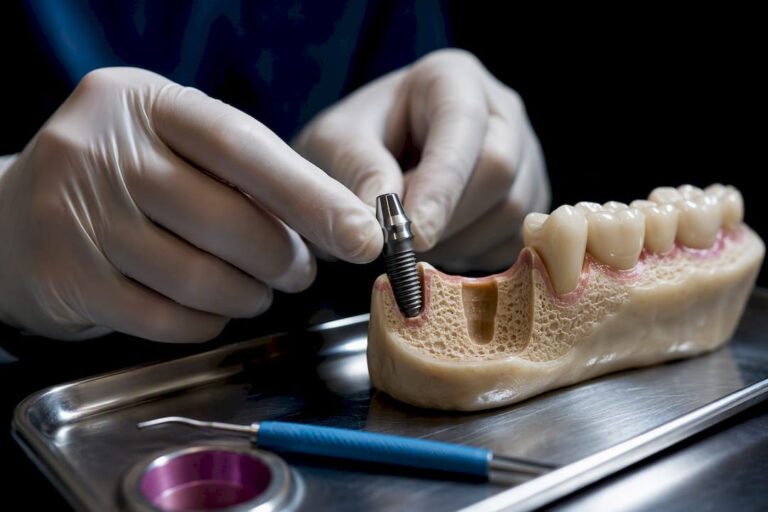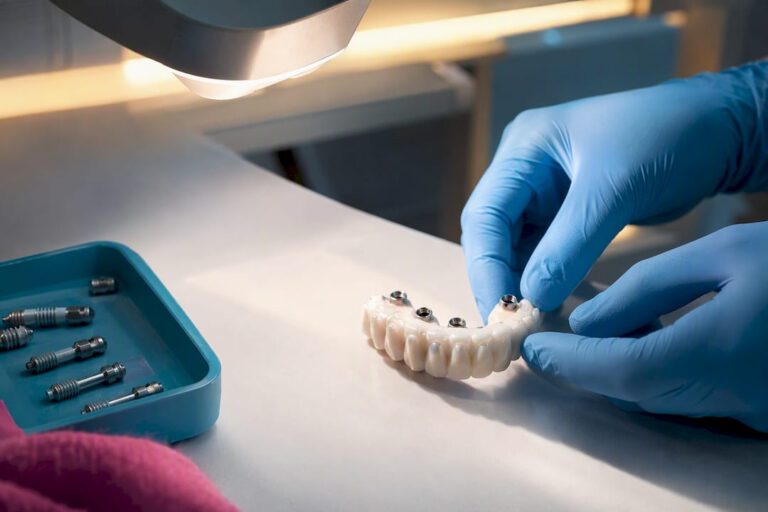
Snap-in dentures are removable, implant-supported dentures that click onto two or more titanium implants anchored in your jaw. They solve the biggest complaint about traditional dentures, slipping and instability, and they help preserve jawbone that regular dentures let shrink away. The trade-off is surgery, a recovery window, and ongoing maintenance. They tend to suit patients who’ve lost most or all of their teeth and want stronger chewing without paying for a fully fixed bridge.
TL;DR:
- Only two implants are typically needed for a lower-jaw overdenture, while four or more are recommended for the upper jaw depending on bone quality.
- Long-term success relies on proper maintenance, with attachment inserts requiring replacement every one to two years and regular professional checkups.
- Costs generally range from $5,000 to $16,000 per arch, influenced by implant number, grafting needs, and regional pricing variations.
- A staged treatment process involving imaging, possible extractions, implant placement, and a three- to six-month healing period is standard before fitting the final denture.
- Patients should expect ongoing expenses for insert replacements and checkups, and must consider hygiene routines and bone health for longevity.
Table of Contents
- How Snap-In Dentures Work: Implants, Abutments, and Attachments
- Do Snap-In Dentures Actually Improve Chewing? What the Research Shows
- What Are the Risks and Who Shouldn’t Get Snap-In Dentures?
- What Happens From Consultation to Final Denture?
- How Much Do Snap-In Dentures Cost?
- How Do You Clean and Maintain Snap-In Dentures?
- How Long Do Snap-In Dentures Last?
- Snap-In Dentures vs. Fixed Full-Arch Implants: How to Decide
- What Complete Dental Care Offers Patients Considering Snap-In Dentures
- Managing Expectations: What Patients Get Wrong About Snap-In Dentures
- Ready to Explore Snap-In Dentures? Here’s Where to Start
- Sources
How Snap-In Dentures Work: Implants, Abutments, and Attachments
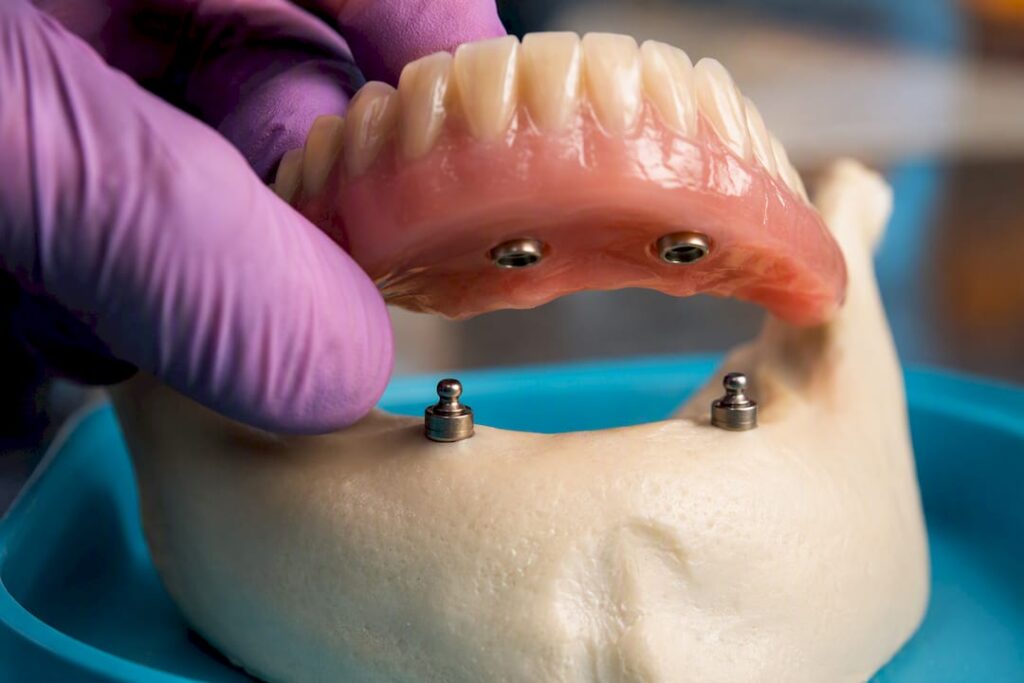
Every snap-in denture relies on the same basic setup: titanium implants placed in the jawbone act as anchor points, small connector pieces called abutments sit on top of the implants, and matching housings built into the underside of the denture snap onto those abutments. The result is a denture that clicks firmly into place but still lifts out for cleaning, unlike a fixed All-on-4 bridge that stays screwed in permanently.
The type of attachment changes how the denture feels day to day:
- Locator attachments sit low profile and come with replaceable inserts in different retention strengths, so a dentist can dial in a tighter or looser fit as the gum tissue changes over time.
- Ball (sphere) abutments are simpler mechanically and tend to hold up well, though they sit slightly taller and can be less forgiving if the implants aren’t perfectly aligned.
- Magnetic attachments seat with almost no effort, which helps patients with limited hand dexterity, but they generally provide less holding power than Locator or ball systems.
How many implants you need depends on the arch and your bone quality. Prosthodontic consensus, including guidance from the International Team for Implantology, treats two implants as the standard for a lower-jaw overdenture. The upper jaw is a different story: because maxillary bone is softer and the palate distributes bite force differently, most clinicians recommend four or more implants, often splinted with a bar, for a predictable result.
Do Snap-In Dentures Actually Improve Chewing? What the Research Shows
The clinical case for snap-in dentures rests mostly on the mandibular two-implant overdenture, which has become something close to a gold standard for edentulous lower jaws. Research summarized by the Cleveland Clinic finds that patients report meaningfully better satisfaction and chewing ability with this setup compared to conventional dentures resting on gum tissue alone.
By the Numbers: Long-term studies reviewed in a systematic analysis of overdenture loading protocols show high implant survival rates over a decade of use, with outcomes for two-implant mandibular overdentures holding up as one of the most predictable options in full-arch prosthodontics.
Beyond the numbers, patients notice the difference in daily life:
- Foods that used to be off the menu, apples, corn on the cob, steak, become manageable again because the denture doesn’t shift mid-bite.
- Speech tends to feel more natural since the appliance isn’t relying on suction or adhesive that can loosen mid-sentence.
- The implants themselves transmit chewing force into the jawbone, which signals the bone to stay dense instead of resorbing the way it does under a traditional denture’s constant pressure.
That last point matters more than most patients realize. Bone loss under a conventional denture is progressive and largely irreversible once it happens, so the stimulation from implants is doing real structural work, not just cosmetic support.
What Are the Risks and Who Shouldn’t Get Snap-In Dentures?
Snap-in dentures require a surgical procedure, and surgery always carries some risk. According to Mayo Clinic’s overview of dental implant surgery, pre-operative imaging and a full medical review are standard precisely because certain conditions raise the odds of complications.
Common risks and limiting factors include:
- Implant failure or incomplete healing, particularly in patients with uncontrolled diabetes or a history of heavy smoking.
- Insufficient bone volume in the jaw, which may require bone grafting before implants can be placed at all.
- Nerve irritation or sinus involvement in the upper jaw, both manageable with careful planning but worth discussing directly.
- Ongoing maintenance demands: attachment inserts wear down, gum tissue around implants needs daily attention, and occasional adjustments are part of the deal.
For patients with severe bone loss who aren’t candidates for grafting, or those who want zero removable components, a fixed full-arch solution or a conventional denture may end up being the more practical route.
Pro Tip: Ask your dentist to show you your own 3D scan before committing to a plan. Seeing your actual bone density and nerve positioning makes the risk conversation concrete instead of abstract.
What Happens From Consultation to Final Denture?
The path from first visit to a finished snap-in denture generally follows a predictable sequence, though the pace varies based on whether extractions or grafting are needed.
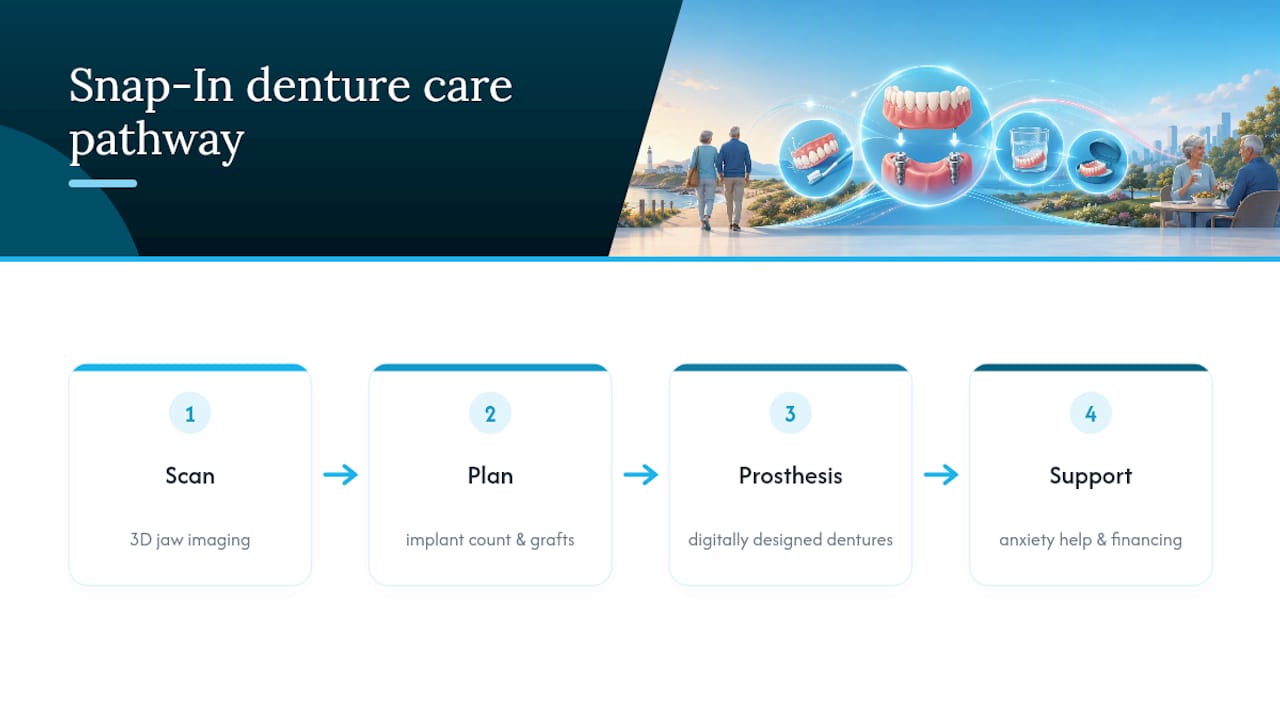
- Consultation and 3D imaging. A cone-beam scan maps your bone density and nerve locations, which determines implant count and placement.
- Extractions, if needed. Remaining teeth come out, sometimes at the same visit as implant placement.
- Implant placement. Titanium implants go into the jawbone during a single surgical appointment.
- Osseointegration. The implants fuse with bone over roughly three to six months, the biological process that gives snap-in dentures their strength.
- Abutment attachment and final denture fitting. Once integration is confirmed, connectors go on and the finished denture is fitted and adjusted.
Some patients qualify for an immediate-load approach, often marketed as “Teeth in a Day,” where a temporary denture snaps on the same day as surgery. It depends heavily on primary implant stability and bone quality at placement, and it isn’t the right fit for every case. Staged treatment, where a temporary denture bridges the healing period, remains the more conservative and widely used option.
How Much Do Snap-In Dentures Cost?
Cost is usually the first question patients ask, and the honest answer is that it depends heavily on how many implants you need and whether grafting is involved.
Typical Range: Aggregated pricing data from industry cost surveys puts snap-in dentures somewhere between roughly $5,000 and $16,000 per arch in the U.S., with many patients landing closer to $7,000 to $9,000 once averages are pulled across providers.
What drives the price up or down:
- Implant count. Two implants for a lower arch cost less than the four-plus typically needed for a stable upper arch.
- Bone grafting. Patients with bone loss often need grafting before implants go in, adding a separate procedure and fee.
- Lab and material fees. The denture itself, plus attachment hardware, is billed separately from the surgical portion.
- Location and provider. Regional cost of living and whether imaging and surgery happen in-house both shift the total.
Dental insurance rarely covers implants in full, though many plans contribute toward the denture portion or a portion of extractions. HSA and FSA funds typically apply, and most practices offer financing plans to spread the cost over time. Request an itemized, written quote and compare at least two or three treatment plans side by side. A detailed cost breakdown can help you understand where each dollar is going before you commit.
How Do You Clean and Maintain Snap-In Dentures?
Daily care isn’t optional with snap-in dentures. Unlike a fixed bridge, they come out every night, which is actually one of their advantages for hygiene access.
- Remove the denture nightly and brush it with a denture-specific cleaner, never regular toothpaste, which can scratch the acrylic.
- Clean around the abutments with a soft brush or implant-specific floss to prevent gum inflammation and bacterial buildup.
- Soak the denture in a cleaning solution overnight to keep it free of odor-causing bacteria.
- Book a professional check at least once a year so your dentist can inspect attachment wear and gum health around each implant.
Attachment inserts, whether Locator, ball, or magnetic, wear out with normal use. Guides on snap-on denture maintenance note that replacing these inserts every one to two years is a routine, expected cost, not a sign that something went wrong.
Pro Tip: Keep a small maintenance log with dates for insert replacements and checkups. It makes it much easier to catch a pattern if retention starts loosening faster than it should. For a full daily routine, see this implant cleaning guide.
How Long Do Snap-In Dentures Last?
The implants themselves and the denture on top of them age at very different speeds, and confusing the two leads to unrealistic expectations.
- Implants have high long-term survival rates when properly integrated and maintained, often functioning for decades. Full details on what affects that timeline are covered in this implant lifespan breakdown.
- Denture bases typically need relining or full replacement somewhere between five and fifteen years, depending on wear and how well they were cared for.
- Attachment inserts wear fastest of all, usually needing replacement every one to two years regardless of how well the rest of the appliance holds up.
Smoking, poor hygiene, teeth grinding, and thin bone quality all shorten these timelines. Annual checkups let your dentist catch loosening or wear before it turns into a bigger repair.
Snap-In Dentures vs. Fixed Full-Arch Implants: How to Decide
Choosing between a removable snap-in denture and a fixed solution like All-on-4 comes down to a handful of practical questions, not just preference.
Weigh these factors before deciding:
- Budget. Snap-in dentures generally cost less upfront than a fully fixed All-on-4 bridge.
- Hygiene and dexterity. If daily removal for cleaning sounds manageable, or preferable, a removable option makes sense. If dexterity is limited, a fixed bridge may be easier to maintain long term.
- Bone volume. Fixed bridges often need more implants and better bone support than a two-implant mandibular overdenture.
- Esthetic priorities. Fixed prostheses feel closer to natural teeth for some patients, with no removable component to think about.
Bring specific questions to your consultation: how many implants does my case actually require, is grafting necessary, and can I see a full itemized cost breakdown comparing both options? Be cautious of any provider who won’t show you imaging or won’t put numbers on paper.
Pro Tip: A vague treatment plan with no imaging and no itemized costs is a red flag, ask for specifics before signing anything.
What Complete Dental Care Offers Patients Considering Snap-In Dentures
Complete Dental Care builds every implant denture plan around a 3D scan of your jaw, not a generic template. That imaging shapes decisions on implant count, attachment type, and whether grafting is needed before moving forward. Patients can explore staged treatment or Teeth in a Day protocols depending on bone quality and healing goals, with digitally designed and printed dentures built for accuracy. Anxiety support and financing options round out a process designed to feel personal rather than assembly-line.
Managing Expectations: What Patients Get Wrong About Snap-In Dentures
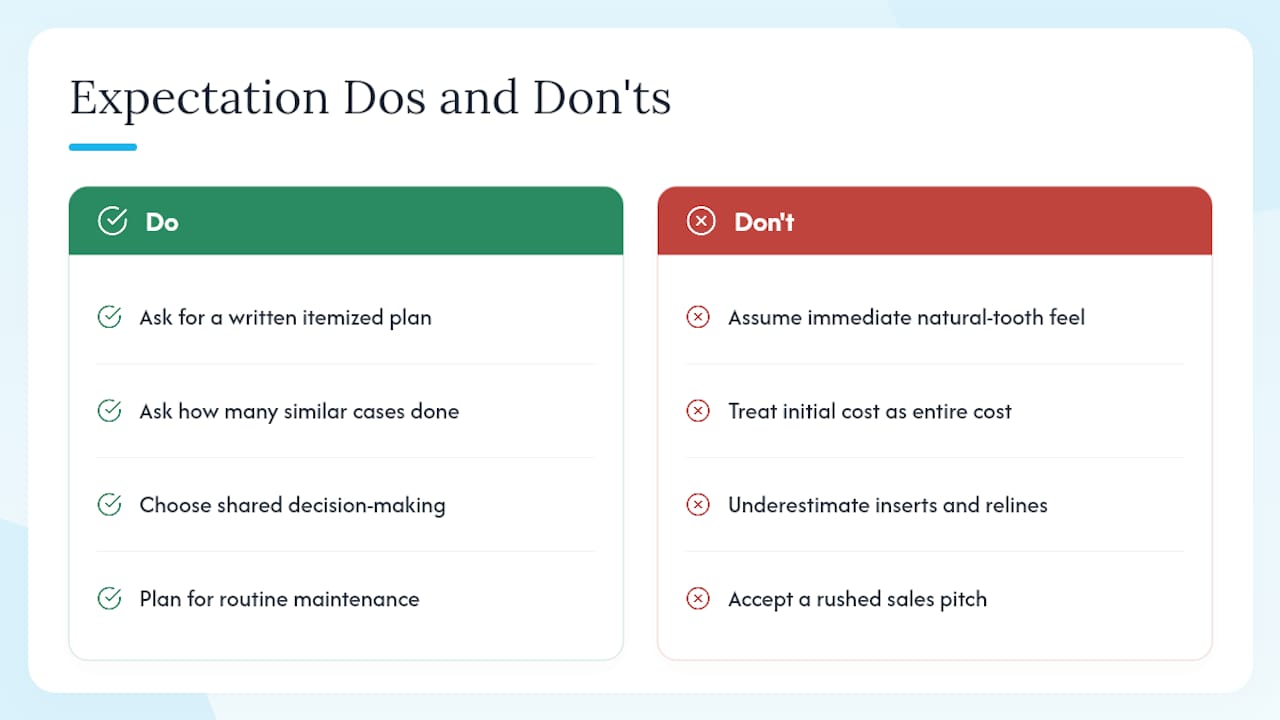
Patients often expect snap-in dentures to feel exactly like natural teeth from day one. They don’t, at least not immediately. What they typically deliver is a dramatic upgrade in stability and chewing confidence over a conventional denture, paired with a maintenance routine that’s easy to underestimate going in.
The biggest misconception is treating the initial cost as the whole picture. Insert replacements, occasional relines, and annual checkups are part of the deal, not surprise add-ons. Ask any provider for a written, itemized plan before committing, and don’t hesitate to ask how many similar cases they’ve handled. Shared decision-making, not a rushed sales pitch, is what leads to a result you’ll actually be happy with years down the road.
— Complete Dental Care
Ready to Explore Snap-In Dentures? Here’s Where to Start
If loose dentures have you avoiding certain foods or skipping social plans, a consultation is the fastest way to find out whether snap-in dentures fit your bone structure and budget. Complete Dental Care builds every plan around your own 3D scan, so you see exactly how many implants your case needs and what it costs before any decision gets made.
Bring a list of current medications, any recent dental X-rays you have on hand, and questions about attachment types or financing. From there, the team can walk you through whether a staged approach or an immediate-load option fits your healing timeline. Start by reviewing the surgical implant dentistry page or scheduling directly through the Complete Dental Care website to get your imaging appointment on the calendar.
Sources
- Implant-supported dentures — Cleveland Clinic
- Loading protocols for implant-supported overdentures — PMC review
- Dental implant surgery — Mayo Clinic
This article is general information, not a substitute for advice from a qualified doctor. Consult a qualified healthcare professional about your own circumstances before acting on anything here.