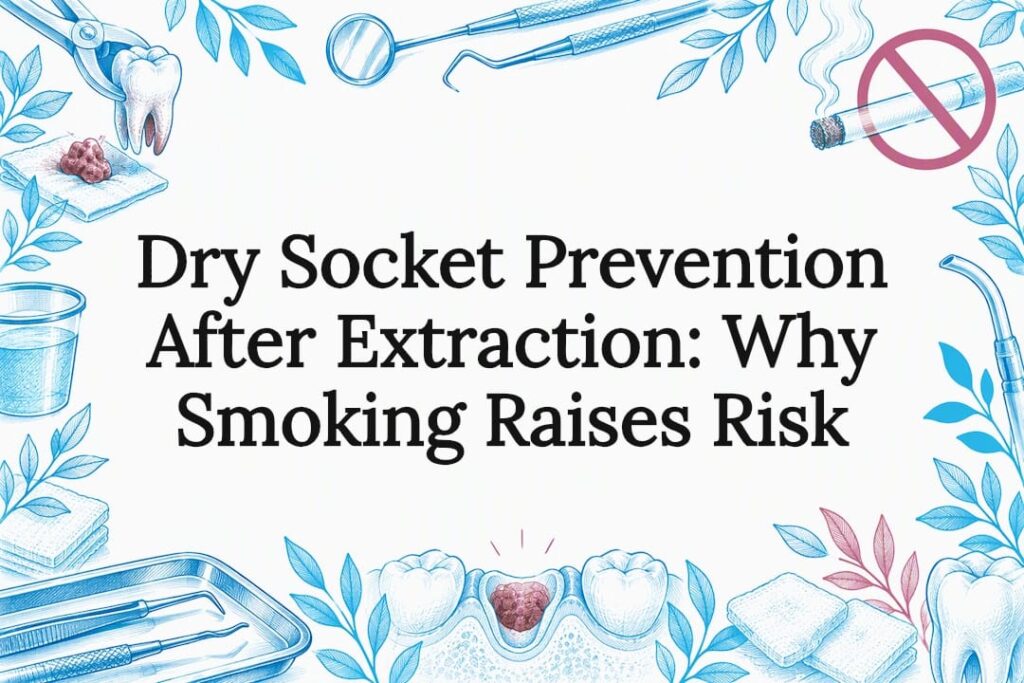
Protecting your blood clot is the single most important thing you can do after a tooth extraction: avoid smoking and anything that creates suction, like straws, and follow the specific aftercare plan your dentist gives you. For higher-risk extractions, your dentist may also recommend a chlorhexidine rinse or an intrasocket gel. Dry socket symptoms most often show up one to five days after extraction, peaking around days three to five, so call your dentist right away if pain suddenly worsens instead of improving.
TL;DR:
- Routine extractions carry a 1% to 5% dry socket risk, rising to about 30% after surgical third molar removal; smokers face 13.2% incidence versus 3.8%.
- Symptoms begin one to five days after extraction and peak around days three to five; worsening pain, exposed bone, or foul taste warrants a call.
- Avoid straws, smoking, vaping, and forceful spitting for at least 72 hours; begin gentle saltwater rinses after 24 hours without swishing.
- Chlorhexidine rinse or socket gel probably lowers risk by roughly 42% to 63%, but use it only as prescribed and avoid it with a known allergy.
- Routine antibiotics are not recommended to prevent dry socket in people with healthy immune systems; dentists reserve them for suspected infection.
questions about this? we're happy to help.
Every patient's situation is a little different. If you want to talk through what this means for you, our Greenville team is one call away.
schedule a free consultationTable of Contents
- What Dry Socket Is and When It Usually Happens
- Risk Factors That Increase Your Chance of Dry Socket
- Actionable Prevention Checklist: What to Do and What to Avoid
- Clinical Evidence: Chlorhexidine, PRF, Saline Rinses and Antibiotics
- When to Contact Your Dentist and What Treatment Looks Like
- The Role of 3D Imaging in Planning Safer Extractions
- Post-Extraction Care When You’re Preparing for an Implant
- How Surgical Technique Affects Your Healing
- Prevention Strategies for Full-Arch and Bone Grafting Patients
- Our Perspective on Preventing Complications After Extraction
- How We Support Safe Extractions and Smooth Recovery
- FAQ
- Sources
What Dry Socket Is and When It Usually Happens
Dry socket, known clinically as alveolar osteitis, happens when the blood clot that should protect the extraction site is lost or fails to form properly, leaving bone and nerve endings exposed to air, food and bacteria. The result is a sharp, throbbing pain that often starts a few days after the tooth comes out, right when you expected healing to be settling in.
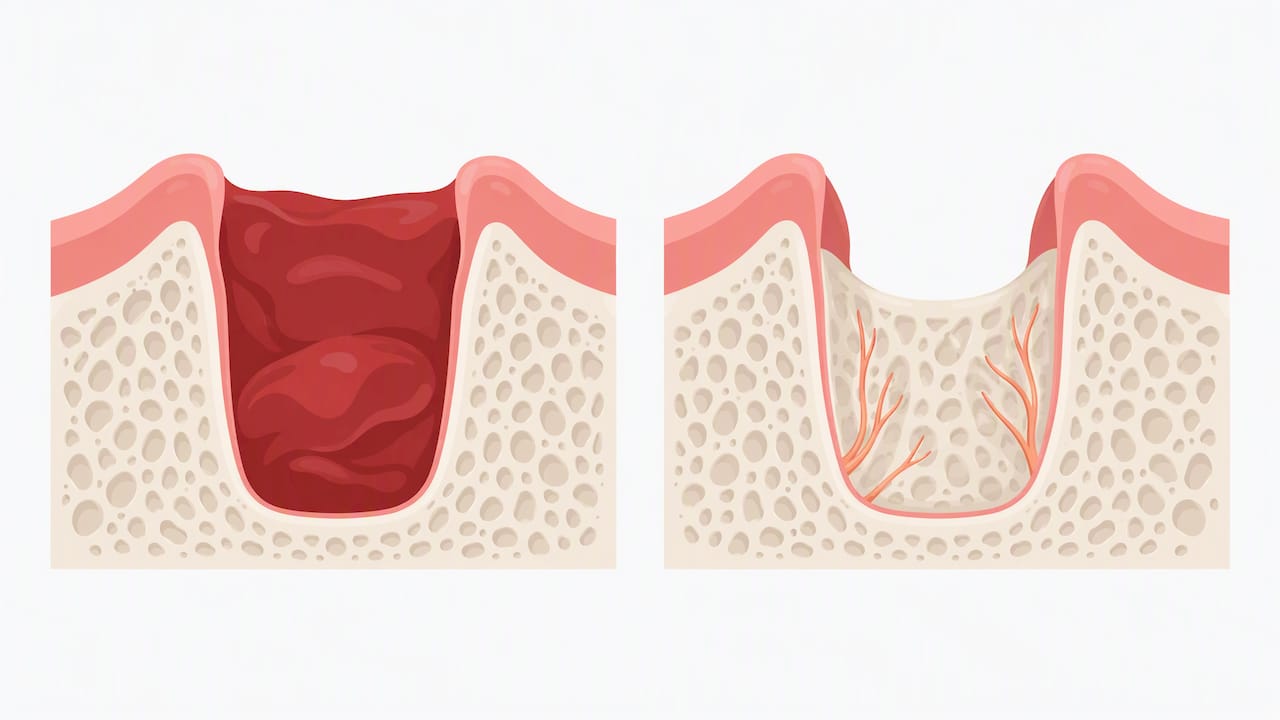
About 1% to 5% of routine extractions develop dry socket, but that figure climbs to roughly 30% for surgically removed third molars, according to Cochrane’s review of prevention and treatment options. Symptoms typically appear one to five days post-extraction, and the pain can radiate toward the ear, temple or neck, which is why some people initially mistake it for an earache or sinus issue rather than a dental problem, as noted on MedlinePlus.
Risk Factors That Increase Your Chance of Dry Socket
Not everyone faces the same odds. Smoking stands out as the clearest preventable risk factor: the heat, chemicals and the physical act of inhaling all work against clot stability, and smokers show a dry socket incidence of about 13.2% compared with 3.8% in non-smokers, according to Cochrane’s analysis. Nicotine’s vasoconstrictive effect also reduces blood flow to the healing site, which research on smoking and bone health ties to broader impacts on bone healing and density.
Several other factors raise your baseline risk:
- Surgical difficulty, especially impacted or surgically removed third molars, increases trauma to the socket.
- Poor oral hygiene before and after extraction lets bacteria interfere with clot formation.
- A history of infection at the extraction site makes complications more likely.
- Oral contraceptive use has been noted as a contributing factor in some observational data.
Smoking and poor oral hygiene show a particularly strong association with dry socket in observational studies of third molar extractions, with some cohorts reporting notably elevated odds for both. One thing that will not help: routine antibiotics are not recommended as a stand-alone preventive measure for people with healthy immune systems.
Actionable Prevention Checklist: What to Do and What to Avoid
The first 72 hours matter most. Here is the sequence that protects your clot and keeps healing on track.
- Control bleeding properly. Bite down gently on the gauze your dentist provides and change it as instructed, without peeking at or disturbing the socket.
- Eliminate suction for at least 72 hours, ideally longer. No straws, no smoking or vaping, and no forceful spitting, since the mechanical pull can dislodge the clot before it stabilizes.
- Stick to cool, soft foods. Think yogurt, mashed potatoes or smoothies eaten with a spoon, chewing on the opposite side of your mouth for the first several days.
- Rinse gently, starting 24 hours after extraction. Warm saltwater baths, where you tilt your head and let the water passively wash over the site rather than swishing hard, are preferred over vigorous rinsing, which clinical guidance from NCBI warns can dislodge the clot.
- Keep brushing, carefully. Clean your other teeth normally but avoid the extraction site directly for the first few days.
- Rest and limit exertion. Avoid heavy exercise or strenuous activity for 48 to 72 hours, and take pain medication on the schedule your dentist recommends.
Pro Tip: Sleep with your head slightly elevated, use ice packs on your cheek for swelling, and bring a full list of your medications and any hormonal contraceptives to your appointment so your dentist can tailor your aftercare.
If your extraction carries higher risk, your dentist might place a chlorhexidine gel directly in the socket or prescribe a chlorhexidine rinse for the days following surgery. Follow the exact concentration, timing and duration given, since these products work best when used as directed rather than longer or shorter than prescribed. For the complete day-by-day breakdown, our tooth extraction aftercare guide walks through the first week in detail, and our guidance on healing nutrition covers which foods support recovery.
Clinical Evidence: Chlorhexidine, PRF, Saline Rinses and Antibiotics
The strongest evidence among prevention methods points to chlorhexidine. A Cochrane review found that chlorhexidine mouth rinse at 0.12% to 0.2% and chlorhexidine intrasocket gel at 0.2% probably reduce dry socket risk, with effect sizes ranging from roughly 42% to 63% depending on the formulation. How much that translates into fewer cases for you depends on your baseline risk: the benefit is more noticeable for third molar extractions with a 30% baseline incidence than for a routine extraction starting around 1% to 5%.
A separate systematic review of 21 trials reached a similar conclusion:
- Chlorhexidine has moderate-certainty evidence supporting its preventive use.
- Platelet-rich fibrin and several other interventions have mixed or limited evidence, with more research needed before firm recommendations can be made.
- Routine antibiotic prophylaxis is not supported for preventing dry socket in people with healthy immune systems, partly due to antibiotic-resistance concerns.
Chlorhexidine mouthwash can cause minor, temporary side effects like taste changes and tooth staining, while intrasocket gel studies reported no adverse events, according to the same 21-trial review. Neither is used on patients with a known chlorhexidine allergy.
When to Contact Your Dentist and What Treatment Looks Like
Certain symptoms mean you should call rather than wait it out:
- Pain that worsens sharply between days one and five instead of gradually improving.
- Visible exposed bone in the socket.
- A bad taste or odor coming from the extraction site.
- Fever, facial swelling or any sign of spreading infection.
If you’re diagnosed with dry socket, treatment focuses on comfort and protection while the socket heals naturally. Your dentist will typically examine the site, gently irrigate it to clear debris, and place a medicated dressing to shield the exposed bone and manage pain, a process Cochrane describes as aimed at symptom relief rather than speeding underlying bone healing. Antibiotics are added only if infection is suspected. Most patients notice significant pain relief within a day or two of the dressing being placed, though you may need a follow-up visit if discomfort lingers or the dressing needs replacing.
The Role of 3D Imaging in Planning Safer Extractions
Before an extraction even begins, how your dentist plans it can influence your risk. 3D imaging and digital scanning let a dentist see the exact position of roots, nerve pathways and bone density around the tooth before touching it, which matters most for impacted or surgically complex extractions like third molars, where baseline dry socket risk is already higher.
With a clearer picture of the anatomy, a dentist can choose an approach that minimizes trauma to the surrounding bone and soft tissue, which supports a more stable blood clot afterward. Digital scans also help predict which cases are likely to be more difficult, so your dentist can plan ahead for extra preventive measures, like a chlorhexidine gel placement, rather than deciding reactively mid-procedure. This kind of planning is especially relevant for patients heading toward implant placement, since the extraction site’s healing quality affects how well it will support an implant later. Technology does not eliminate risk entirely, but it gives your dentist more information to work with before the first incision, which is part of why a thorough pre-extraction evaluation matters as much as what you do afterward.
Post-Extraction Care When You’re Preparing for an Implant
If your extraction is a step toward a dental implant rather than the end of treatment, your aftercare instructions carry extra weight. The socket needs to heal with enough bone volume and soft tissue quality intact to support an implant, whether that happens right away or after a healing period.
The same core rules apply: no smoking, no suction, and gentle hygiene around the site. But implant patients often get more specific instructions about protecting a bone graft or healing abutment if one was placed at the time of extraction, since disturbing that area can affect both dry socket risk and the long-term stability of the eventual implant. You may also be asked to avoid chewing directly on the site for longer than you would after a routine extraction, since the healing timeline for implant-ready bone is longer than for a socket simply closing over.
Diet matters here too. Protein, vitamin C and vitamin D all support the tissue repair your body needs during this window, which our guide to healing nutrition after implants covers in more detail. If you want a sense of how the weeks ahead typically unfold, our implant recovery timeline walks through what to expect week by week, from the extraction site closing to the implant eventually integrating with bone.
How Surgical Technique Affects Your Healing
The way a tooth is removed influences how well the clot holds. When a surgeon needs to raise a flap of gum tissue to access an impacted tooth, how that flap is designed and closed affects how much trauma the surrounding bone and blood supply experience, which in turn affects clot stability.
Bone grafting, often placed at the time of extraction to preserve the ridge for a future implant, introduces its own considerations. A graft material needs to stay undisturbed while new bone forms around it, so the same suction and smoking restrictions that protect a standard blood clot apply here too, often for a longer stretch of time. Gentler surgical approaches and careful suturing techniques that minimize tissue trauma tend to support more predictable healing, which is one reason surgical skill and planning matter alongside what you do at home during recovery. For more complex cases involving grafting or ridge preservation, your dentist may also schedule earlier follow-up visits simply to check that everything is healing as expected before any restorative work begins.
Prevention Strategies for Full-Arch and Bone Grafting Patients
Full-arch implant procedures and bone augmentation cases involve more extraction sites and more surgical complexity at once, which calls for a more individualized prevention plan rather than a one-size-fits-all handout.
When multiple teeth come out in the same visit, often alongside immediate implant placement, your dentist needs to balance protecting several healing sites simultaneously. That usually means more detailed instructions around which side to chew on, how long to avoid certain foods, and how to manage swelling across a wider area of the mouth. Patients undergoing sinus lift procedures or significant ridge augmentation may also receive specific guidance about avoiding nose-blowing or activities that change pressure in the sinus and jaw area, since that pressure can affect graft stability in ways a simple extraction does not involve.
Medication review becomes more important too, since full-arch and grafting patients are often managing multiple medications or health conditions that can affect healing. Bringing a complete list of what you take, including any hormonal medications, helps your dental team adjust your aftercare plan rather than relying on generic instructions that may not account for your specific procedure.
Our Perspective on Preventing Complications After Extraction
We find that patients who understand exactly what to expect, and why each instruction matters, tend to have smoother recoveries. Clear, personalized aftercare and a follow-up plan matter more than any single product. If something feels off during healing, reach out before assuming it will pass.
— Complete Dental Care
How We Support Safe Extractions and Smooth Recovery
We handle everything from routine tooth extractions to complex surgical and implant dentistry cases, including bone grafting and ridge augmentation, with detailed aftercare instructions built around your specific procedure rather than a generic handout. Patients moving toward Teeth in a Day or full-arch solutions get a prevention plan that accounts for the extra healing demands of multiple sites.
For anxious patients, we offer comfort measures and sedation options designed to make the appointment itself less stressful, which you can read more about in our guide to sedation factors. Our tooth extraction aftercare resource covers the first week in detail. If you’re due for an extraction or want to review your aftercare options beforehand, reach out to schedule a visit.
This article is general information, not a substitute for advice from a qualified doctor. Consult a qualified healthcare professional about your own circumstances before acting on anything here.
FAQ
What are the odds of getting a dry socket?
Routine extractions carry roughly a 1% to 5% chance of dry socket, while surgically removed third molars carry a much higher risk, up to about 30%, according to Cochrane’s review. Smokers face a notably higher incidence than non-smokers in the same data.
Can salt water rinse prevent dry socket?
Gentle saltwater rinses, done as a passive mouth bath rather than vigorous swishing, support clean healing but are not a proven stand-alone prevention method on their own. Clinical guidance recommends starting them about 24 hours after extraction and avoiding forceful rinsing that could dislodge the clot.
What are the riskiest days for dry socket?
Dry socket symptoms most commonly appear between one and five days after extraction, with the highest risk window typically falling around days three to five. Pain that worsens rather than improves during this stretch is the key warning sign to watch for.
What is the number one cause of dry socket?
Smoking is widely considered the single most significant preventable cause, since inhaling creates mechanical suction while nicotine also narrows blood vessels at the healing site. Cochrane data shows smokers developing dry socket at roughly 13.2%, compared with 3.8% in non-smokers.
Sources
- What treatments can be used to prevent and treat alveolar osteitis (dry socket)? | Cochrane
- Prevention and treatment of dry socket – PubMed
- Dry Socket Prevalence and Risk Factors in Third Molar Extractions: A Prospective Observational Study – PMC
questions about this? we're happy to help.
Every patient's situation is a little different. If you want to talk through what this means for you, our Greenville team is one call away.
schedule a free consultation