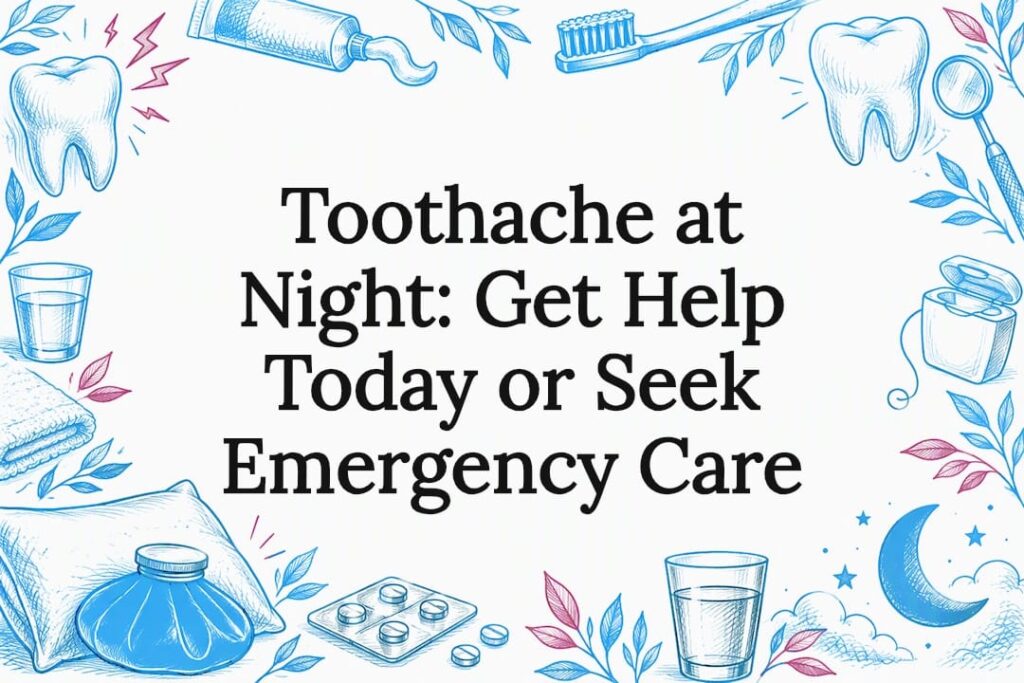
A toothache that gets worse at night most often means the tooth’s nerve is inflamed or infected, and that calls for safe pain control right away plus prompt dental care. Take an NSAID like ibuprofen (or acetaminophen if NSAIDs are not an option for you), prop your head up, rinse with warm salt water, and call a dentist for a same-day evaluation. If you notice facial swelling, trouble breathing or swallowing, or a high fever, treat that as an emergency and seek care immediately.
TL;DR:
- Adults should not exceed daily limits of 2,400 milligrams for ibuprofen or 4,000 for acetaminophen, and should check cold medicine labels for duplicate ingredients.
- Combining ibuprofen with acetaminophen relieves acute dental pain better than either medicine alone for many adults, provided both are appropriate for their health history.
- Triggered sensitivity differs from constant throbbing; pain on biting may signal a crack, while several upper teeth aching with congestion can point to sinus pressure.
- Rapid swelling toward the eye, neck, or under the jaw, or fever with severe pain, warrants emergency services rather than waiting for a dental office.
questions about this? we're happy to help.
Every patient's situation is a little different. If you want to talk through what this means for you, our Greenville team is one call away.
schedule a free consultationTable of Contents
- Why tooth pain often feels worse at night
- Common dental and referred causes of nighttime toothache
- Safe short-term relief for a toothache at night
- When a nighttime toothache is an emergency
- Home remedies that help briefly, and what to avoid
- How a dental visit resolves the underlying cause
- Do fillings and crowns cause nighttime tooth sensitivity?
- Can sinus problems cause tooth pain at night?
- Can TMJ or nerve conditions cause toothache at night?
- A note on losing sleep to tooth pain
- Getting same-day relief from a tooth that won’t let you sleep
- FAQ
- Sources
Why tooth pain often feels worse at night
Lying flat changes the physics of blood flow. When you recline, blood pressure in the head and jaw rises slightly, which increases pressure inside an already inflamed tooth and makes throbbing worse. During the day, gravity helps keep that pressure lower while you’re upright.
Nighttime also strips away the distractions that usually mask low-level pain: no work, no conversation, no screen time competing for your attention. Your brain has less to focus on besides the ache, so the same level of inflammation feels more intense once the lights go off.
These mechanisms matter because they often point to a specific problem rather than random bad luck:
- Pulpitis (inflammation of the tooth’s nerve) tends to throb harder when blood flow increases from lying down.
- Abscess or infection can build pressure inside confined tissue overnight, since nothing is draining or relieving it while you sleep.
- Reduced swallowing and jaw movement during sleep can also let pressure accumulate around an already irritated tooth.
Understanding this link helps you describe your symptoms accurately when you call a dentist in the morning or sooner.
Common dental and referred causes of nighttime toothache
Most nighttime tooth pain traces back to a handful of specific problems, and recognizing the pattern can help you explain what’s happening when you reach out for care.
- Reversible pulpitis causes brief, sharp pain triggered by hot, cold, or sweet foods that fades quickly once the stimulus is gone.
- Irreversible pulpitis causes spontaneous, constant throbbing that doesn’t need a trigger and often gets worse lying down, a pattern clinical reviews describe as a shift from reversible sensitivity to lasting nerve damage.
- Dental abscess or periapical infection brings swelling, a bad taste from drainage, or fever alongside the pain, and MedlinePlus notes this kind of infection generally needs professional treatment such as a root canal or extraction.
- A cracked tooth or failing filling can cause sharp, intermittent pain specifically when you bite down or release pressure, which feels different from constant throbbing.
- Bruxism or jaw muscle strain usually shows up as morning jaw soreness or a dull ache around the whole jaw rather than one specific tooth.
- Referred pain from sinus congestion or ear pressure can mimic a toothache in the upper back teeth, especially when it comes with nasal congestion or discomfort that shifts with head position.
Noting exactly where the pain is, what triggers it, and whether it’s constant or intermittent gives a dentist a real head start on diagnosis.
Safe short-term relief for a toothache at night
First-line pain control for a dental ache does not require a prescription for most adults. The American Dental Association’s 2024 guideline recommends NSAIDs such as ibuprofen alone, or an NSAID combined with acetaminophen, as the preferred approach for acute dental pain when you can’t get to a dentist immediately.
- Take ibuprofen in doses of 200 to 400 milligrams every 4 to 6 hours, staying under a total daily maximum commonly cited as 2,400 milligrams for adults.
- If you also use acetaminophen, keep your combined total under 4,000 milligrams in 24 hours, and never combine multiple products that each contain acetaminophen.
- Check every label carefully, since many cold and flu products already contain acetaminophen, and confirm either medication is appropriate for your personal health history.
Combining ibuprofen and acetaminophen can relieve dental pain better than either one alone for many adults, according to the JADA living guideline on acute dental pain, as long as you track your cumulative totals carefully to avoid liver toxicity from acetaminophen.
Beyond medication, a few physical steps make a real difference overnight; for practical after-hours guidance, see Clinician Steps to Sleep and Seek Same Day Care. Prop your head up with an extra pillow or two to reduce blood flow pressure to the tooth. Apply a cold compress to your cheek for 20 minutes at a time. Rinse gently with warm salt water to reduce surface irritation, and avoid chewing on the painful side. Over-the-counter topical benzocaine can help temporarily when used exactly per the label. For a full walkthrough of these steps, see our guide to emergency tooth pain relief.
Pro Tip: Set a phone alarm for your next dose so pain doesn’t wake you up after the medication wears off in the middle of the night.
When a nighttime toothache is an emergency
Some symptoms mean you shouldn’t wait until morning. Difficulty breathing or swallowing, rapid swelling that spreads toward your eye or neck, a swollen tongue, or a high fever paired with severe pain are signs of a possible deep-space infection, which MedlinePlus explains can threaten the airway and needs emergency evaluation, not a routine appointment.
Watch for these red flags specifically:
- Trouble breathing, swallowing, or opening your mouth fully
- Swelling that spreads quickly toward your eye, neck, or under your jaw
- A fever along with facial swelling or uncontrolled pain
- Pain that medication doesn’t touch at all
If any of these apply to you, call emergency services or go to an emergency department rather than waiting for a dental office to open. Without a red flag, call a dentist first thing for a same-day visit. Pain that keeps you from sleeping, or that lasts more than a day or two, needs prompt dental evaluation, since an untreated abscess can progress to involve the surrounding bone or spread further.
Home remedies that help briefly, and what to avoid
A few simple measures can take the edge off while you wait for a dental appointment.
- Rinse with warm salt water several times a day to reduce surface irritation.
- Apply a cold compress to the outside of your cheek in 20-minute intervals.
- Keep your head elevated, even during the day, if lying flat makes the ache worse.
- Use over-the-counter topical benzocaine exactly as the label directs, for short-term relief only.
- Skip very hot, cold, or sweet foods and drinks if they trigger sharp pain.
Avoid a few common mistakes, too. Never place aspirin or any crushed pill directly on the gum or tooth, since this can burn soft tissue without doing anything for the pain. Don’t stack multiple products that each contain acetaminophen, and don’t exceed the directions on any topical anesthetic hoping for stronger relief.
Pro Tip: Write down what helped and what didn’t overnight, since that detail helps a dentist narrow down the cause faster at your visit.
These measures only manage symptoms. They don’t resolve the underlying infection or damage, so they’re a bridge to a dental visit, not a substitute for one.
How a dental visit resolves the underlying cause
A typical emergency dental visit starts with a focused history and exam, often followed by an X-ray or 3D scan to pinpoint exactly what’s happening below the surface. From there, treatment depends on the diagnosis.
- A deep cavity or cracked filling often needs a new filling or a crown to seal and protect the tooth.
- Irreversible pulpitis or an abscess usually requires root canal therapy, or incision and drainage if there’s a pocket of infection.
- A tooth that’s too damaged to save may need extraction, with replacement options discussed afterward.
- Nighttime grinding that’s straining a tooth may call for a custom occlusal guard to protect it going forward.
Our team uses 3D imaging and digital scanning to diagnose the exact source of pain quickly, which supports same-day treatment planning and transparent cost conversations before any work begins. You can see what a first visit typically involves on our new patient information page.
Do fillings and crowns cause nighttime tooth sensitivity?
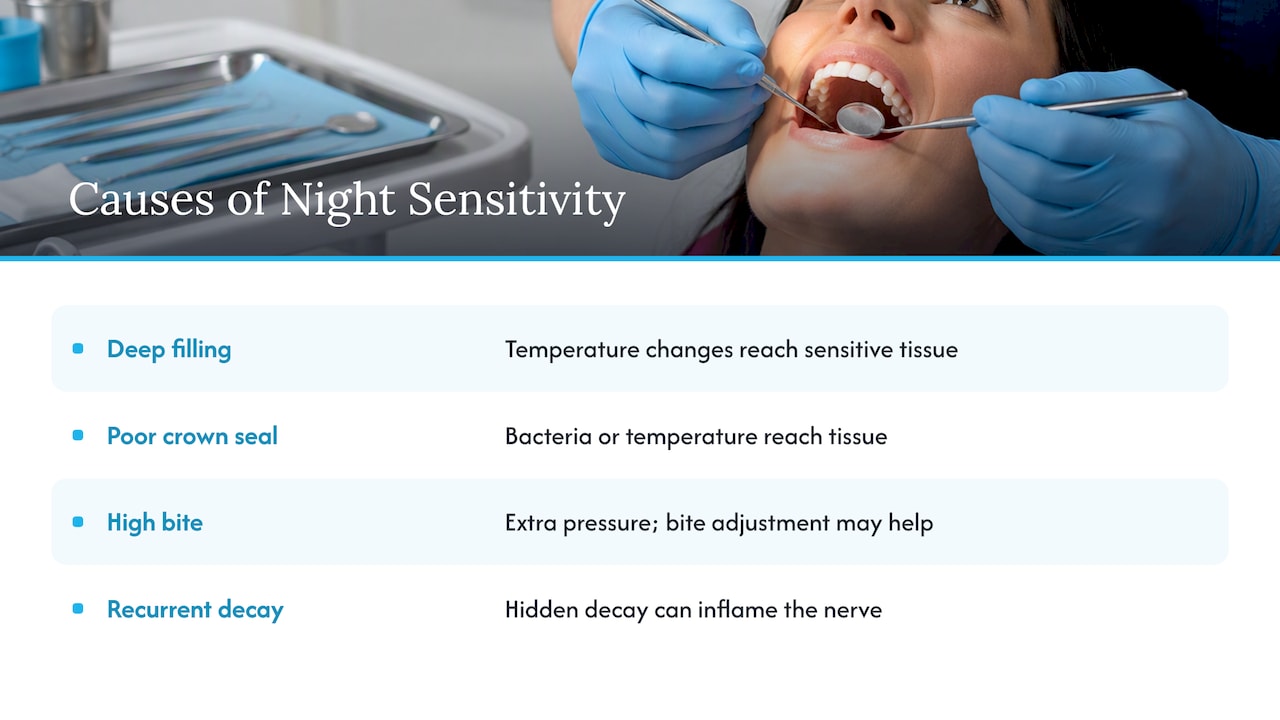
A tooth that already has a filling or crown can still ache at night, and the restoration itself is sometimes the reason. A filling placed too close to the nerve, or a crown that doesn’t seal perfectly against the tooth, can let temperature changes or bacteria reach sensitive tissue underneath, which often shows up as sharper sensitivity once you’re lying down and distractions fade.
A high or uneven bite on a new restoration is another common culprit. If a filling or crown sits even slightly too tall, the tooth absorbs extra pressure every time you clench or grind at night, which can cause an ache that wasn’t there right after the procedure. This kind of pain usually responds to a simple bite adjustment rather than anything more invasive.
Recurrent decay underneath an old filling or crown is a third possibility, especially if the restoration is several years old. Bacteria can work their way in at the margins without being visible from the outside, slowly inflaming the nerve until it produces the kind of spontaneous nighttime throbbing associated with pulpitis.
If you have a tooth with existing dental work that’s suddenly more sensitive at night, that’s worth mentioning specifically when you call for an appointment, since it points toward a bite adjustment, a new restoration, or treatment for decay underneath the old one rather than a brand-new problem. Our general dentistry and root canal services cover exactly this kind of diagnosis and repair.
Can sinus problems cause tooth pain at night?
The roots of your upper back teeth sit close to the floor of the maxillary sinuses, so sinus pressure and tooth pain can feel nearly identical. When sinus passages are inflamed from a cold, allergies, or sinusitis, that pressure can transmit directly to the nerves of nearby teeth, producing an ache that feels like it’s coming from one or more upper molars even though the teeth themselves are healthy.
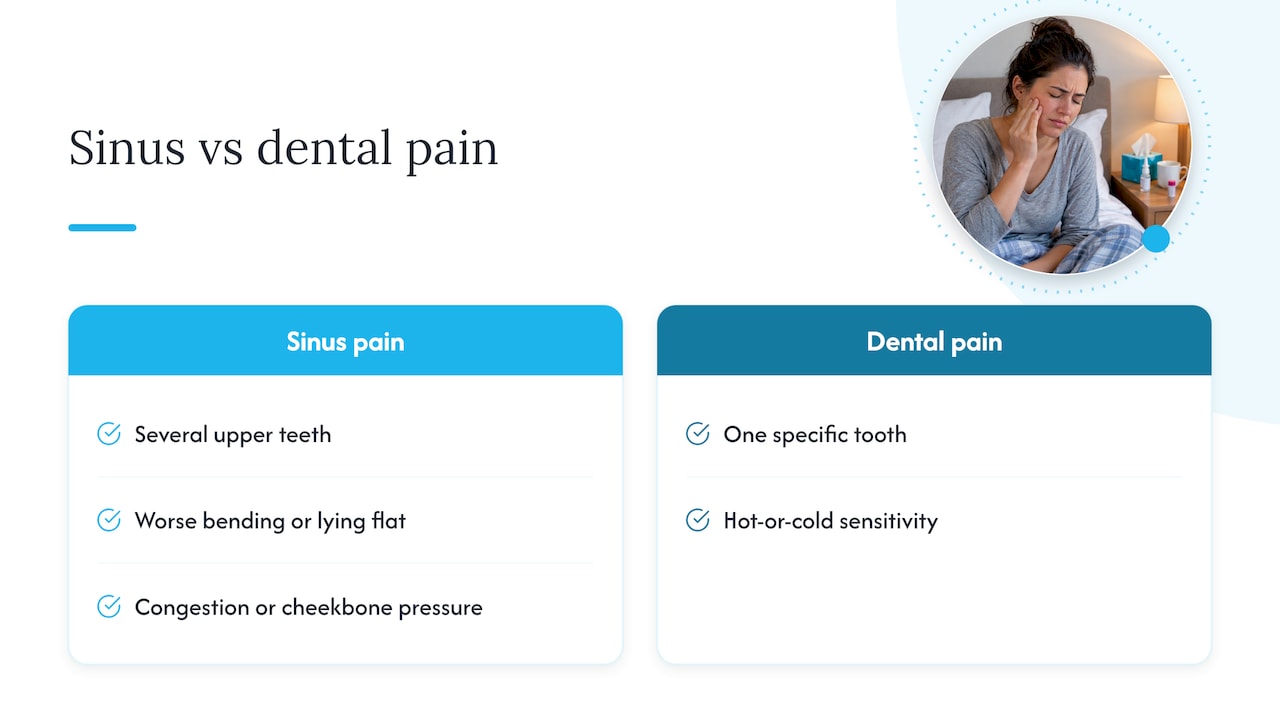
A few clues help tell the two apart. Sinus-related tooth pain usually affects several upper teeth at once rather than a single tooth, and it often gets worse when you bend forward or lie down flat, since that shifts fluid and pressure within the sinus cavity. Referred orofacial pain from the sinuses also tends to come with nasal congestion, facial pressure near the cheekbones, or a history of recent allergy symptoms, while a true dental problem is more likely to respond to hot or cold stimulation on one specific tooth.
If your tooth pain lines up with a cold or seasonal allergies and involves multiple teeth on one side, sinus involvement is worth considering before assuming the worst about a single tooth. That said, a dental exam is still the most reliable way to rule out an actual cavity or infection hiding behind sinus symptoms, especially if the pain lingers after congestion clears.
Can TMJ or nerve conditions cause toothache at night?
Not every nighttime toothache starts in the tooth itself. Temporomandibular joint disorder, commonly called TMJ, can radiate pain into the teeth and jaw, especially overnight when clenching or grinding tends to increase. Unlike pulpitis, TMJ-related pain usually comes with jaw clicking, stiffness, or soreness in the muscles around the ear rather than sensitivity isolated to one tooth.
Neuropathic pain conditions, where nerves themselves misfire or stay irritated, can also produce tooth pain without any visible cavity, crack, or infection. This type of pain is less common but tends to be described as burning, electric, or oddly persistent even after a dentist has ruled out a structural cause. It often needs a different management approach than a standard dental infection.
Because TMJ and nerve-related pain can closely mimic a toothache, a dental exam that includes checking jaw movement and muscle tenderness, not just the teeth, helps sort out which category you’re dealing with. If a dentist finds no dental cause for ongoing nighttime pain, that’s a signal to look at jaw function or a broader pain evaluation rather than repeating dental treatment that won’t address the actual source.
A note on losing sleep to tooth pain
Losing sleep to a toothache is miserable, and it’s reasonable to feel frustrated by pain that won’t let up. Use safe relief tonight, then call for a same-day evaluation rather than waiting it out. Comfort-focused options, including sedation and a supportive team, are there to make that visit easier.
— Complete Dental Care
Getting same-day relief from a tooth that won’t let you sleep
We offer same-day emergency evaluation for exactly this kind of pain, with 3D imaging that pinpoints the cause at your first visit so treatment can start without multiple trips back and forth. Depending on what we find, that might mean a root canal, an extraction, or a straightforward filling repair, all planned digitally so you know the cost and the path forward before anything begins. If a tooth can’t be saved, we also walk through replacement options, including same-day planning for implants, so you’re never left guessing about next steps. Call our office or book directly through our emergency and appointment page to get seen as soon as possible.
FAQ
How can I stop a toothache at night?
Take an NSAID like ibuprofen, or acetaminophen if NSAIDs aren’t right for you, following label limits, and prop your head up with extra pillows to reduce pressure in the tooth. A cold compress and warm salt water rinse also help temporarily, but ADA’s 2024 guideline recommends following up with a dentist since medication only manages symptoms.
What is the 3-3-3 rule for toothache?
There’s no established clinical guideline called the “3-3-3 rule” for toothache in dental literature, so treat any version you’ve seen online as informal advice rather than a verified standard. The reliable approach is to manage pain with NSAIDs or acetaminophen within label limits and see a dentist promptly, especially if pain lasts more than a day or two.
How long will a tooth hurt before the nerve dies?
There’s no fixed timeline, since it depends on the extent of decay or damage and how the nerve responds to inflammation. Clinical reviews describe pulpitis as progressing from brief, triggered pain to constant spontaneous throbbing as inflammation becomes irreversible, which is a signal to seek treatment rather than wait.
How do I make my tooth nerve stop hurting?
Short-term relief comes from NSAIDs or acetaminophen at safe doses, a cold compress, and keeping your head elevated, but these steps don’t resolve inflammation inside the tooth. Lasting relief typically requires a dentist to treat the cause directly, often with a filling, root canal therapy, or extraction depending on how far the damage has progressed.
When does a toothache become a dental emergency?
A toothache becomes an emergency when you notice swelling spreading toward your eye or neck, difficulty breathing or swallowing, or a fever paired with severe pain, since these signs can indicate a deep-space infection threatening the airway. Without those red flags, a same-day dental appointment is usually the right next step rather than an emergency room visit.
Sources
- American Dental Association — press release on acute pain management guideline (2024)
- JADA — Evidence-based clinical practice guideline for the pharmacologic management of acute dental pain
- FDA — Safe use of acetaminophen
- MedlinePlus — Ludwig angina and deep-space infections
- MedlinePlus — Tooth abscess / periapical infection overview
questions about this? we're happy to help.
Every patient's situation is a little different. If you want to talk through what this means for you, our Greenville team is one call away.
schedule a free consultation