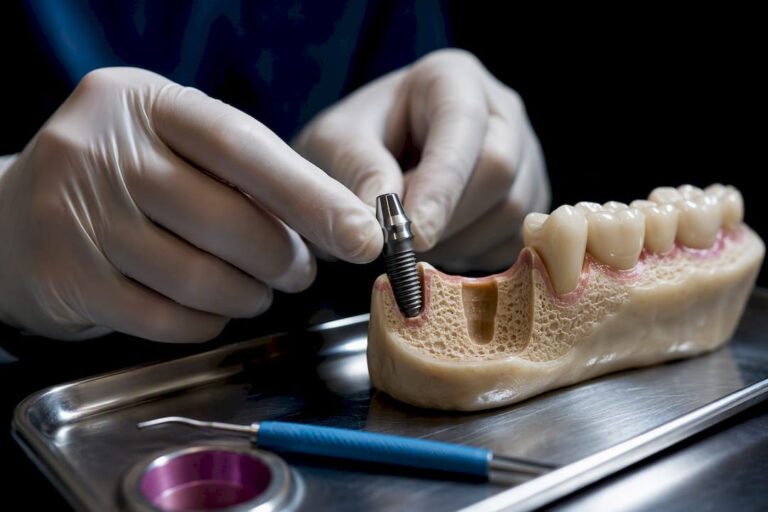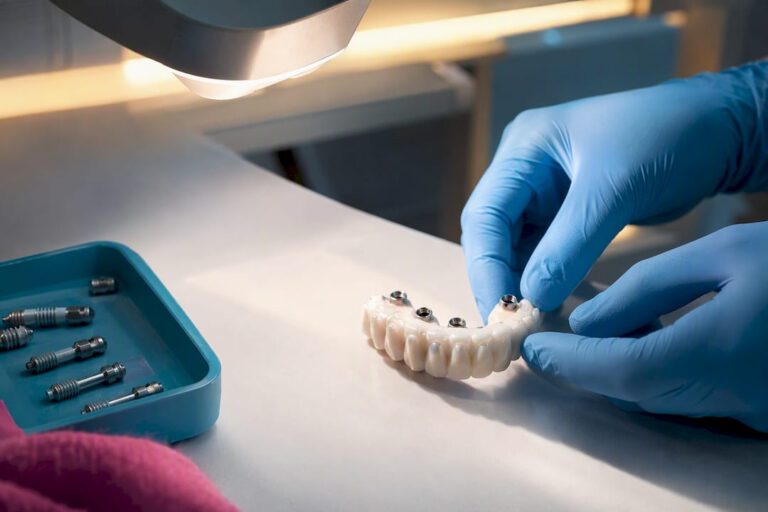
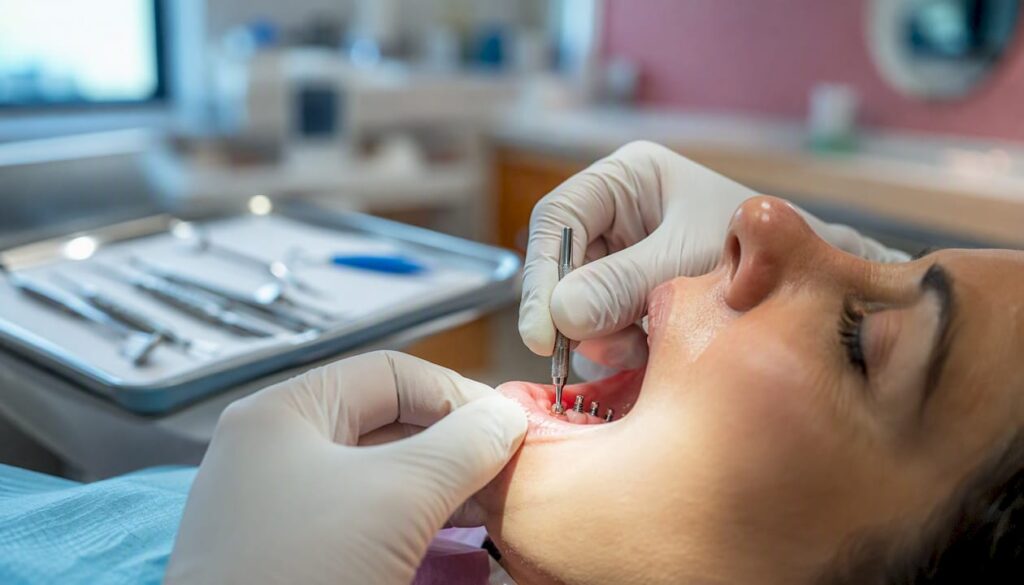
Mini dental implants stabilize loose dentures and replace teeth in narrow ridges using a smaller, one-piece implant under 3 mm in diameter, according to clinical classifications. If you’re tired of denture adhesive failing you at dinner, this is usually the fix people search for once they’ve had enough.
You’re likely a good candidate if you meet three quick markers: enough bone width in the jaw to anchor a narrow post, no serious grinding or clenching habit that would overload a thinner implant, and no uncontrolled diabetes or other systemic issue that would slow healing. Placement itself is minimally invasive, often done without cutting a surgical flap, and many practices load the implant with a denture attachment the same day.
- Bone check: enough width in the ridge, even where it’s too narrow for a standard implant
- Bite check: no heavy grinding, clenching, or high posterior chewing forces
- Health check: no uncontrolled diabetes, recent radiation therapy, or major healing risk factors
Quick fact: Mini dental implants generally involve a less invasive procedure than traditional implants, and many patients often return to normal activities within a few days.
Key Takeaways
Mini dental implants stabilize dentures effectively and safely for the right candidates, but bone width, bite force, and diameter selection determine long-term success.
| Point | Details |
|---|---|
| Best-suited use | Mandibular overdenture stabilization has the strongest supporting evidence among all mini implant applications. |
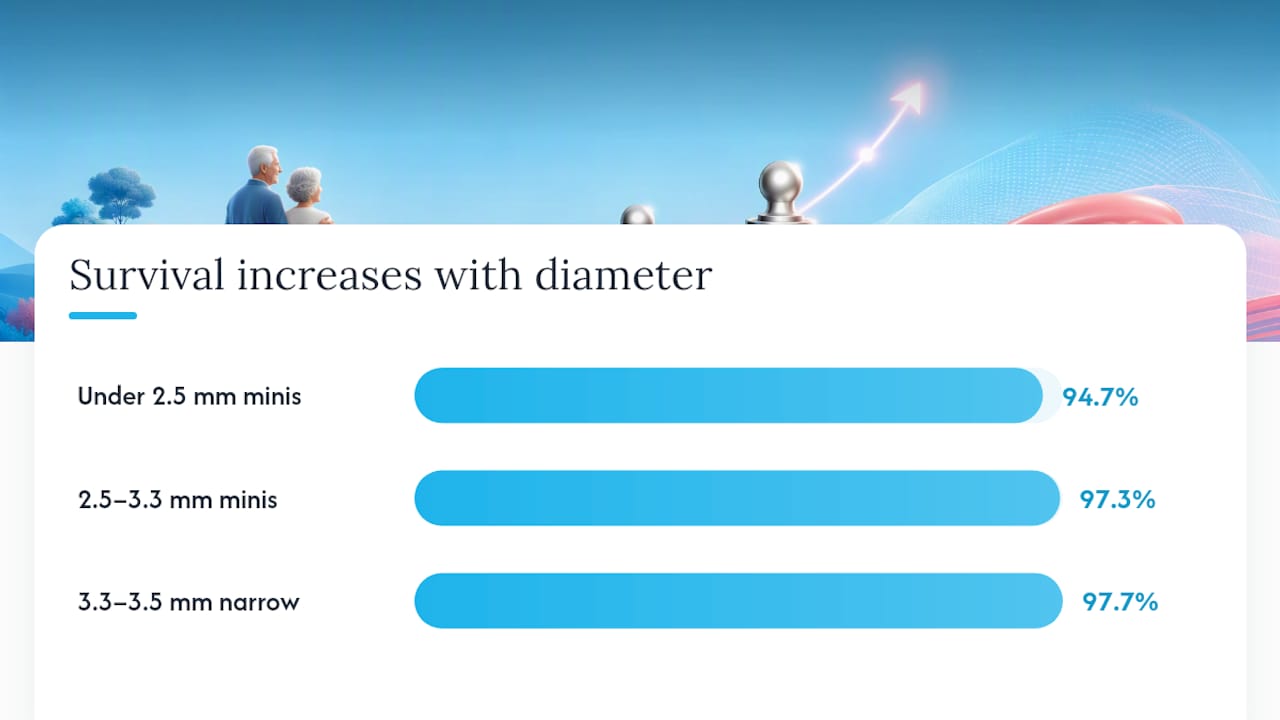
| Diameter affects survival | Implants under 2.5 mm average lower survival (~94.7%) than the 2.5 to 3.5 mm range (~97.3% to 97.7%). |
| Not for heavy loads | Avoid mini implants for fixed bridges or high-force posterior chewing; standard implants handle those better. |
| Budget for maintenance | Retention rings wear and need periodic replacement, a cost often left out of initial estimates. |
| Next step | Complete Dental Care evaluates candidacy with in-house 3D imaging before recommending a mini or standard implant path. |
Table of Contents
- What Are Mini Dental Implants and How Do They Differ From Standard Implants?
- Benefits and Disadvantages of Mini Dental Implants
- Who Is a Good Candidate for Mini Dental Implants?
- How the Mini Implant Procedure Works, Start to Finish
- How Much Do Mini Dental Implants Cost?
- What the Research Says About Mini Implant Survival and Outcomes
- Risks, Complications, and What Aftercare Actually Involves
- Mini Implants vs. Standard Implants: Which One Fits Your Situation?
- Questions to Ask Before Choosing a Dentist for Mini Implants
- What a Modern Mini Implant Visit Actually Looks Like
- A Clinician’s View on Realistic Expectations
- How Complete Dental Care Approaches Mini Implant Candidacy
- Frequently Asked Questions
- Sources
What Are Mini Dental Implants and How Do They Differ From Standard Implants?
A mini dental implant is defined by size, not by a separate design philosophy. Clinical literature draws the line at under 3 mm in diameter, according to clinical classifications, and within that category researchers further split implants into tiers: true “mini” implants less than about 2.5 mm in diameter, a mid-range narrow category, and a slightly larger narrow-diameter group up to approximately 3.5 mm. Standard implants typically run 3.5 mm or wider.
Most mini implants are also built as a single piece, fusing the post and the ball or bar attachment into one unit instead of the screw-plus-abutment setup you see with standard implants. That one-piece design is what lets a dentist place it through a small puncture in the gum rather than cutting and folding back tissue.
The practical differences show up fast once you compare protocols side by side:
- Surgical approach: mini implants are usually placed flapless (no gum incision); standard implants often require flap surgery, especially when grafting is involved
- Bone requirements: minis can work in narrower ridges that would otherwise need bone grafting for a standard implant
- Loading timeline: minis are frequently loaded the same day; standard implants often need three to six months of healing before a crown or denture attaches
- Prosthetic role: minis excel at retaining a removable overdenture; standard implants handle both removable and fixed, high-load restorations
That smaller diameter isn’t free of trade-offs. Less surface area in the bone means less mechanical resistance to bending forces, which is exactly why diameter matters when we get to who should and shouldn’t use them.
Benefits and Disadvantages of Mini Dental Implants
The appeal is real, and so are the limits. Here’s the honest breakdown.
Benefits:
- Less invasive placement, often flapless, with less swelling and bleeding than standard implant surgery
- Faster recovery. Many patients are back to normal activities within one to two days
- Frequently avoids the need for a separate bone graft, which cuts both cost and treatment time
- Generally more affordable per implant than standard fixtures, since less surgical time and fewer stages are involved
- Same-day loading means many denture wearers walk out with a more stable bite that same visit
Disadvantages:
- Not built for heavy chewing loads in the back of the mouth. Clinical guidance consistently warns against using mini implants for extended fixed bridges or high-force posterior restorations
- The thinnest posts (under 2.5 mm) carry a real fracture risk under repeated stress
- Long-term data for some uses, especially anything beyond overdenture retention, is thinner than the decades of research behind standard implants
- Retention components wear out and need replacement, an ongoing cost some patients don’t anticipate
Pro Tip: If your jawbone has resorbed significantly, a mini implant might still need a bone graft first, which erases the “no grafting” advantage entirely. Ask your dentist to measure bone width before assuming you’ll skip that step.
Who Is a Good Candidate for Mini Dental Implants?
The clearest use case is denture stabilization. If your lower denture slides, rocks, or needs adhesive reapplied by noon, mini implants anchored in the mandible solve that problem directly, and the mandible is where most of the strongest evidence sits. Narrow ridges that can’t accommodate a standard implant’s width without grafting are the second major indication, along with patients who want a less invasive or lower-cost path to a stable tooth replacement.
Common indications:
- Mandibular overdenture stabilization (the single best-studied use)
- Narrow alveolar ridges where standard implants would require grafting first
- Patients who want to avoid a multi-stage surgical process
- Single-tooth replacement in tight spaces where a wider implant won’t fit
Common contraindications and safety flags:
- Uncontrolled diabetes or other conditions that impair healing
- Recent radiation therapy to the jaw
- Severe bruxism or clenching habits that overload a narrow post
- Poor oral hygiene or active gum disease that isn’t yet controlled
- Certain medications linked to higher failure rates, including some SSRIs and long-term PPI use, according to ITI consensus reporting on implant length and diameter
Before your consult, bring a full medication list, any recent bone density or radiation history, and a plain description of your bite habits. A dentist who skips asking about grinding or clenching is skipping a question that actually determines whether a mini implant will hold up.
How the Mini Implant Procedure Works, Start to Finish
Getting from “my denture won’t stay put” to a stabilized bite usually follows a predictable path.
- Diagnostic imaging. A panoramic X-ray is the minimum; a CBCT scan (3D cone-beam imaging) is strongly recommended for narrow ridges, since it measures bone thickness in a way a flat panoramic image can’t.
- Treatment planning. The dentist maps implant positions based on bone width, nerve location, and how many implants the case needs. Manufacturer guidance for some systems calls for at least four implants in the lower jaw with roughly 5 mm of spacing between them, and up to six in the upper jaw, per device instructions for use.
- Flapless placement. In many cases, the dentist uses a small pilot drill through the gum tissue rather than cutting a flap, then threads in the self-tapping implant.
- Attachment fitting. A ball or bar attachment on the implant head is fitted to snap into the corresponding housing built into the denture.
- Same-day loading. For many patients, the denture is adjusted and seated onto the new attachments the same day, giving immediate stability.
- Early healing check. A follow-up within one to two weeks confirms the implants have settled and the denture fits without pressure points.
Pro Tip: Eat soft foods for the first few days and skip anything that requires hard biting or tearing. Bring a list of current medications to your appointment, since blood thinners and certain other drugs affect healing time.
Recovery for most patients is short. Soreness typically fades within a few days, and many people resume normal activities within one to two days of placement.

How Much Do Mini Dental Implants Cost?
Total cost depends less on the implant itself and more on how many you need and what happens around them. A single mini implant generally costs less than a standard implant, but the total bill adds up once you factor in the number of fixtures, the denture or crown work attached to them, and any imaging required beforehand.
What drives the price:
- Number of implants needed. A stabilized lower denture typically requires multiple implants, not one, so the per-implant price multiplies quickly.
- Immediate versus staged prosthesis. Same-day loading with an existing, retrofitted denture usually costs less than fabricating a brand-new prosthesis to match the implants.
- Imaging. A CBCT scan adds to the bill but is often worth the accuracy, especially on a ridge that’s already narrow.
- Ongoing maintenance. Retention rings inside the denture housing are consumable parts that wear down over time and need periodic replacement, a real cost most patients don’t budget for up front.
Ask your dentist directly about warranty terms, how often O-rings typically need swapping, and whether relines are included in the original treatment fee or billed separately later. Many practices offer in-house membership or savings plans for patients without dental insurance, and it’s worth confirming ahead of time what your dental insurance actually covers for implant-retained dentures, since coverage varies widely by plan.
What the Research Says About Mini Implant Survival and Outcomes
The strongest evidence backs mini implants specifically for stabilizing mandibular overdentures, and it’s stronger than most people expect for a “less invasive” option.
A review of implant performance by diameter found survival rates climbing with size: the smallest true “mini” implants under 2.5 mm averaged around 94.7% survival, the 2.5 to 3.3 mm category averaged around 97.3%, and the 3.3 to 3.5 mm narrow-diameter group averaged around 97.7%, according to ITI consensus data on implant length and diameter. That’s a meaningful spread. It means the thinnest implants carry noticeably more risk than their slightly wider cousins, which is a strong argument for choosing the widest diameter your bone can accommodate rather than defaulting to the smallest option available.
A 2026 systematic review comparing mini and standard implants for mandibular overdentures found comparable survival and marginal bone health between the two, with patient-reported satisfaction often favoring the mini implant group. A separate systematic review covering studies through July 2024, which pooled 12 studies including eight randomized trials with follow-up ranging from six to sixty months, reached a similar conclusion on survival but flagged a real limitation: reporting on prosthodontic complications, like attachment wear or denture fractures, varied so much between studies that firm conclusions about long-term maintenance needs remain elusive.
The takeaway isn’t that mini implants are unproven. It’s that the evidence is strongest for overdenture stabilization specifically, and thinner within the “mini” range still means a higher failure ceiling than the next size up.
Risks, Complications, and What Aftercare Actually Involves
Most mini implant patients deal with nothing worse than a few days of soreness and mild swelling around the gum line, which resolves on its own. The complications worth watching for are less common but matter more.
Short-term issues:
- Localized soreness and swelling for two to four days
- Minor bleeding at the puncture site immediately after placement
Less common but serious complications:
- Implant fracture, particularly in the thinnest diameter posts under load
- Loosening of the implant if bone integration didn’t fully take hold
- Peri-implantitis, a gum infection around the implant caused by plaque buildup
- Numbness or tingling in the lip or chin, which can signal nerve proximity issues
Aftercare that keeps implants working long-term:
- Daily cleaning around the implant necks and attachment housings, not just the denture itself
- Periodic O-ring or retention insert replacement, generally every twelve to eighteen months, though this varies by wear pattern and bite force
- Denture relines as the gum tissue changes shape over time
- Occlusal (bite) adjustments if the denture starts contacting unevenly
See a dentist promptly if you notice: persistent pain beyond the first week, an implant that feels loose or mobile, visible pus or bleeding around the site, or any numbness that doesn’t resolve. None of these are things to wait out.
Mini Implants vs. Standard Implants: Which One Fits Your Situation?
Neither option is universally “better.” The right choice depends on anatomy, budget, and what you’re asking the implant to do.
Choose mini implants when: you need to stabilize a lower denture, your ridge is too narrow for a standard implant without grafting, you want to avoid a multi-stage surgical timeline, or budget is a major factor and grafting would otherwise be required.
Choose standard implants when: you need to support a fixed bridge or a heavily loaded posterior restoration, you grind or clench with enough force to stress a narrow post, or you’re replacing multiple back teeth where chewing forces are highest.
A practical decision rule: if your case is purely about denture retention and your bone width supports a mini implant without extra grafting, minis are a reasonable and well-supported starting point. If you’re rebuilding chewing function in the molars or planning a permanent fixed bridge, standard implants remain the more established choice. Mini implants can also serve as a transitional solution in some treatment plans, stabilizing a denture now while a longer-term plan is developed.
Questions to Ask Before Choosing a Dentist for Mini Implants
Not every practice that offers mini implants approaches candidacy the same way, so the questions you ask upfront matter as much as the procedure itself.
- Do you use CBCT imaging to measure bone width, or just a panoramic X-ray?
- How many mini implant cases have you placed, and what’s your typical follow-up schedule?
- What’s the expected maintenance timeline for retention rings or O-rings, and is that cost included upfront?
- What happens if an implant loosens or fails within the first year?
- Can I see before-and-after examples or talk to a patient who’s had this done?
Red flags worth walking away from: a dentist who skips CBCT imaging on an obviously narrow ridge, vague or evasive answers about ongoing maintenance costs, or no clear plan for long-term follow-up. A provider confident in their work should have straightforward answers to all of the above.
What a Modern Mini Implant Visit Actually Looks Like
Here’s how the process typically unfolds at a practice built around digital planning and same-day workflows.
- New patient exam and history review. The dentist reviews your medical history, current denture fit, and bite pattern before recommending anything.
- Imaging. A panoramic X-ray, often paired with in-house CBCT scanning, maps bone width and nerve position in the exact area under consideration.
- Treatment plan and consultation. You see your own scan, understand exactly where implants would go, and get a straight cost estimate before committing to anything.
- Same-visit placement. For qualifying candidates, implants are placed and the denture is fitted with new attachments in a single appointment.
- Follow-up check. A short visit within one to two weeks confirms healing and comfort, with adjustments made as needed.
That kind of single-visit workflow depends heavily on in-house 3D imaging and digital planning tools, the same infrastructure behind full-arch procedures like Teeth in a Day. Seeing your own scan on a screen, rather than being told to imagine it, changes how confident most patients feel walking into surgery.
A Clinician’s View on Realistic Expectations
Case selection is everything with mini implants. When a patient has a narrow ridge, needs denture stability, and doesn’t have a heavy bite pattern working against them, mini implants perform close to what standard implants would deliver for the same job, at a fraction of the invasiveness and often a fraction of the cost.
Where I see this go wrong isn’t the implant itself. It’s mismatched expectations: a patient who wants a fixed bridge in the back of the mouth being sold on the “easier, cheaper” mini option instead of being told plainly that a standard implant is the more durable tool for that job. A good consult should include that honest conversation, not just enthusiasm for the less invasive path. Follow-up matters just as much as placement. Retention components wear, gum tissue changes shape over months, and a practice that schedules real maintenance checks, not just a one-time placement appointment, is the one giving you the full value of the implant rather than half of it.
How Complete Dental Care Approaches Mini Implant Candidacy
Getting a straight answer on whether mini implants fit your case shouldn’t require guesswork on your part. Complete Dental Care evaluates candidacy using in-house 3D imaging and digital scanning before recommending anything, so you see your own bone width and nerve positioning instead of taking a generic recommendation on faith.
For patients dealing with a loose lower denture, that evaluation often points straight to mini implant stabilization; for those needing a fuller rebuild, the same digital planning process supports Teeth in a Day full-arch solutions instead. Either way, you walk out of the consult with a clear picture of your options and a real cost estimate, not a sales pitch. If insurance or financing is a concern, the team can walk you through what your plan covers and what in-house options exist. The next step is simple: schedule a consultation through Complete Dental Care and find out whether your bone structure and bite pattern make you a strong candidate.
Frequently Asked Questions
Are mini dental implants safe?
Yes, for appropriate candidates. They’re a well-studied option for denture stabilization, with survival rates comparable to standard implants once you’re working in the 2.5 mm and wider range. Safety depends heavily on proper case selection, meaning enough bone width and no uncontrolled health conditions working against healing.
How do mini dental implants compare to standard implants for missing teeth?
Mini implants work well for denture retention and narrow-ridge single-tooth cases, while standard implants remain the better choice for fixed bridges and high-load posterior restorations. The comparison isn’t about which is universally better, it’s about which fits the specific job.
What’s the typical mini implant procedure like?
Most placements are flapless, meaning no gum incision, using a small pilot drill and a self-tapping implant. Many patients have their denture attached the same day and return to normal activities within a day or two.
Are mini dental implants a more affordable dental implant option?
Generally yes, per implant, since the procedure often skips bone grafting and requires less surgical time. Total cost still depends on how many implants your case needs and whether a new denture or prosthesis is required.
How long do mini implants last?
Well-selected cases, especially mandibular overdenture stabilization, show high survival rates in systematic reviews. Retention components like O-rings need periodic replacement, but the implants themselves can function for years with proper maintenance and regular dental checkups.
This article is general information, not a substitute for advice from a qualified doctor. Consult a qualified healthcare professional about your own circumstances before acting on anything here.
Sources
- Pubmed
- Dental Mini-Implants – StatPearls – NCBI Bookshelf
- Pubmed
- Prosthetic rehabilitation with mini and standard implant-supported overdentures: A systematic review of the evidence and recommendations for clinical practice
Study follow-up periods, implant systems, and patient populations vary widely across this research, so discuss how any specific study applies to your case with a treating dentist before making a final decision. This article is for general information and isn’t a substitute for a personalized dental evaluation.