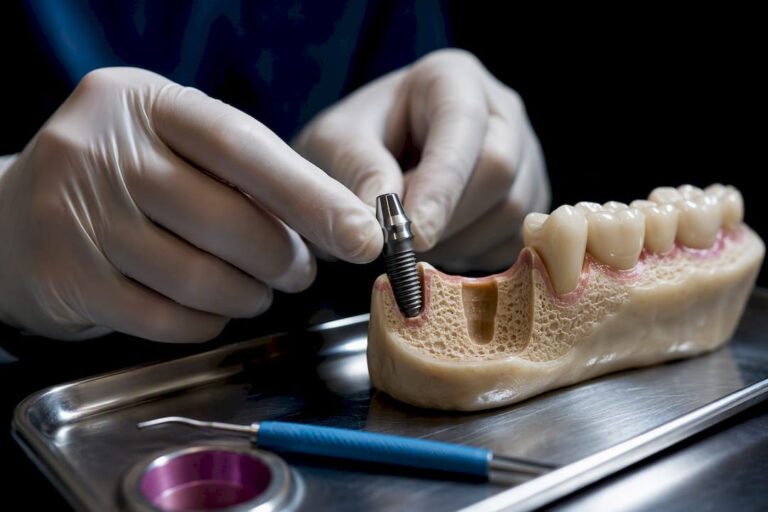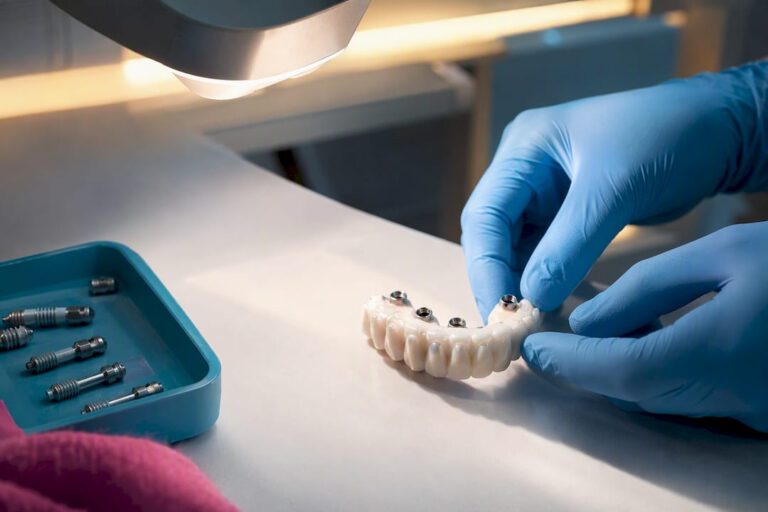
If your dental implant feels loose, hurts more than it should weeks after healing, or you notice pus, swelling, or a foul taste near the site, treat it as urgent and call your dentist. These are the classic implant failure signs that separate normal recovery from a real problem, and waiting rarely makes them better. The sooner a dentist examines the site, the better the odds of saving the implant instead of replacing it.
TL;DR:
- Most implant failures happen early, within the first few months, often due to failed bone bonding or surgical trauma.
- Signs of trouble include implant mobility, persistent pain, ongoing swelling, pus, or a foul taste, all requiring urgent dental evaluation.
- Imaging, especially CBCT scans, helps detect silent bone loss or misalignment that may not be symptomatic but needs treatment.
- Mechanical issues like loose crowns are easier to fix than infections or bone loss, which may require cleaning, antibiotics, or grafting.
- Maintaining good oral hygiene, quitting smoking, and controlling systemic conditions like diabetes significantly reduce the risk of implant failure.
Table of Contents
- Implant Failure Signs: A Quick Checklist to Know
- What Happens at a Dental Evaluation for a Failing Implant
- What Causes Dental Implant Problems in the First Place
- What to Do Now If You Suspect Implant Failure
- Treatment Options for a Failing Implant and What to Expect
- Preventing Implant Problems Before They Start
- How Complete Dental Care Diagnoses and Treats Implant Problems
- A Publisher’s Note on Catching Problems Early
- Getting Help From Complete Dental Care
- Sources
Implant Failure Signs: A Quick Checklist to Know
Some discomfort after implant placement is expected. Bruising, mild swelling, and tenderness for a few days to a couple of weeks are part of normal healing. What is not normal is any symptom that gets worse over time instead of better, or that shows up months or years after the implant has already healed and been in function.
Here is what actually signals trouble, ranked roughly by urgency:
- Mobility or looseness: an implant that wiggles, shifts, or feels different when you bite down is the single most urgent sign. Unlike a loose crown or a backed out abutment screw, which usually clicks or feels slightly off but stays anchored, movement in the implant fixture itself often means the bone around it has failed to hold on.
- Persistent or worsening pain: soreness that fades day by day is healing. Pain that spikes when you bite, throbs at night, or intensifies a week or more after placement is not.
- Swelling, redness, or bleeding gums: a small amount of pink in the sink after brushing isn’t unusual early on, but ongoing bleeding, puffy gum tissue, or a gumline that looks angry weeks later points to inflammation that needs attention.
- Pus, discharge, or a persistent bad taste: any drainage from around the implant, or a metallic or foul taste that won’t go away with brushing, usually means infection.
- Difficulty chewing or a changed bite: if your bite suddenly feels off, or chewing on one side causes pressure or a dull ache, something mechanical or biological has shifted.
- Exposed metal or receding gum tissue: seeing shiny implant threads where gum tissue used to cover them is a visible marker of bone or soft tissue loss.
Large-scale registry data covering nearly 159,000 implants found an overall failure rate around 2.21%, with early failure making up about 1.56 percentage points of that total. In other words, most implants that fail do so early, and most implants never fail at all. Your job is not to panic over normal healing. It’s to know the difference and act fast when something crosses the line from “healing” to “wrong.”
What Happens at a Dental Evaluation for a Failing Implant
A dentist working through a suspected implant problem starts with questions before touching anything: when was the implant placed, when did symptoms start, has pain been constant or triggered only by biting, and do you have any relevant health changes like new medications or a diabetes diagnosis. Timeline matters because early failure and late failure point to different causes and different fixes.
The clinical exam usually includes:
- Gentle probing around the implant to check pocket depth and look for bleeding or pus
- A mobility test, where the dentist checks whether the implant itself moves or just the crown on top
- Visual inspection for gum recession, redness, or visible threads
- A bite check to see whether pressure lands unevenly on the implant
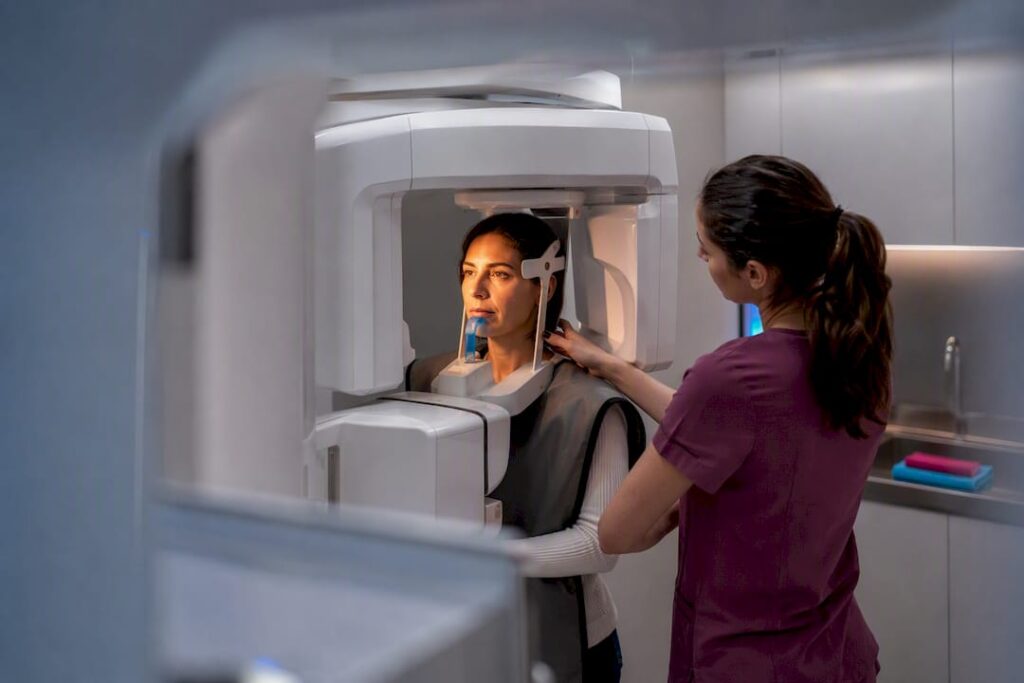
Imaging fills in what the exam can’t see. A periapical X-ray gives a quick look at bone level around the implant, while a CBCT scan (cone beam CT) provides a 3D view that shows bone loss, implant angulation, and proximity to nerves or sinuses in far more detail. This distinction matters because a loose crown with a fine implant underneath needs a completely different fix than an implant that has lost the bone supporting it. Imaging is also how dentists catch “quiet” bone loss, the kind that doesn’t hurt yet but shows up clearly on a scan, often before a patient notices any symptoms at all.
What Causes Dental Implant Problems in the First Place
Implant failure splits into two categories, and understanding which one you’re dealing with changes both the urgency and the treatment.
Early failure happens within the first few months, usually before or shortly after the implant integrates with the jawbone. The main culprits are failed osseointegration (the implant never bonded properly with the bone), surgical trauma during placement, or a lack of primary stability, meaning the implant wasn’t secure enough from the start. A retrospective clinical study of over 9,000 implants found early failures occur roughly twice as often as late failures, and they’re closely tied to impaired bone healing.
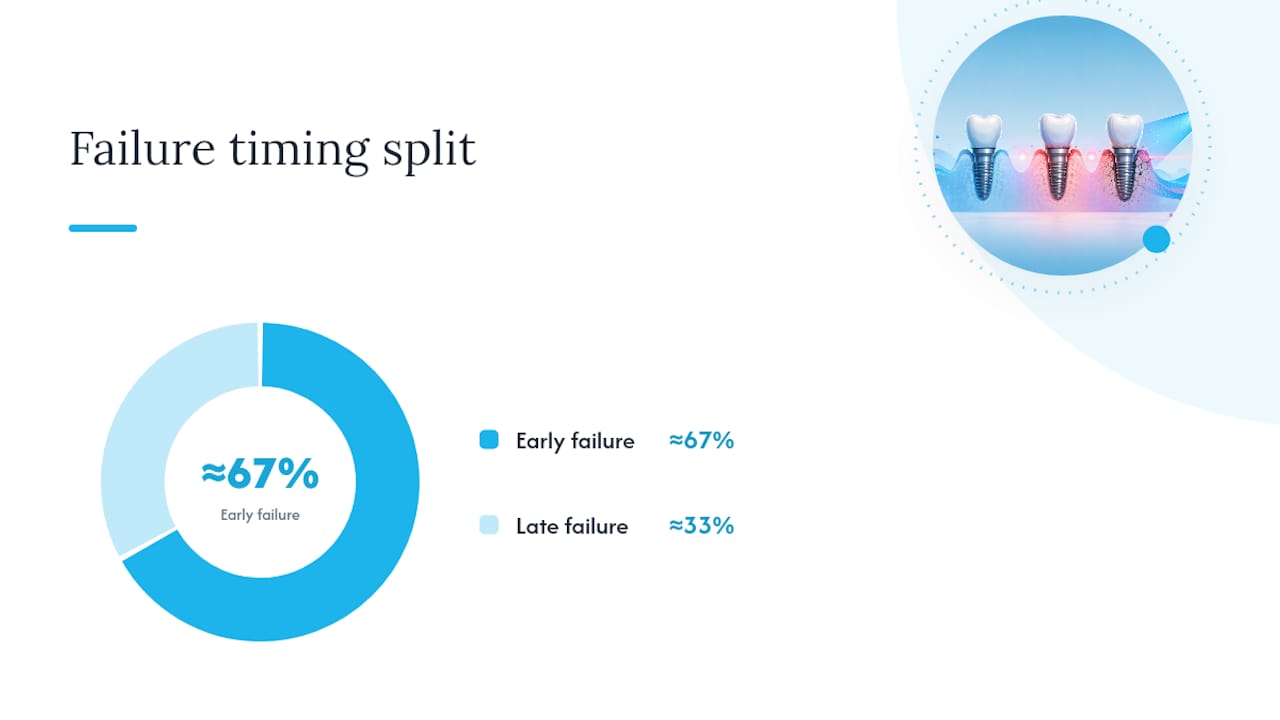
Late failure shows up after the implant has been functioning for a while, sometimes years. Here, the dominant driver is peri-implantitis, an infection of the gum and bone around the implant that behaves a lot like gum disease around natural teeth. Progressive bone loss, occlusal overload (biting forces that are too heavy or unevenly distributed), and prosthetic complications also fall into this bucket.
Risk factors that push the odds in the wrong direction include:
- Smoking, which research consistently links to higher failure rates and slower healing
- Uncontrolled diabetes, which impairs bone healing and immune response
- Poor oral hygiene, the single biggest controllable factor in peri-implantitis
- Implant location, since the maxilla (upper jaw) shows higher failure rates than the lower jaw in registry data, likely due to softer bone density
- Augmented or grafted bone sites and shorter implants, both associated with slightly higher early-failure odds in some studies
- Immediate placement protocols, which trade convenience for a narrower margin of stability during healing
Infection early in the healing window is especially damaging because it can interrupt osseointegration entirely, according to a review of risk factors for implant failure. Catching it fast is often the difference between a course of antibiotics and losing the implant altogether.
What to Do Now If You Suspect Implant Failure
If you’re reading this because something feels wrong right now, here’s the order of operations.
- Stop chewing on the affected side. Give the area a break while you sort out next steps.
- Rinse with warm salt water a few times a day to reduce mild inflammation. This helps with comfort, not infection.
- Use over-the-counter pain relief as directed on the label if pain is manageable, but don’t let medication mask a symptom you should be reporting.
- Call your dentist and describe the timeline. When did it start, has it gotten worse, is there any discharge or taste change, and has your bite shifted.
- Take a photo of the area before your appointment. Visual changes over even a few days can help your dentist see progression you might not think to describe.
Treat it as an emergency, not a wait-and-see situation, if you notice pus, spreading facial swelling, fever, sudden mobility, or pain severe enough to disrupt sleep or eating. Those combinations point to active infection that needs same-day attention.
Pro Tip: Keep a simple symptom log on your phone, even just three or four lines a day. “Day 1: mild ache, biting fine. Day 4: throbbing at night, slight swelling.” A dentist can spot a trend in seconds that’s hard to reconstruct from memory alone.
Treatment Options for a Failing Implant and What to Expect
Not every warning sign means losing the implant. A surprising number of cases turn out to be mechanical, not biological, and mechanical problems are usually the easiest to fix.
If the implant fixture itself is stable but the crown or abutment feels loose, re-tightening or replacing that component often resolves the issue in a single visit. This is the best-case scenario, and it’s more common than most patients expect.
When infection is behind the symptoms, treatment escalates based on severity. Early-stage peri-implant inflammation often responds to professional debridement (deep cleaning around the implant) combined with local antiseptics. More advanced infection may need systemic antibiotics, and in cases with meaningful bone loss but a still-stable implant, regenerative surgery using bone grafting can rebuild lost support.
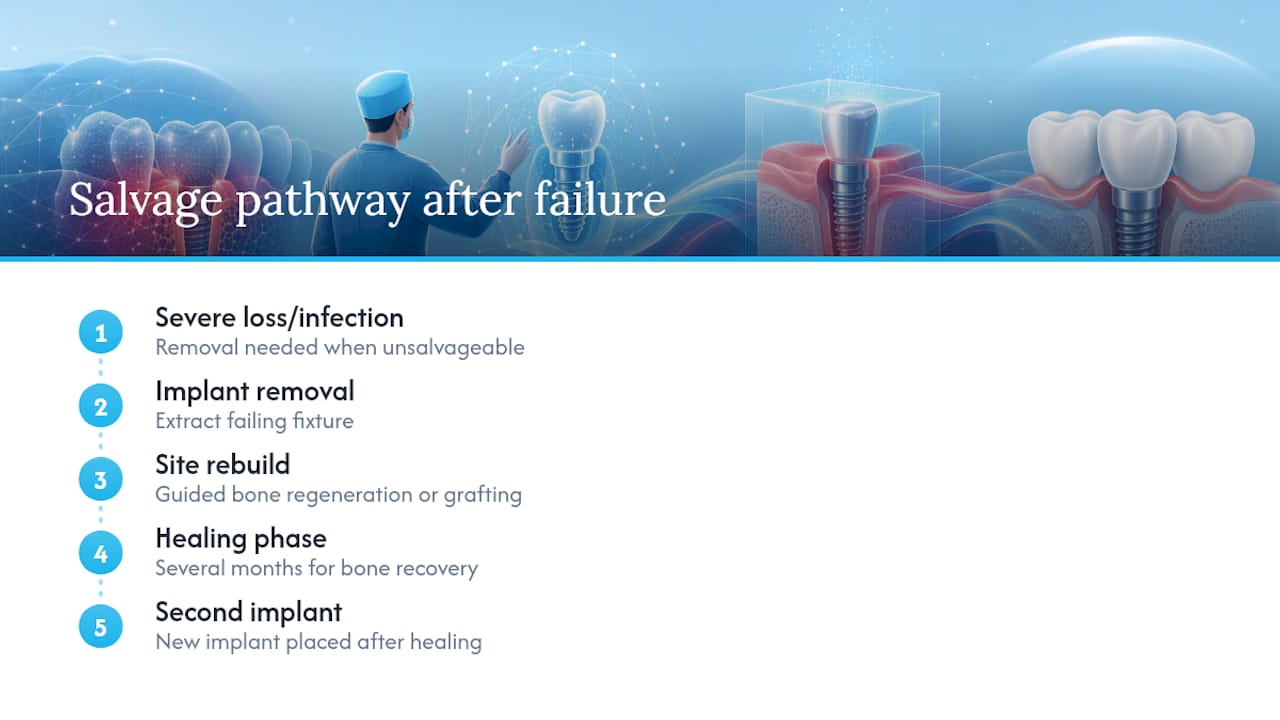
Removal becomes necessary when infection is uncontrolled or bone loss is too extensive to salvage the implant safely. Even then, it’s rarely the end of the road. A staged approach using guided bone regeneration or grafting can rebuild the site over several months, setting up a second implant placement once the bone has recovered.
Prognosis depends heavily on three things: how much bone has already been lost, the patient’s overall systemic health, and how early the problem was caught. The registry data showing a 2.21% overall failure rate is a useful reality check. Most implants succeed long term, and understanding your implant’s expected lifespan helps set realistic expectations for maintenance rather than fear.
Preventing Implant Problems Before They Start
Daily maintenance is the cheapest insurance you’ll ever buy for an implant. That means a consistent hygiene routine using interdental brushes or water flossers designed to clean around the implant collar, plus an antimicrobial rinse if your dentist recommends one.
Two habits move the needle more than almost anything else: quitting smoking and keeping systemic conditions like diabetes under control. Both directly affect how well bone heals and how resistant your tissue is to infection.
- Brush and clean interdentally around the implant every day, not just the natural teeth next to it
- Schedule professional cleanings and periodic radiographs on the timeline your dentist recommends, typically every six months
- Quit smoking, or at minimum reduce it significantly during healing and long term
- Manage diabetes or other conditions that affect healing with your physician’s guidance
- See your dentist earlier than your next scheduled visit if you notice any bleeding, looseness, or discomfort that wasn’t there before
Pro Tip: If flossing around an implant feels awkward, ask your hygienist to show you the exact angle for your specific restoration. A slightly wrong technique can miss the area most prone to plaque buildup, right at the gumline.
How Complete Dental Care Diagnoses and Treats Implant Problems
Some dental practices use in-house 3D imaging and digital scanning to see exactly what’s happening below the gumline, whether that’s early bone loss, a shifted prosthetic fit, or an infection pattern that isn’t visible on a standard X-ray. That level of detail speeds up diagnosis and allows for a treatment plan built around your specific situation rather than a generic protocol.
Every evaluation includes clear communication about what the imaging shows and what your options actually are, with attention to reducing anxiety around what can be a stressful appointment. For a closer look at diagnostic and surgical implant services, visit the implant and oral surgery page.
A Publisher’s Note on Catching Problems Early
Implants succeed the overwhelming majority of the time, and that’s worth remembering when a symptom sends you into a spiral of worry. But complications do happen, and the single biggest factor in a good outcome is how quickly a problem gets evaluated rather than watched and hoped away.
If something feels off, schedule an evaluation. A thorough visit means a clinical exam, imaging to see what’s happening at the bone level, and a straight answer about whether you’re looking at a simple fix or something that needs more attention. Waiting rarely improves the odds. Early evaluation almost always does.
— Complete Dental Care
Getting Help From Complete Dental Care
If any of the signs above sound familiar, the fastest path forward is a diagnostic evaluation built around real imaging, not guesswork. An implant and oral surgery team may use in-house CBCT scanning and digital impressions to pinpoint whether you’re dealing with a mechanical fix, an infection that needs treatment, or something more advanced, often within a single visit instead of weeks of back-and-forth referrals.
An initial visit typically includes a clinical exam, imaging to check bone levels around the implant, and a direct conversation about your options, whether that’s a simple repair, a course of treatment to manage infection, or exploring full-arch solutions like Teeth in a Day if replacement becomes necessary. If you’re noticing looseness, pain, swelling, or a bite that feels different than it used to, schedule an implant evaluation rather than waiting to see if it resolves on its own.
Sources
- Dental Implant Survival Rates: Comprehensive Insights from a Large-Scale Electronic Dental Registry
- Factors associated with early and late failure of dental implants
This article is general information, not a substitute for advice from a qualified doctor. Consult a qualified healthcare professional about your own circumstances before acting on anything here.