All-on-4 implants replace a full arch of missing or failing teeth with four surgically placed implants that support one fixed prosthesis, delivered as a temporary bridge the same day as surgery. It suits adults who are edentulous or headed that way and want stable, fixed teeth without a bone graft in most cases. The trade-off: it costs more upfront than dentures and demands lifelong hygiene commitment.
TL;DR:
- All-on-4 implants rely on four angled implants to avoid grafting and support a fixed arch, with survival rates around 94.8% overall.
- Candidates must have sufficient bone quality, particularly Type 1 or 2, as success drops to about 89.1% in Type 4 bone.
- The procedure includes four phases: planning with CBCT scans, same-day surgery for implant placement and provisional, healing for four to six months, then final restoration.
- Costs range from $25,000 to $38,000 per arch for zirconia prostheses, with many initial prices excluding essential items like scans, extractions, or sedation.
- Long-term risks include biological issues like peri-implantitis, which can be prevented by diligent hygiene and routine checkups every six months.
Table of Contents
- What Are All-on-4 Implants and How Does the Concept Work?
- Who Is a Good Candidate for All-on-4?
- What Happens During the All-on-4 Procedure?
- All-on-4 Benefits and Drawbacks Compared to Other Options
- How Much Do All-on-4 Implants Cost?
- What Are the Risks and Long-Term Outcomes of All-on-4?
- How Do You Care for All-on-4 Implants Long-Term?
- Complete Dental Care’s Approach to Full-Arch Restoration
- Ready to Talk Through Your Options?
- Sources
What Are All-on-4 Implants and How Does the Concept Work?
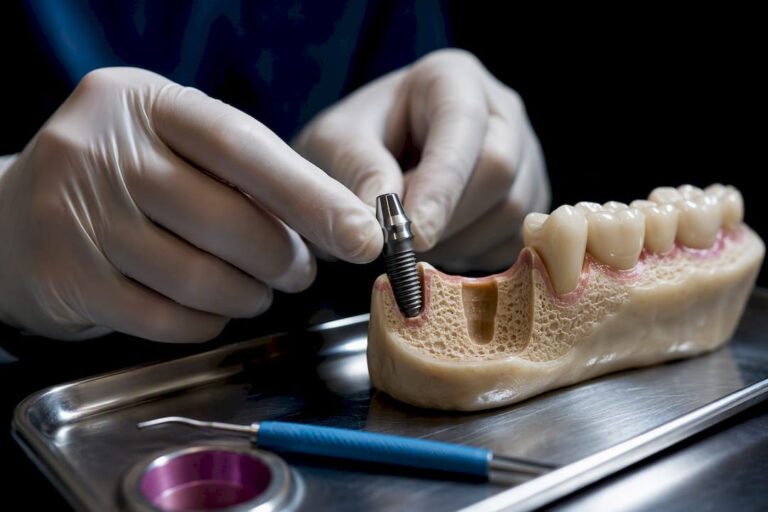
The name describes the geometry. Two implants go in straight, near the front of the jaw, where bone is usually thickest. Two more angle back at roughly 30 to 45 degrees to reach denser bone near the sinus or nerve canal while avoiding both structures entirely. That angulation is not cosmetic. It shortens the cantilever, the unsupported length of prosthesis extending past the last implant, which cuts down on the mechanical stress that causes screws to loosen or bridges to crack.
Because all four implants anchor into good bone at useful angles, the surgeon can often skip a bone graft that a straight-implant approach would require. That’s the whole reason “teeth in a day” is possible at all.
A few terms get used interchangeably and it’s worth knowing the difference:
- All-on-4: the specific four-implant, angled-posterior protocol described above.
- Fixed full-arch prosthesis: any full-arch replacement that doesn’t come out, whether it rides on four implants or six.
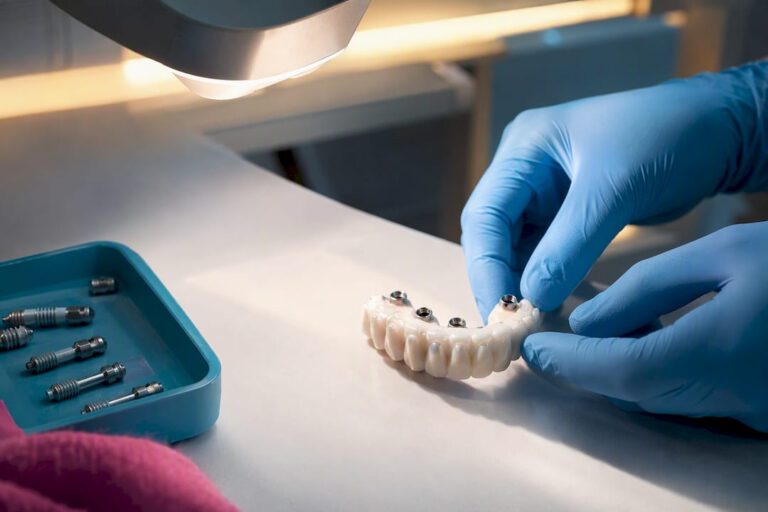
- Hybrid prosthesis: a denture-like arch of teeth permanently screwed onto the implants, as opposed to a removable overdenture.
- Teeth in a day: the same-day provisional bridge patients leave surgery wearing.
Immediate loading, putting a functional bridge on implants the same day, only works when the implants achieve enough primary stability at placement, measured by insertion torque above the typical threshold for immediate loading. Without that stability, the surgeon delays the temporary bridge until the implants heal further.
Who Is a Good Candidate for All-on-4?
Candidacy comes down to three things: how many teeth you’re missing or losing, how much bone you have left, and your overall health. Good candidates typically fall into one of these categories:
- Adults who are already edentulous (missing all teeth in an arch) or wearing dentures they want fixed permanently.
- People with widespread decay, failing crowns, or advanced gum disease who are losing an arch and want one solution instead of tooth-by-tooth repairs.
- Patients medically classified ASA I or II, meaning generally healthy or with well-controlled conditions like managed diabetes, since healing capacity affects implant success.
Bone quality matters as much as bone quantity; for more information on bone health and related treatment options, see our osteogenic loading evidence resource. Dentists grade jawbone density on a Type 1 through Type 4 scale, with Type 1 being dense, cortical bone and Type 4 being soft, sparse bone often found in the upper jaw after long-term tooth loss. Cohort data tracking 1,000 implants found survival rates around 98.3% in Type 1 bone versus roughly 89.1% in Type 4. That gap is exactly why a thorough diagnostic workup matters before anyone commits to a surgery date.
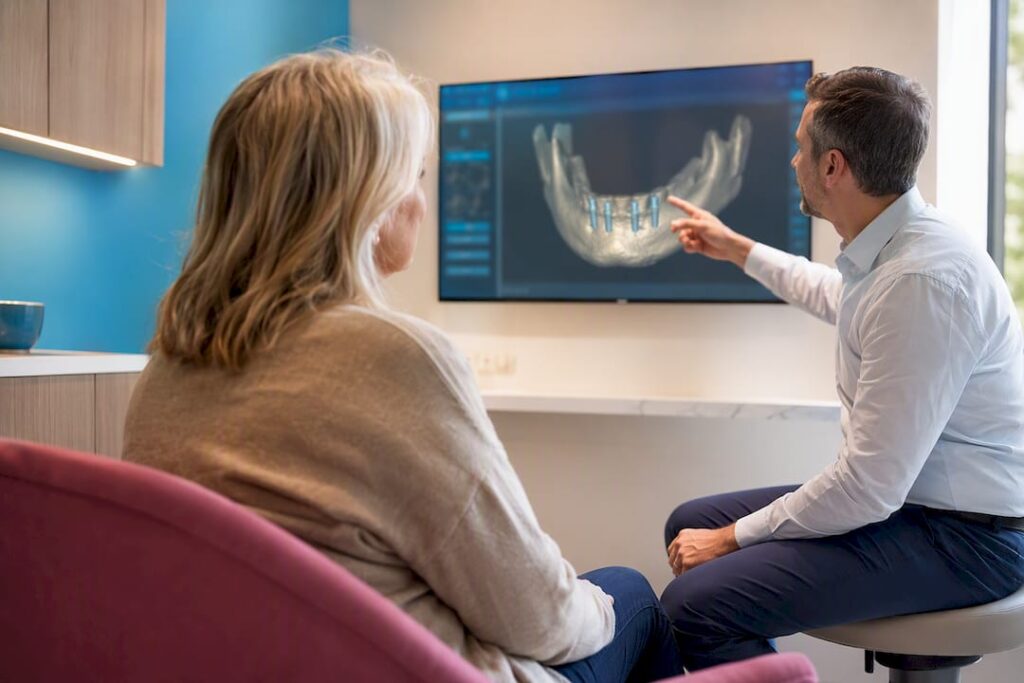
Expect three diagnostic steps at a proper evaluation: a CBCT scan to map bone volume and nerve position in 3D, a digital intraoral scan to plan the prosthesis, and an occlusion analysis to check how your bite will function once the new arch is in place.
Pro Tip: Ask to see your own CBCT scan before surgery. A dentist who walks you through your bone density and implant placement on-screen is planning transparently, not guessing.
What Happens During the All-on-4 Procedure?
The path from consultation to finished smile runs through four distinct phases, and knowing what belongs in each one helps you evaluate any quote you’re handed.
- Pre-op planning. Your dentist takes a CBCT scan, builds a digital treatment plan, and should hand you an itemized quote listing extractions, implants, sedation, the provisional prosthesis, and the final prosthesis as separate line items, not one vague number.
- Surgery day. Any remaining failing teeth are extracted, four implants are placed at the planned angles, and a fixed provisional bridge is attached before you leave. Most clinics offer IV sedation or oral sedation for this visit, and the surgery itself typically runs two to four hours per arch.
- Healing phase. The provisional bridge stays in place for several months, usually four to six, while the implants fuse to the bone. You’ll have follow-up visits to check the bite, tissue healing, and screw tightness.
- Final prosthesis. Once osseointegration is confirmed, the provisional is swapped for the permanent bridge, milled from zirconia or a reinforced acrylic hybrid based on your treatment plan.
Complete Dental Care’s surgical implant dentistry page and video library walk through what surgery day actually looks like, which helps set expectations before you sit in the chair.
All-on-4 Benefits and Drawbacks Compared to Other Options
All-on-4 earns its popularity for a reason, but it’s not the right fit for everyone, and comparing it honestly against dentures and All-on-6 helps clarify where it fits.
What it does well:
- Restores fixed, functional teeth in one surgical visit instead of a string of appointments.
- Uses only four implants per arch, which usually means lower surgical cost and shorter healing than six or eight implant approaches.
- Often avoids bone grafting because the angled posterior implants reach usable bone that straight implants can’t.
- Delivers dramatically better chewing stability than a removable denture, which can shift, click, or trap food.
Where it falls short:
- The upfront cost is significantly higher than dentures.
- Provisional and even final prostheses can chip or fracture under heavy bite forces and sometimes need repair.
- Peri-implant hygiene is non-negotiable; skip it and you risk the gum inflammation that threatens the whole arch.
- Very poor bone (Type 4) sometimes still requires grafting or a different implant count.
All-on-6, which spreads the same fixed-bridge concept across six implants, distributes bite forces further and is sometimes recommended for patients with lower bone density or heavier bite forces. It costs more per arch and takes longer to place, so the choice usually comes down to what your bone can support rather than personal preference. Zirconia prostheses show fewer mechanical complications than metal-acrylic hybrids over the medium term, though they cost more and are harder to repair chairside if something does crack.
How Much Do All-on-4 Implants Cost?
Expect a wide range depending on prosthesis material and where you’re treated. Acrylic (PMMA) hybrid prostheses typically run in the mid to high range of typical U.S. per-arch prices, while zirconia versions run $25,000 to $38,000 per arch. Treating both arches commonly costs tens of thousands in total, varying with materials and other factors, and the biggest swing factor is prosthesis material, followed by lab fees and the implant brand your surgeon uses.
The number that should worry you isn’t the total, it’s the word “starting.” Cost guides consistently flag that headline “starting at” prices often omit key items like extractions, CBCT scans, sedation, and the final prosthesis, items that can add tens of thousands of dollars once tallied separately. A genuinely all-inclusive quote should spell out:
- CBCT imaging and digital treatment planning
- Any necessary extractions
- The four implants themselves
- The same-day provisional prosthesis
- The final prosthesis (specify acrylic or zirconia)
- Sedation fees and lab fees
Financing options generally include in-house payment plans, third-party medical credit like CareCredit, and HSA or FSA funds if your plan allows major dental work. University dental school clinics sometimes offer lower-cost treatment supervised by faculty, though timelines run longer. Treat dental tourism offers with real caution. Follow-up care for complications becomes far more complicated when your surgeon is thousands of miles away.
What Are the Risks and Long-Term Outcomes of All-on-4?
The clinical track record is solid but not flawless, and the details matter more than the headline number. A multicenter cohort study following 1,000 implants reported 94.8% overall survival, a figure that held up well across most patients but dropped meaningfully in poor-quality bone.
Survival in Type 1 bone reached 98.3%, while Type 4 bone brought that number down to roughly 89.1%, a gap wide enough to change how a surgeon plans implant length and placement before ever picking up a drill.
Complications split into two categories. Mechanical issues include prosthesis fracture and loose or broken screws, both of which are repairable without removing the implants. Biological issues center on peri-implantitis, an infection around the implant caused by plaque buildup, which is more serious because it can lead to bone loss and implant failure if ignored.
- Prosthesis fracture: more common in acrylic hybrids than zirconia
- Screw loosening: usually caught and fixed at routine checkups
- Peri-implantitis: the most serious complication and largely preventable with proper hygiene
Systematic reviews of the All-on-4 protocol note real biomechanical advantages over traditional parallel-implant setups, but also caution that study designs vary enough that long-term conclusions deserve some hedging. Outcomes depend heavily on surgical precision and prosthetic design, not just the implant count. For more on what “long-term” actually means implant by implant, see how long dental implants really last.
How Do You Care for All-on-4 Implants Long-Term?
Daily maintenance is simpler than caring for natural teeth in some ways, but skipping it carries higher stakes. A water flosser aimed under the bridge, paired with interdental brushes sized for the gaps between implants, clears the plaque a regular toothbrush can’t reach. Avoid biting into ice or extremely hard foods, especially with an acrylic provisional, since that’s the most common way patients crack a temporary bridge.

Professional maintenance typically means a checkup every six months, with periodic X-rays to monitor bone levels and a screw-tightness check at each visit. Report any looseness, gum bleeding around the implants, or a sudden bite change right away rather than waiting for your next scheduled visit.
Pro Tip: If your provisional bridge feels even slightly loose, call your dentist that week. Left alone, a loose screw can shift the bite enough to overload a different implant.
Complete Dental Care’s guide to cleaning dental implants breaks the daily routine down step by step.
Complete Dental Care’s Approach to Full-Arch Restoration
Complete Dental Care builds every All-on-4 case around 3D CBCT imaging and digital scanning, so the implant plan is mapped before anyone touches a drill. That planning, paired with sedation options and a same-day Teeth in a Day workflow, is meant to reduce both surgical guesswork and patient anxiety. Every quote is itemized upfront…
— Complete Dental Care
Ready to Talk Through Your Options?
If you’re missing most or all of your teeth and tired of dentures that slip or click, a consultation is the next real step, not another article. Bring your medical history, any recent dental X-rays or imaging you already have, and a written list of questions about cost, timeline, or sedation. That first visit usually includes a CBCT scan and a conversation about what your bone can support.
Complete Dental Care provides an itemized, all-inclusive quote before any commitment, so you know exactly what’s covered before you agree to surgery, and financing options are available for patients who need to spread out the cost. The Teeth in a Day page walks through what to expect on surgery day itself. Ready to find out if you’re a candidate? Schedule a consultation through Complete Dental Care and get a straight answer on timeline and cost specific to your case.
Sources
- The All‑on‑4 treatment concept: systematic review (PMC)
- Medium‑term clinical outcomes of the All‑on‑4 system in different bone types | BMC Oral Health
This article is general information, not a substitute for advice from a qualified doctor. Consult a qualified healthcare professional about your own circumstances before acting on anything here.