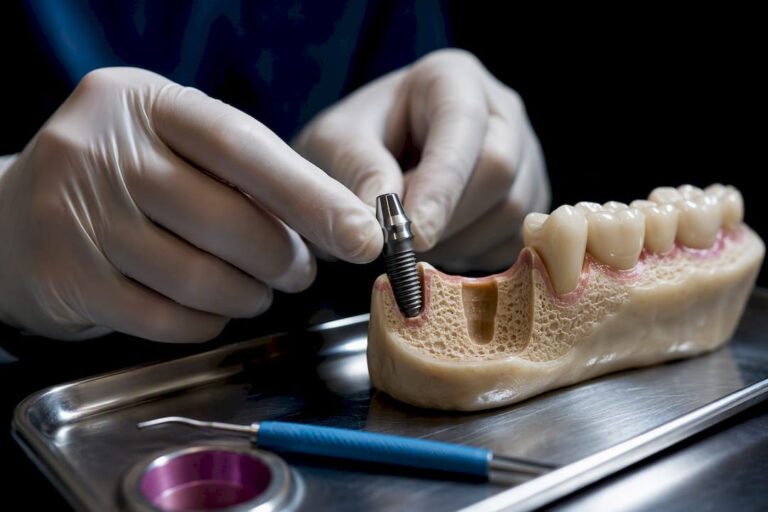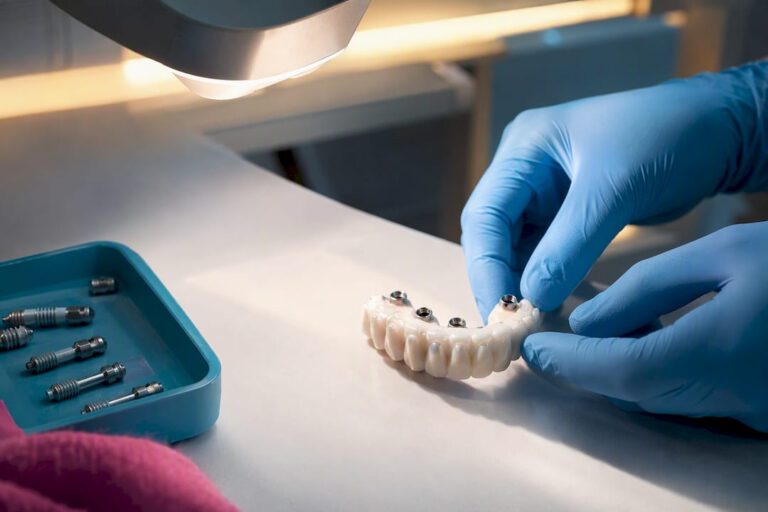

Immediate load implants can deliver a predictable, same-day restoration with survival rates matching conventional protocols, but only in carefully screened patients who meet strict bone and stability criteria. The tradeoff is real: faster results come with higher mechanical demands on the implant during the first months and require disciplined follow-up. For the right candidate, it works. For the wrong one, it’s a costly setback.
TL;DR:
- Immediate loading requires high initial stability, with insertion torque of at least 25 to 40 Ncm and ISQ values above 60 to 70, to reduce failure risk.
- The strongest outcomes are observed in patients with intact socket walls, sufficient facial bone thickness, and no active infections, as these criteria ensure predictable stability.
- Failure risks are highest within the first six months, often due to biological or technical complications; careful follow-up and proper occlusal management are crucial.
- Costlier than traditional protocols, immediate load implants involve advanced planning, digital workflows, and may require financing or insurance discussions upfront.
- Surgeons may convert plans mid-surgery from immediate to delayed loading if primary stability or bone quality criteria are not met.
Table of Contents
- What Are Immediate Load Implants and How Are They Classified?
- What Are the Benefits of Immediate Loading?
- What Are the Risks and Complications of Immediate Load Implants?
- Who Is a Good Candidate for Immediate Load Implants?
- What Does the Procedure and Timeline Look Like?
- What Does the Research Actually Show About Outcomes?
- How Do You Care for an Implant During Osseointegration?
- When Is Immediate Loading Not Appropriate?
- What Types and Materials of Implants Work Best for Immediate Loading?
- What Prosthetic Options Work for Immediate Load Implants?
- How Do You Manage Poor Bone Quality or Low Primary Stability?
- What Do Immediate Load Implants Cost, and How Should You Plan Financially?
- Practice Perspective: How Complete Dental Care Approaches Immediate Loading
- Ready to Find Out if You Qualify for Immediate Loading?
- Sources
What Are Immediate Load Implants and How Are They Classified?
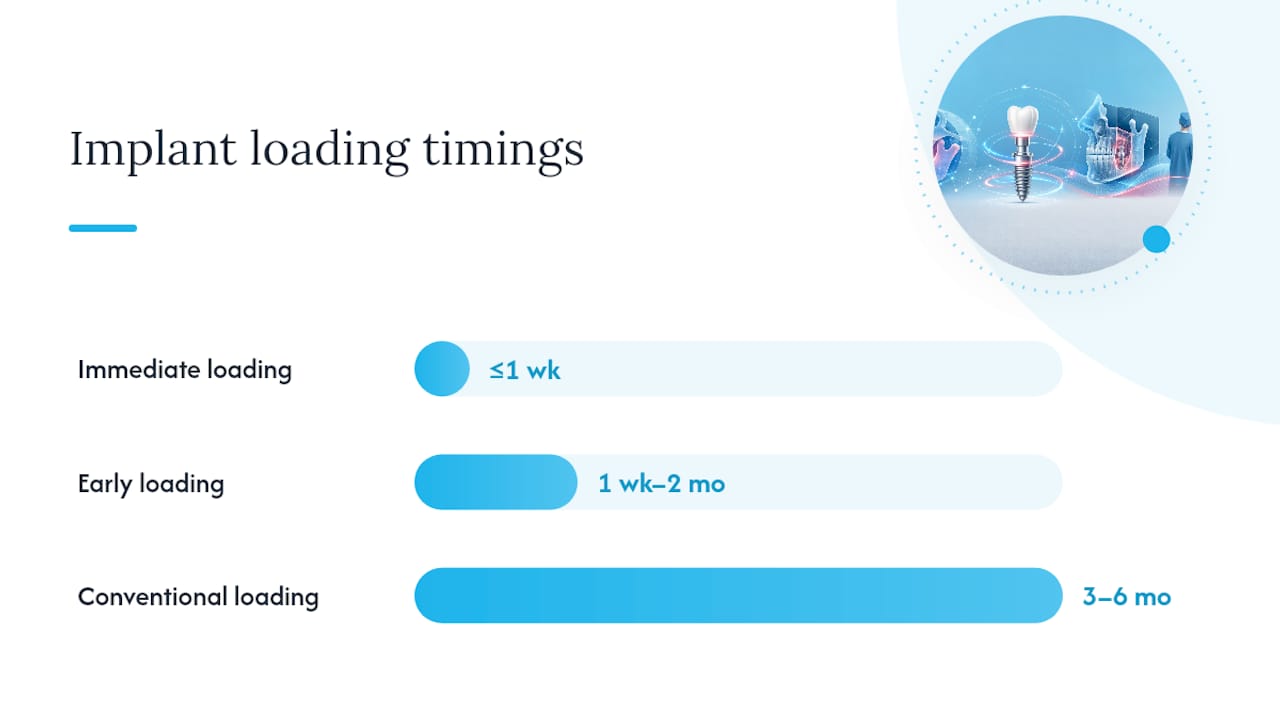
The ITI consensus defines immediate loading as attaching a prosthesis in occlusion within one week of implant placement. That’s the working clinical definition, and it matters because “immediate” gets used loosely in marketing materials to mean almost anything faster than the old three-to-six-month wait.
Dentistry actually splits timing into four distinct categories, and understanding them helps you ask better questions at a consult:
- Immediate loading — the prosthesis contacts opposing teeth in occlusion within one week of placement.
- Immediate restoration — a crown or bridge is attached shortly after placement but kept out of occlusal contact, so it looks finished without bearing chewing forces yet.
- Early loading — restoration happens between one week and roughly two months after placement, once initial healing has started but before full osseointegration.
- Conventional loading — the traditional approach, waiting three to six months for bone to fully integrate before loading the implant.
Layered on top of that timing scale is a placement classification that combines when the implant goes in with when it gets loaded. Type 1A means immediate placement (the implant goes into the socket right after extraction) plus immediate loading (a functional provisional within a week). Type 1B is immediate placement with early loading. Type 1C is immediate placement with conventional loading, essentially delaying the restoration even though the implant went in on day one.
Patients often don’t distinguish between these, but the difference shows up chairside. A same-day provisional crown you can chew on that afternoon is Type 1A. A same-day implant with a temporary that stays out of your bite for two months is something else entirely, even though both get marketed as “same day implants.” Ask specifically which protocol your clinician is proposing, because it changes what your first few months look like.
For full-arch cases, the same logic scales up: a “Teeth in a Day” full-arch immediate implant protocol follows Type 1A principles across multiple implants supporting one connected prosthesis, which distributes load differently than a single tooth does.
What Are the Benefits of Immediate Loading?
The appeal is straightforward: you leave with teeth, not a gap and a removable temporary. That single fact drives most patients toward immediate load dental solutions when they’re candidates.
The practical advantages break down into a few categories:
- Fewer surgical stages. Conventional protocols often mean an extraction visit, a healing period, a second surgery to place the implant, another healing period, then a restoration visit. Type 1A collapses extraction, placement, and provisional restoration into one appointment.
- Immediate esthetics. In the anterior maxilla, where a gap is visible every time you smile or talk, walking out with a natural-looking provisional the same day carries real psychological weight, not just cosmetic value.
- Avoiding removable temporaries. Flippers and temporary partials are uncomfortable, alter speech, and many patients find them harder to tolerate than the surgery itself.
- Compressed total treatment time. For full-arch cases, immediate loading can shrink a process that might otherwise span the better part of a year down to a single day for the provisional phase, with the final prosthesis following once healing is confirmed.
Quality-of-life reporting in well-selected cohorts tends to track high satisfaction scores, largely because the disruption window shrinks dramatically compared to staged treatment.
Pro Tip: If esthetics in the smile zone is your top priority, ask whether your case qualifies for immediate restoration even if immediate loading itself isn’t recommended. You can sometimes get a tooth-shaped provisional out of occlusion the same day, protecting your smile while the implant heals on a safer, slower loading schedule.
The benefit only holds when the risk profile supports it. A patient with thin facial bone, an infected socket, or heavy nighttime grinding trades a faster timeline for a meaningfully higher chance of complication, and that’s not a trade worth making.
What Are the Risks and Complications of Immediate Load Implants?
Most failures and complications with immediate loading show up early. The literature consistently points to the first six months as the window where things go wrong, if they’re going to go wrong at all, because that’s when the implant is under functional load before bone has fully matured around it.
Complications tend to fall into three buckets:
- Surgical complications — infection at the extraction/placement site, wound dehiscence, or inadequate soft tissue closure.
- Biological complications — peri-implant mucositis, early marginal bone loss, or in more serious cases, failure of osseointegration itself.
- Technical complications — screw loosening, provisional fracture, or occlusal issues from a temporary that wasn’t properly protected from bite forces.
A 2023 systematic review reports survival rates commonly between 96% and 100% for immediate placement and immediate loading in selected cohorts, while also quantifying distinct surgical, technical, and biological event rates that clinicians weigh before recommending the protocol.
That’s a strong survival number, but survival isn’t the same as complication-free. A separate systematic review of single immediate implants found short-term success rates near perfect in studies with clearly defined success criteria, with most of the recorded complications being esthetic or technical rather than outright implant loss. In other words, the implant usually survives, but a provisional crack or a slightly off gum contour is a more common outcome than total failure.
Several factors raise your personal risk profile above the study averages. Smoking impairs healing and is one of the most consistently cited risk modifiers in implant literature. Active infection at the extraction site, poor bone density, and untreated bruxism (nighttime grinding) all increase mechanical or biological stress on a fresh implant before it’s ready to handle it. Meta-analytic data also shows that early and immediate loading can carry a higher early-failure risk compared with conventional loading, even though marginal bone loss and long-term outcomes often even out once cases are well-selected.
Clinician experience is not a minor variable here. Achieving primary stability, judging socket quality intraoperatively, and managing provisional occlusion correctly all require surgical judgment that a general practitioner without advanced implant training may not have developed.
Who Is a Good Candidate for Immediate Load Implants?
Candidacy comes down to a handful of measurable factors your clinician checks before, during, and immediately after surgery. This isn’t a subjective call.
- Intact socket walls. If the extraction leaves the surrounding bone walls broken or thin, immediate placement into that socket loses the structural support it needs.
- Adequate facial bone thickness. Clinical guidance generally looks for buccal (facial-facing) bone thickness of at least roughly 1 millimeter to protect against recession and resorption over time.
- Sufficient apical bone for primary stability. There has to be enough healthy bone beyond the socket, at the root tip area, for the implant to grip firmly on insertion.
- Insertion torque and ISQ thresholds. ITI decision-tree guidance commonly references insertion torque in the range of roughly 25 to 40 Ncm and Implant Stability Quotient (ISQ) values above 60 to 70 as the benchmark for proceeding with immediate loading. Fall short, and the safer move is converting to delayed loading on the spot.
- No active infection at the site. Untreated periapical or periodontal infection at the extraction site is a hard stop for immediate placement in most protocols.
- Controlled systemic health and no heavy smoking. Uncontrolled diabetes, active heavy smoking, and untreated bruxism all push a case toward conventional loading instead.
Pro Tip: Ask your clinician what your insertion torque and ISQ readings were immediately after placement, and get comfortable with the idea that a good surgeon may pivot mid-surgery from an immediate-load plan to a delayed one if those numbers come in low. That flexibility is a sign of good judgment, not a failed procedure.
When stability criteria aren’t met, grafting the socket and staging the implant for a later date is often the more conservative and ultimately more predictable path. That’s not a downgrade. It’s the correct clinical call for that particular mouth.
What Does the Procedure and Timeline Look Like?
A Type 1A case, combining immediate placement with immediate loading, follows a fairly consistent sequence, though the exact steps vary by clinic and case complexity.
- Pre-op planning. This includes a full medical history review, CBCT (3D cone-beam) imaging to map bone volume and nerve position, and digital treatment planning to determine implant position and angulation before you ever sit in the chair. A surgical guide, printed from that digital plan, is often fabricated in advance.
- Atraumatic extraction. The clinician removes the failing tooth while preserving as much of the surrounding socket wall as possible, since damage here can disqualify the site for immediate placement.
- Socket debridement. Any infected or granulation tissue is cleaned out of the socket before the implant goes in.
- Implant placement and stability check. The implant is seated, and insertion torque and ISQ are measured on the spot to confirm it meets the threshold for loading that day.
- Provisional insertion. A screw-retained provisional crown or bridge, milled or 3D printed from the same digital plan, is placed and carefully adjusted.
- Occlusal management. The provisional is checked to eliminate contact during side-to-side jaw movement (eccentric contacts) and to keep proximal contacts light, reducing mechanical stress while bone integrates.
- Early follow-up. Checks typically occur across the first one to twelve weeks to monitor healing, tissue response, and implant stability.
If stability targets aren’t met at step 4, the plan converts to delayed loading right there in the same appointment, protecting the long-term outcome over the timeline goal.
What Does the Research Actually Show About Outcomes?
Survival numbers for immediate loading look genuinely good in the current literature, but the details matter more than the headline figure. The ITI consensus describes Type 1A as clinically documented and predictable under favorable conditions, and multiple systematic reviews back that framing with concrete numbers.
A 2023 systematic review puts survival for immediate placement and immediate loading commonly in the 96% to 100% range in selected cohorts, roughly on par with conventional loading survival figures reported elsewhere in the implant literature.
That’s a strong signal, but “selected cohorts” is the operative phrase. These are patients who already passed the anatomical and stability screening described above. Extrapolating that survival rate to an unscreened population would be a mistake.
A long-term umbrella review reinforces this with a nuanced conclusion: immediate loading can achieve implant survival and patient satisfaction similar to non-immediate protocols when high initial stability is achieved at placement. But the same review is explicit that non-immediate (delayed) loading remains the preferred approach in compromised cases, meaning the evidence doesn’t argue for immediate loading universally. It argues for it conditionally.
Where things get more cautious is in the meta-analytic data on early failure. Research published in Scientific Reports found early loading protocols can carry a higher early-failure risk compared with conventional loading, even though marginal bone loss and long-term outcomes tend to converge once both groups are well-selected. That’s a meaningful distinction for patients to sit with: the risk isn’t necessarily that the implant fails eventually, it’s that if something goes wrong, it tends to go wrong faster and closer to the surgery date.
A few limitations run through this body of evidence worth flagging honestly:
- Definition inconsistency. Not every study uses identical timing thresholds for “immediate,” “early,” and “conventional,” which makes cross-study comparison imperfect.
- Selected populations. Most of the strong survival numbers come from patients who already met strict inclusion criteria, not from unscreened general populations.
- Short follow-up windows. Several randomized controlled trials informing this evidence track outcomes for a year or two, not the decade-plus horizon patients actually care about.
For a patient trying to translate this into personal risk, the honest takeaway is this: if you meet the selection criteria your clinician checks for, published survival rates suggest immediate loading performs close to conventional loading. If you’re borderline on any single criterion, the early-failure risk in the meta-analytic data becomes the more relevant number, and a staged approach may serve you better even though it takes longer.
How Do You Care for an Implant During Osseointegration?
The months right after placement are when your daily habits matter as much as the surgery itself. Follow-up adherence and diet discipline during this window materially affect whether the implant integrates cleanly.
- Stick to a soft diet. Avoid biting directly on the provisional with anything hard, crunchy, or chewy for the first several weeks, and expand your diet gradually only as your clinician clears you to.
- Brush gently around the site. Use a soft-bristle brush and any antiseptic rinse your clinician prescribes, being careful not to disturb the healing tissue directly around the implant.
- Keep every follow-up appointment. Expect checks across the first several weeks with periodic radiographs to confirm bone integration is progressing as expected.
- Watch for warning signs. Increasing pain (rather than gradually decreasing), visible swelling, implant mobility, or pus (suppuration) at the site all warrant a same-day call to your clinic, not a wait-and-see approach.
Most complications that do occur announce themselves through one of those warning signs well before they become serious, which is exactly why the early follow-up schedule isn’t optional.
When Is Immediate Loading Not Appropriate?
Immediate loading is not the right call for every patient, and a good clinician will tell you that directly rather than push the faster option regardless of fit.
Common reasons to opt for conventional loading instead include:
- Uncontrolled diabetes or other systemic disease that impairs healing.
- Active infection at the extraction or implant site.
- Heavy or habitual smoking, which measurably reduces integration success.
- Untreated bruxism, which places excessive mechanical load on a healing implant.
- Insufficient facial bone thickness or damaged socket walls from the extraction.
- Insertion torque or ISQ readings that fall below threshold at the time of surgery.
When immediate loading isn’t advisable, two evidence-backed alternatives exist. Early loading, restoring the implant between one week and two months after placement, offers a middle path with a somewhat stronger evidence base than immediate loading in marginal cases. Alternatively, immediate placement without loading (Type 1C), or full staging with socket grafting followed by delayed implant placement months later, gives compromised sites time to rebuild before bearing any functional load. For denture wearers specifically, mini dental implants can offer a lower-intervention stabilization option worth discussing if a full immediate-load case isn’t the right fit.
What Types and Materials of Implants Work Best for Immediate Loading?
Not every implant design is suited to immediate loading, and the material and surface characteristics matter more here than in conventional protocols because the implant needs to achieve stability fast, without months of undisturbed healing to compensate for a slower-integrating surface.
Titanium remains the dominant material choice, largely because of its long track record with osseointegration. Titanium-zirconium alloys have gained ground for immediate-load cases specifically because they allow narrower implant diameters without sacrificing mechanical strength, which matters in tight anterior spaces where esthetics and bone volume are both constrained.
Surface treatment matters as much as the base metal. Roughened, moderately textured surfaces, often created through acid-etching or grit-blasting, tend to be favored for immediate-load cases because they promote faster bone-to-implant contact than smoother, machined surfaces did in older implant generations.
Implant geometry plays a role too. Tapered designs that compress bone slightly on insertion tend to achieve higher primary stability in fresh extraction sockets than parallel-walled designs, which is part of why tapered implants dominate immediate-placement protocols specifically.
For full-arch immediate-load cases, the implant count and distribution (often four to six implants per arch depending on bone volume) is planned digitally in advance using CBCT data, so the surgical and restorative team knows exactly where each implant needs to land to support the connected provisional evenly.
What Prosthetic Options Work for Immediate Load Implants?
The temporary restoration you leave with the day of surgery is not a cosmetic afterthought. It’s a functional device that has to protect the implant while it heals, and its design directly affects your risk of complications.
Screw-retained provisionals are the standard for immediate loading, largely because they can be removed and adjusted without disturbing the implant itself, unlike cement-retained designs. That matters if your clinician needs to check the site or make an occlusal adjustment during a follow-up visit.
Surface polish is a deceptively important detail. A highly polished provisional surface reduces plaque accumulation right at the gum margin during the exact window when soft tissue is most vulnerable to inflammation.
Occlusal design follows a consistent rule across single-tooth and full-arch cases alike: no contact during side-to-side jaw movements (eccentric contacts), and only light contact with neighboring teeth. This keeps functional load on the new implant controlled while bone matures around it, rather than exposing it to the full mechanical demand of normal chewing from day one.
For single-tooth replacement in the esthetic zone, the provisional is typically shaped to guide gum tissue into a natural contour around the crown, a detail that affects how the final restoration looks months later far more than most patients realize. Full-arch cases use a rigid, implant-supported bridge design specifically because it splints the implants together, distributing bite force across all of them rather than concentrating stress on any single implant.
How Do You Manage Poor Bone Quality or Low Primary Stability?
Not achieving target insertion torque or ISQ during surgery isn’t a failure. It’s information, and a well-trained clinician has several ways to respond to it without abandoning the case entirely.
The most common response is simply converting to delayed loading on the spot. The implant stays in place, but the provisional is either left out of occlusion or omitted entirely until a follow-up visit confirms integration is progressing well enough to load safely.
For bone quality issues identified during pre-op CBCT planning rather than discovered mid-surgery, grafting is often scheduled proactively. Socket grafting at the time of extraction, followed by a healing period of several months, rebuilds volume and density before an implant is ever placed, trading time for a substantially more predictable stability outcome.
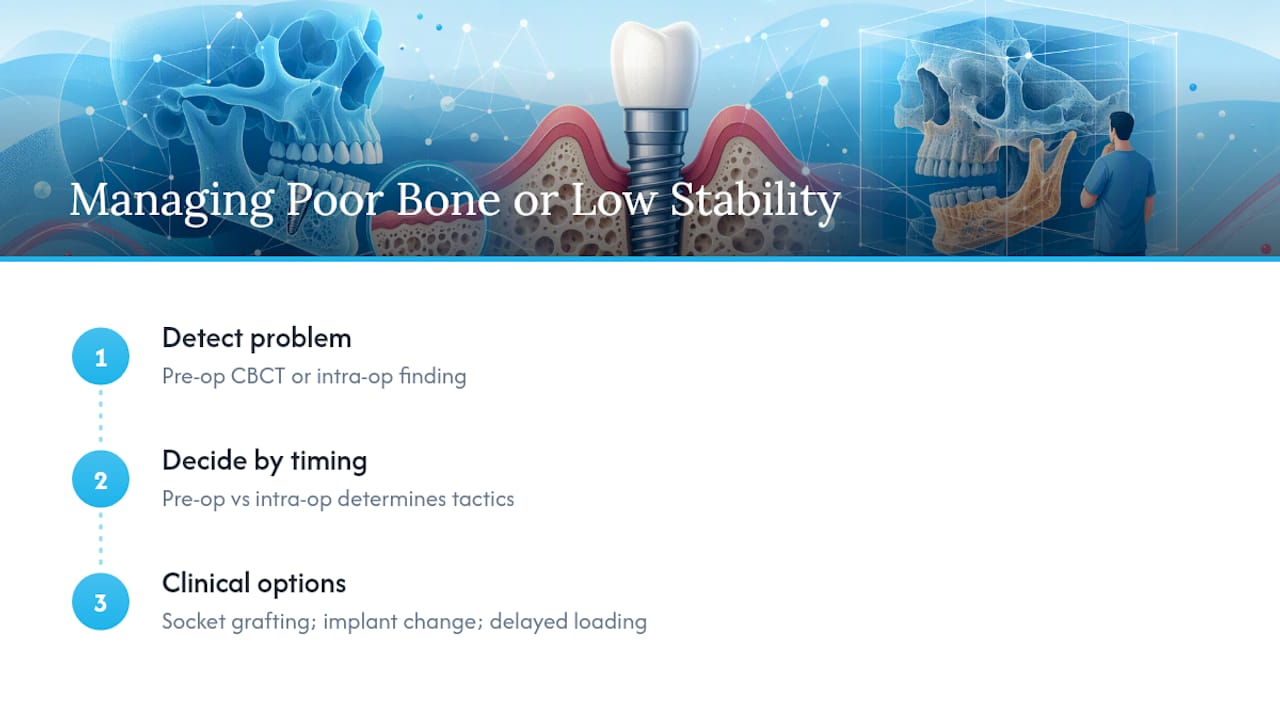
Implant selection itself can also shift in marginal-bone cases. A wider-diameter or longer implant, when anatomy allows, can improve primary stability by engaging more surrounding bone. In some cases, repositioning the implant slightly deeper or angling it toward denser bone (sometimes toward the nasal floor or a specific cortical plate) achieves the torque needed without changing the treatment plan’s overall timeline.
The unifying principle across all of these approaches is the same one that governs the entire immediate-loading decision: the stability threshold isn’t negotiable, but the path to reaching it, or the decision to wait for it, has real flexibility built in.
What Do Immediate Load Implants Cost, and How Should You Plan Financially?
Immediate load implants typically carry a higher upfront cost than conventional staged implants, largely because the digital planning, surgical guide fabrication, and same-day provisional all get bundled into a single, more resource-intensive appointment. Full-arch immediate-load cases sit at the higher end of that spectrum, since they involve multiple implants and a more complex provisional bridge.
Dental insurance coverage for implants varies significantly by plan, and many policies treat implants as a partially covered or entirely elective procedure rather than a standard benefit. That makes a direct conversation with your provider’s billing team, before treatment starts, worth the time it takes.
Financing structures fill the gap for a lot of patients. In-house payment plans, third-party dental financing, and Health Savings Account (HSA) or Flexible Spending Account (FSA) funds can all offset the upfront cost, and documenting HSA-eligible expenses correctly matters if you’re planning to use those funds for implant treatment.
The most useful financial question to ask at a consult isn’t “what does it cost,” but “what does it cost if my case doesn’t qualify for immediate loading and needs staging instead.” Getting both numbers upfront, along with what each covers, prevents a mid-treatment financial surprise if your surgeon has to pivot plans based on what they find at the surgical appointment.
Practice Perspective: How Complete Dental Care Approaches Immediate Loading
Complete Dental Care built its full-arch and same-day implant workflow around one non-negotiable: the imaging comes before the promise. CBCT scanning and digital treatment planning happen before any patient hears a timeline, because a same-day result only means something if the bone actually supports it.
The practice’s “Teeth in a Day” protocol and its documented same-day implant outcomes reflect the same selection discipline described throughout this guide: stability thresholds get checked intraoperatively, and if a case doesn’t meet them, the plan adjusts rather than forcing a provisional onto bone that isn’t ready for it. That’s not a hedge. It’s what keeps survival rates high in the first place.
Every consult includes a direct conversation about candidacy, not just enthusiasm about the timeline. Patients see their own CBCT imaging, understand why a given site does or doesn’t qualify for immediate loading, and leave with a plan they actually understand rather than one they were simply told to trust. Follow-up care and emergency contact pathways are built into that same plan from day one, so the weeks after surgery, the ones that matter most for a healing implant, are never a guessing game.
— Complete Dental Care
Ready to Find Out if You Qualify for Immediate Loading?
The only way to know whether you’re a candidate for immediate load implants is a proper evaluation, and that starts with imaging, not guesswork. Bring your medical history, a list of current medications, and any prior dental X-rays or imaging you have, since that history directly affects the bone-quality and stability assessment your clinician needs to make.
At your first visit, Complete Dental Care walks through CBCT imaging, reviews your specific anatomy, and gives you a straight answer on whether same-day loading fits your case or whether a staged approach will serve you better long term. If financing is a concern, ask about HSA documentation and in-house payment options before treatment begins, not after. Full-arch candidates can explore the Teeth in a Day protocol directly, while anyone considering single or multiple implants can start with the practice’s surgical implant dentistry page to see the technology and process behind the timeline. Schedule a consult and get a real answer on your candidacy, backed by your own imaging rather than a generic estimate.
This article is general information, not a substitute for advice from a qualified doctor. Consult a qualified healthcare professional about your own circumstances before acting on anything here.
Sources
- Implant placement and loading protocols – ITI consensus
- Systematic review reporting survival and event rates for immediate placement/loading (2023)
- Systematic review reporting success rates and complications for single immediate implants (2022)