For most adults, a professional dental cleaning roughly twice a year is the standard starting point — but that number is a benchmark, not a prescription. Your actual ideal interval depends on your gum health, medical history, and how quickly plaque and tartar build up between visits.
If any of the following apply to you, your dentist will likely recommend more frequent visits:
- History of periodontitis or active gum disease (often every 3–4 months)
- Dental implants or prosthetics prone to peri-implantitis
- Smoking or tobacco use
- Uncontrolled or poorly managed diabetes
- Heavy calculus buildup that returns quickly between appointments
- Medications that reduce saliva flow (antihistamines, antidepressants, blood pressure drugs)
- Orthodontic appliances like braces that trap plaque
The sections below walk through what the evidence actually says about cleaning frequency, who needs a shorter interval, and the exact questions to ask your dentist to set a schedule that fits your situation.
Key Takeaways
Your cleaning frequency should be set by your clinical data, not a default calendar — most adults start at six months, but risk factors like periodontitis, implants, or smoking often call for every three to four months.
| Point | Details |
|---|---|
| Six-month baseline | A reasonable starting point for healthy adults, but not universally correct for everyone. |
| Risk-based intervals | Periodontitis, implants, smoking, and diabetes typically require cleanings every 3–4 months. |
| Evidence is mixed | Cochrane and IQuaD trials found no significant benefit of six-month over 12-month visits for low-risk adults. |
| Ask your dentist | Request your probing depths and bleeding scores to understand what interval your clinical data supports. |
| Complete Dental Care | Offers personalized recall planning with periodontal assessment, implant hygiene, and membership options in Greenville, TX. |
Table of Contents
- How often should you get a dental cleaning, according to the evidence?
- Why professional cleanings matter beyond what brushing can do
- Who needs more frequent cleanings?
- What happens during a professional cleaning?
- How to set your own recall interval
- How long cleanings take and what they cost
- When to call your dentist before your next scheduled visit
- An editorial perspective on cleaning frequency
- Schedule a personalized cleaning and recall plan at Complete Dental Care
- Sources
How often should you get a dental cleaning, according to the evidence?
The twice-yearly rule has been around since the mid-20th century, promoted largely through public health campaigns as a simple preventive baseline. The CDC’s oral health guidance still presents twice-yearly visits as a practical preventive benchmark while noting that individual needs vary. That framing is accurate: for many healthy adults with low cavity risk and stable gums, six months works well as a starting point.
What the research complicates is the idea that six months is universally correct. A Cochrane review covering more than a thousand participants found little or no meaningful difference in gingival inflammation or probing depths between planned roughly six-month and 12-month scale-and-polish schedules in adults who regularly attend dental appointments. Six-monthly visits did reduce calculus slightly, but the clinical significance of that difference was unclear.
Large pragmatic trials tell a similar story. The IQuaD trial and related reports found no statistically significant clinical benefit from scaling and polishing performed around twice a year compared with yearly visits in regular adult attenders over multi-year follow-up. A scoping review reached the same conclusion: evidence for a fixed universal visit frequency is weak, and individualized, risk-based recall is the better approach for adults.
The bottom line from the research: A six-month cleaning schedule is a reasonable default for low-risk adults, but the evidence does not support applying it uniformly to everyone. Your dentist should be setting your interval based on your clinical markers, not a calendar.
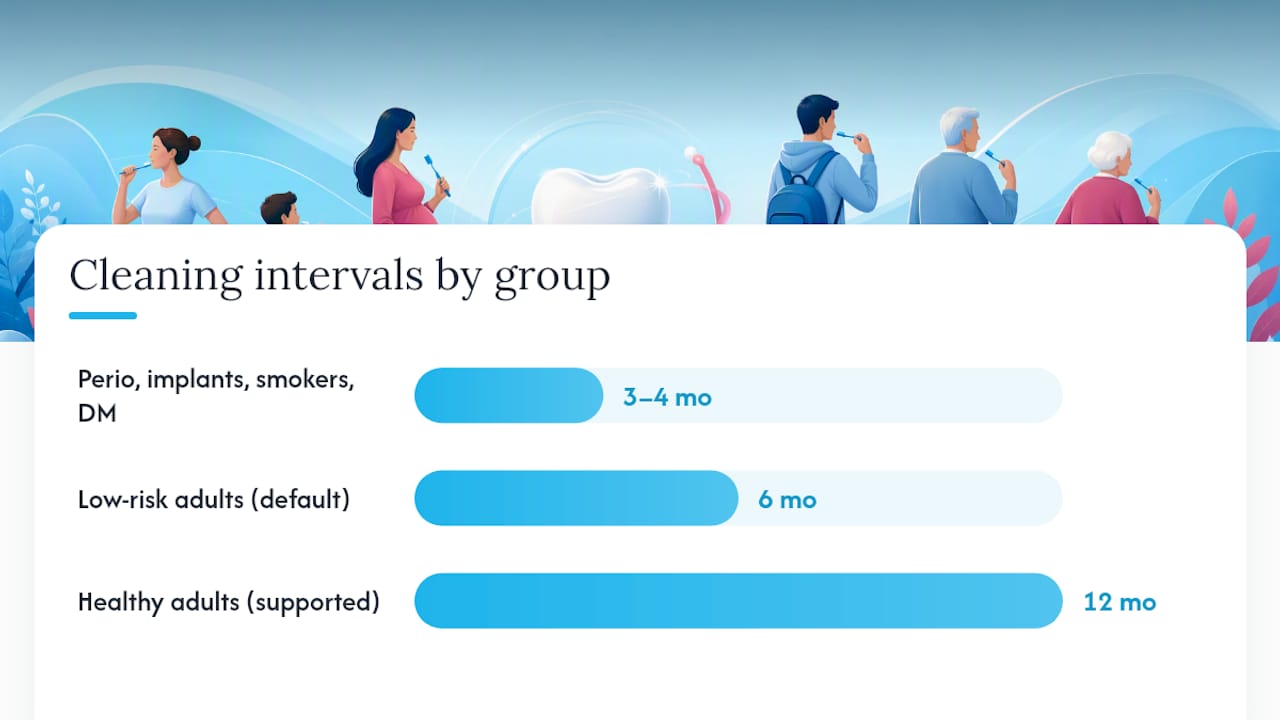
Where the evidence is strong is in periodontal maintenance. After active treatment for gum disease, supportive periodontal therapy (SPT) at three-month intervals has clear clinical backing, with intervals extended only when clinical measures are stable over time.
| Schedule | Who it typically fits | Evidence strength |
|---|---|---|
| Every 3–4 months | Active/treated periodontitis, implants, smokers, uncontrolled diabetes | Strong for SPT; well-supported |
| Every 12 months | Most healthy adults, low cavity risk, stable gums | Common baseline; evidence mixed versus 12 months |
| Every 12 months | Low-risk adults with consistently clean exams | Supported by Cochrane and IQuaD for select patients |
Why professional cleanings matter beyond what brushing can do
Brushing and flossing remove soft plaque, but once plaque hardens into calculus (tartar), only a dental instrument can remove it. Calculus typically forms within 24–72 hours of plaque going undisturbed, and it accumulates in spots most people miss: just below the gumline, between teeth, and along the back surfaces of molars.
Regular professional cleanings help prevent or catch early signs of:
- Gum disease (gingivitis and periodontitis) — the leading cause of tooth loss in adults
- Cavities in hard-to-reach areas that home care misses
- Oral cancer signs — hygienists and dentists screen for suspicious tissue changes at each visit
- Peri-implantitis — bacterial infection around implant posts that can cause bone loss
- Worn or failing restorations — crowns, fillings, and bridges that need attention before they fail completely
Routine cleanings are one of the few dental procedures where catching a problem early almost always means a cheaper, less invasive fix later. A cavity found at a cleaning visit is a filling. The same cavity found two years later may be a root canal.
The Cleveland Clinic notes that most people benefit from a cleaning roughly twice a year, while some need visits more often — and that talking to your dentist about your specific situation is the right move.
Who needs more frequent cleanings?
Research consistently shows there is no single correct interval for dental cleanings — the right cadence depends on your risk profile. Here is how common risk factors typically map to recall frequency:
High risk (approximately every 3 to 4 months):
- History of periodontitis or current active gum disease
- Dental implants, especially with any history of peri-implant inflammation
- Smokers or tobacco users (smoking suppresses the immune response in gum tissue)
- Uncontrolled diabetes (elevated blood sugar accelerates gum disease progression)
- Dry mouth from medications or systemic conditions
Moderate risk (every several months to half a year):
- Orthodontic appliances (braces, clear aligners with attachments)
- Heavy calculus buildup that returns quickly
- Bridges or partial dentures that complicate home cleaning
- Pregnancy (hormonal changes increase gum inflammation risk)
Lower risk (roughly twice a year to once a year):
- Healthy gums with consistent probing depths under 3mm
- No history of cavities in several years
- Excellent home care habits confirmed by clean exams
After completing active periodontal treatment, most patients start on a three-month SPT schedule. That interval is not permanent. If probing depths stabilize, bleeding on probing decreases, and plaque scores stay low over several consecutive visits, your dentist may extend the interval to four or six months.
Pro Tip: If you have dental implants, ask specifically about peri-implant probing at each visit. Peri-implantitis is often painless until significant bone loss has already occurred — early monitoring is the only reliable way to catch it.
What happens during a professional cleaning?
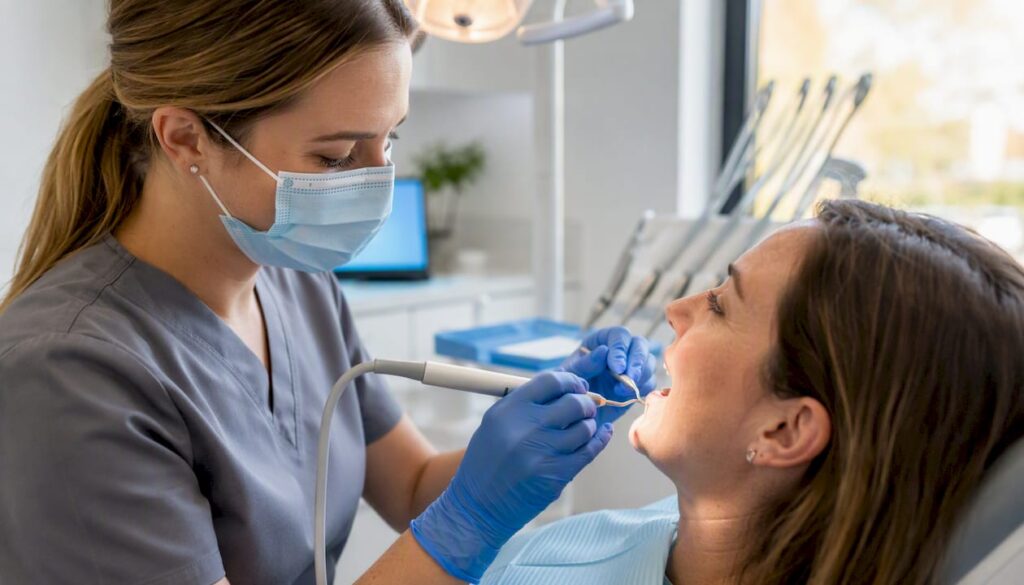
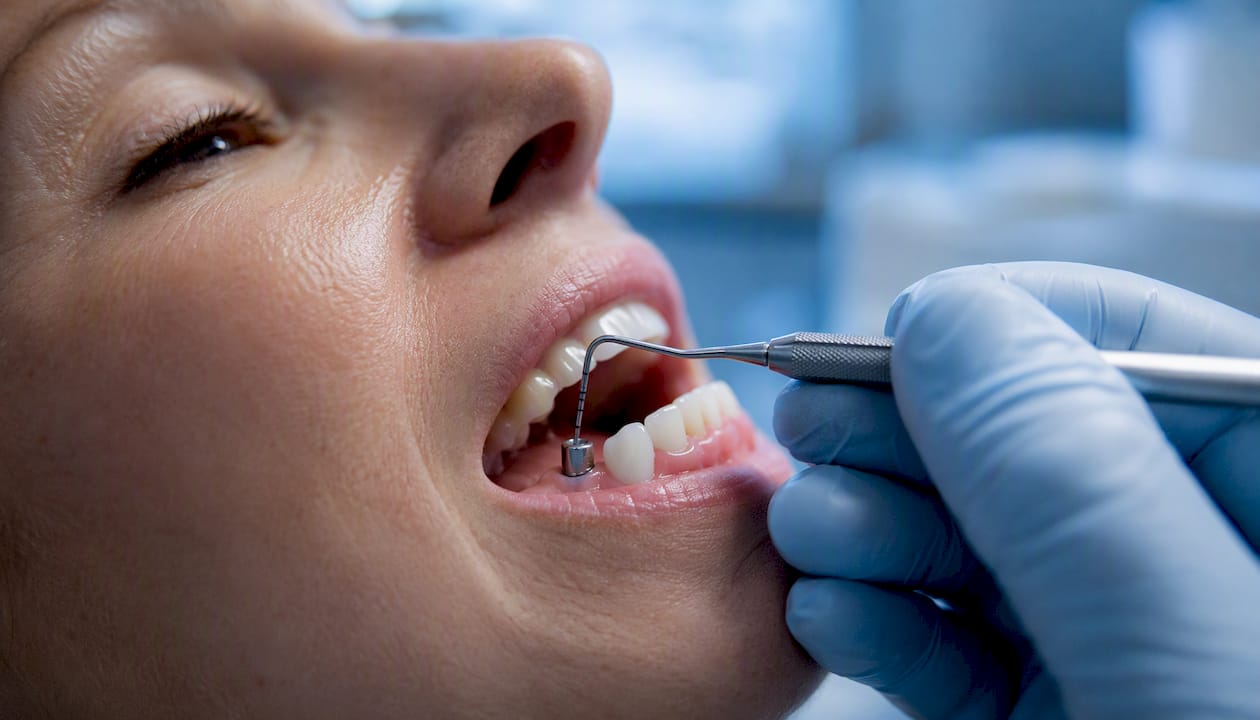
A standard prophylaxis appointment (the routine cleaning most adults get) typically runs 45–60 minutes and follows a predictable sequence. Understanding the steps makes the appointment less stressful and helps you ask better questions.
- Medical history and health update — your hygienist reviews any changes to medications, conditions, or concerns since your last visit
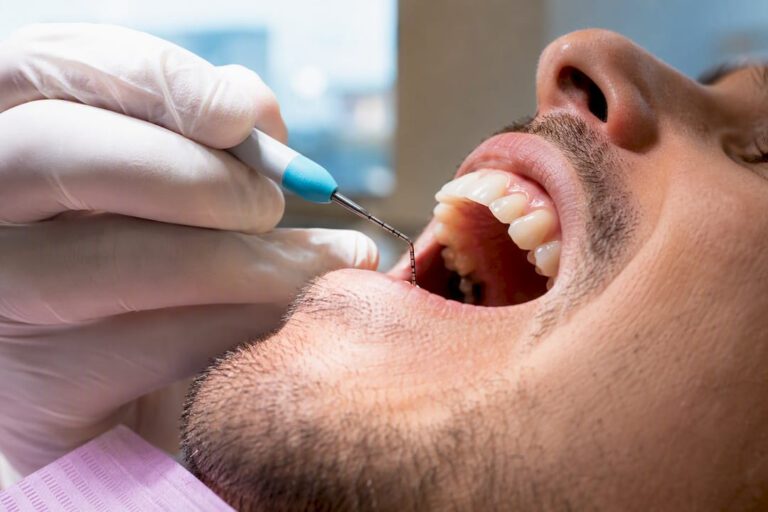
- Periodontal exam — probing depths around each tooth are measured; bleeding on probing is noted
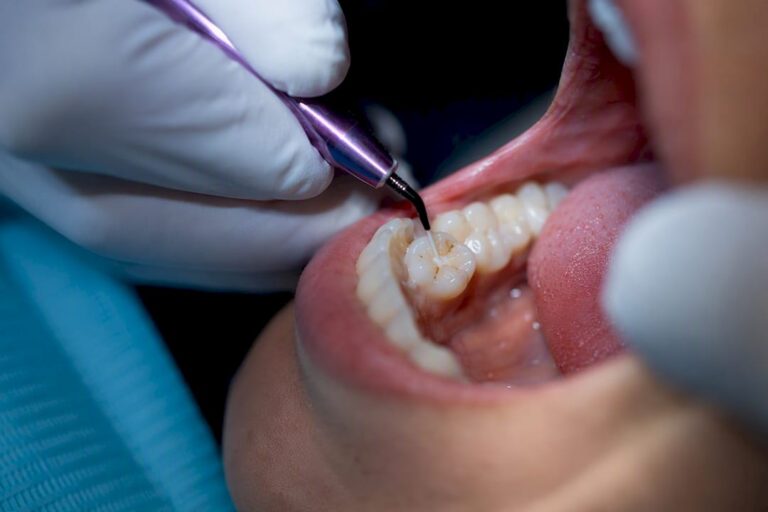
- Scaling — hand instruments and ultrasonic scalers remove calculus above and just below the gumline
- Polishing — a mildly abrasive paste removes surface stains and smooths enamel
- Flossing — interproximal areas are cleaned and checked for contact issues
- Oral hygiene instruction (OHI) — personalized tips on technique, tools, or areas to focus on at home
- Dentist exam — the dentist reviews X-rays, checks restorations, and screens for oral cancer
The type of cleaning you receive depends on your gum health:
Prophylaxis is the standard routine cleaning for patients with healthy gums or mild gingivitis. It cleans above and just at the gumline.
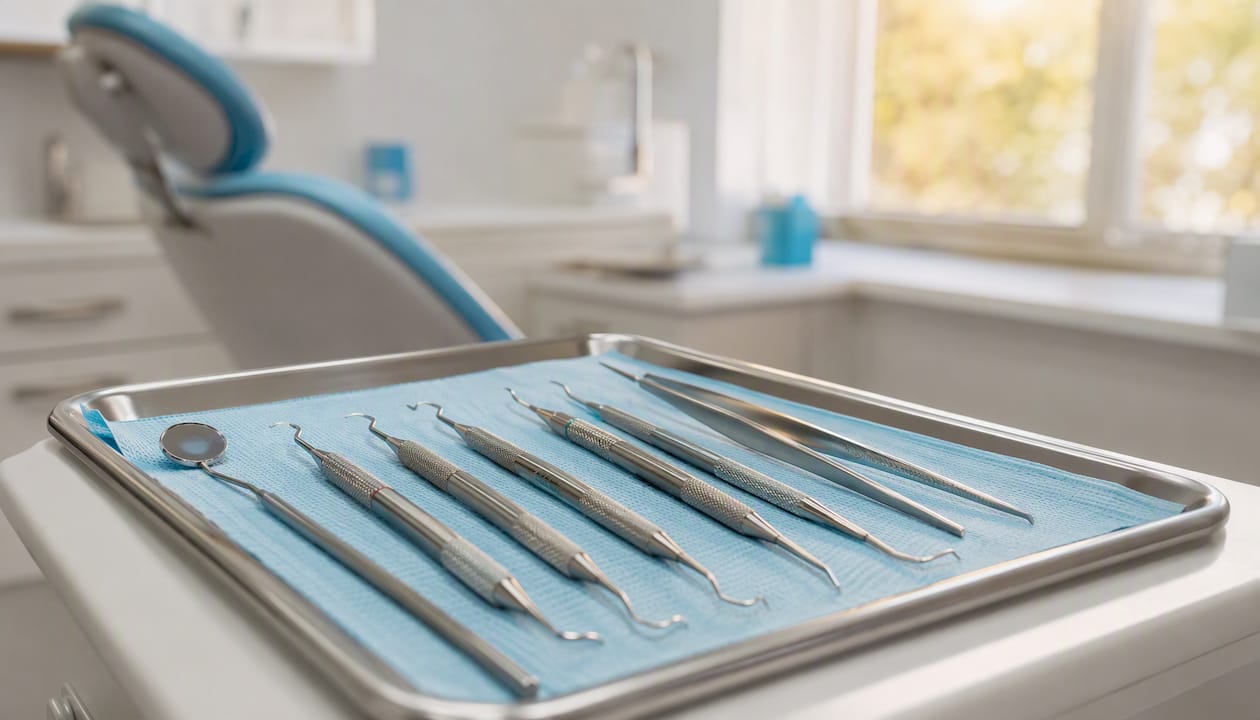
Scaling and root planing (deep cleaning) goes below the gumline to remove calculus from root surfaces and smooth them to discourage bacterial reattachment. It is the first-line treatment for periodontitis and is usually done in quadrants with local anesthetic.
Periodontal maintenance (SPT) follows active periodontal treatment. It combines elements of prophylaxis and deep cleaning, with closer monitoring of pocket depths and bone levels. This is the cleaning type most often scheduled at three-month intervals.
Implant and prosthetic maintenance uses specialized instruments that will not scratch implant surfaces, along with careful assessment of peri-implant tissue. Patients with full-arch implants or complex prosthetics often need this type of visit more frequently than standard prophylaxis patients.
How to set your own recall interval
The best recall interval is one your dentist sets based on your actual clinical data, not a default. Here is a practical framework for that conversation:
- Review your last exam findings — ask what your pocket depths were, whether there was bleeding on probing, and whether any new calculus was noted.
- Identify your personal risk factors — use the list in the previous section to flag anything that applies to you.
- State your goal — prevention (keeping healthy gums healthy) versus maintenance (managing existing disease) calls for different intervals.
- Propose a trial interval — agree on a schedule with a built-in review point, not an open-ended commitment.
Questions to ask your dentist or hygienist at your next appointment:
- Based on my pocket depths and bleeding scores from today, what interval do you recommend?
- Has my calculus buildup changed compared to my last visit?
- Do any of my medications or health conditions affect how often I should come in?
- If I improve my home care, could my recall interval change?
- How will we know if the interval we set is working?
Pro Tip: If your dentist says “every six months” without referencing your probing depths, calculus levels, or bleeding scores, ask specifically: “What clinical markers are you basing that on?” A good clinician will have a concrete answer. If they cannot give one, that is a signal to ask more questions or seek a second opinion.
How long cleanings take and what they cost
A routine prophylaxis appointment runs roughly 45–60 minutes for most adults. Add time if your visit includes full-mouth X-rays (another 15–20 minutes), a new-patient exam, or if calculus buildup is heavier than usual.
Scaling and root planing takes significantly longer, often about an hour to an hour and a half per quadrant, and is usually split across two or more appointments.
Factors that affect what you pay out of pocket:
- Type of cleaning — prophylaxis costs less than scaling and root planing or periodontal maintenance
- Local fee schedules — dental fees vary considerably by region
- Insurance coverage — most dental plans cover two prophylaxis visits per year at 100%; periodontal maintenance is often covered at 80%, but some plans limit the number of covered visits per year
- Whether you are a new patient — first visits often include a comprehensive exam and X-rays billed separately
Insurance plans frequently distinguish between prophylaxis and periodontal maintenance billing codes. If your dentist bills a periodontal maintenance code (D4910) instead of a prophylaxis code (D1110), your plan may apply a different co-pay or count it against a different benefit. Ask your front desk to verify coverage before your appointment.
If you do not have dental insurance, an in-house membership plan can reduce the cost of routine cleanings significantly. Many practices offer annual plans that bundle two cleanings, exams, and X-rays for a flat fee. Check insurance and payment options before assuming a cleaning is out of reach.
When to call your dentist before your next scheduled visit
Scheduled cleanings are not the only time you should contact your dental office. Call sooner if you notice:
- Bleeding gums that are new or getting worse, especially if they bleed without provocation
- A loose tooth in an adult mouth — this is never normal and warrants prompt evaluation
- Persistent bad breath that does not resolve with improved home care
- Pain, swelling, or discharge around a tooth, implant, or under a crown
- Increased sensitivity to temperature or pressure that is new or worsening
- A visible change in your gums — recession, color change, or tissue that looks different around an implant
- Anything that changed suddenly after recent dental work
Most of these symptoms are manageable when caught early. Left until the next scheduled cleaning, a localized infection can spread, a loose implant can fail, and a small abscess can become a dental emergency requiring oral surgery. For severe swelling, difficulty swallowing, or fever alongside dental pain, go to an urgent care or emergency room rather than waiting for a dental appointment.
An editorial perspective on cleaning frequency
The six-month rule is one of dentistry’s most durable myths — not because it is wrong, but because it has been repeated so often that patients and some clinicians treat it as biology rather than convention. The truth is more interesting: the research on routine scaling and polishing for healthy adults is genuinely mixed, and the profession has been moving toward individualized recall for years. Expert commentary and practitioner interviews document this shift clearly.
What gets lost in that conversation is that “individualized” does not mean “less often.” For patients with periodontitis, implants, or uncontrolled systemic disease, three months is not aggressive — it is the minimum that keeps disease from progressing silently. The patients who benefit most from a longer interval are the ones who already have excellent home care, stable probing depths, and no significant risk factors. That describes a smaller share of the adult population than most people assume.
At Complete Dental Care, recall intervals are set using digital records, probing depth trends, and a review of systemic health at every visit. The goal is a schedule that reflects where your mouth actually is, not where the calendar says you should be. Penn Dental Medicine’s guidance mirrors this approach: six months as a starting point, adjusted by clinical evidence at each visit.
Schedule a personalized cleaning and recall plan at Complete Dental Care
Knowing the right cleaning frequency is one thing. Getting a schedule built around your actual gum health, restorations, and risk profile is another.
At Complete Dental Care in Greenville, TX, every cleaning appointment includes a full periodontal assessment and a recall recommendation grounded in your clinical data, not a default calendar. Whether you need a routine prophylaxis, periodontal maintenance after prior gum treatment, or specialized hygiene care around implants or prosthetics, the team builds a plan that fits your situation.
Services that support your recall plan:
- Routine cleanings and preventive exams
- Periodontal maintenance (SPT) for patients with a history of gum disease
- Implant hygiene and peri-implant monitoring
- In-house membership plans for patients without insurance
Ready to set a cleaning schedule that actually fits your mouth? Book your appointment at Complete Dental Care and get a personalized recall plan at your first visit.
Sources
- Pubmed
- The Cochrane Library
- Pmc
- Effect of Different Frequencies of Dental Visits on Dental Caries and Periodontal Disease: A Scoping Review
- What Happens During a Dental Cleaning?
This article is general information, not a substitute for advice from a qualified doctor. Consult a qualified healthcare professional about your own circumstances before acting on anything here.