
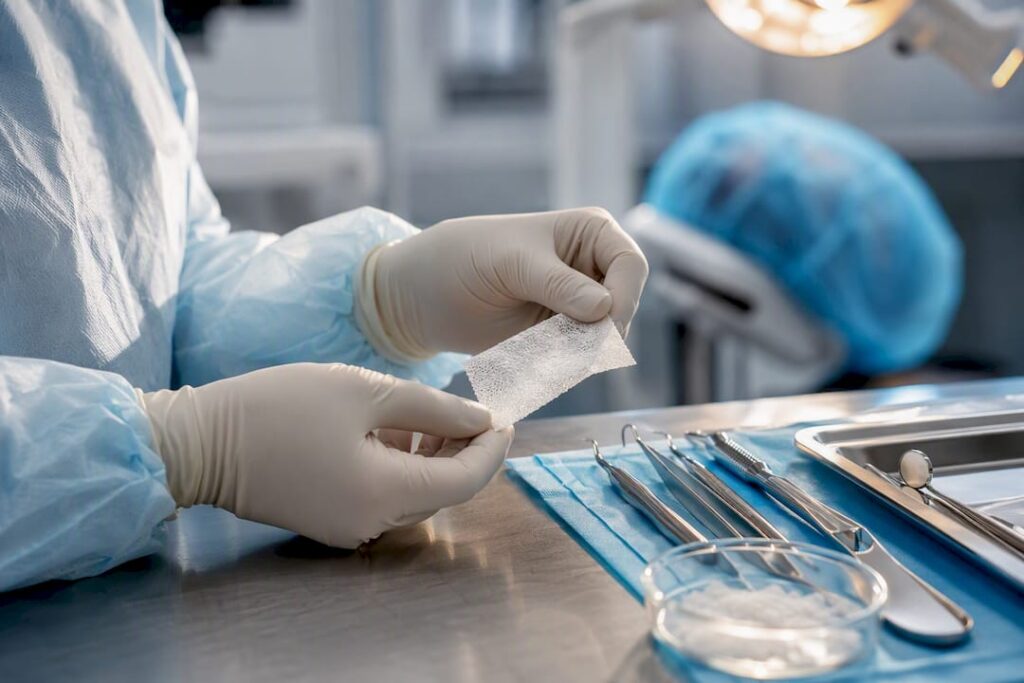
You need a bone graft for implants only when your jaw lacks enough width or height to anchor an implant securely. Grafting rebuilds that foundation but usually adds months to your treatment plan: soft tissue closes in 2 to 4 weeks, while the graft itself typically takes 4 to 9 months to fully integrate, sometimes up to a year for larger cases. Success rates are high when the material and timing are matched to your specific bone loss.
TL;DR:
- Bone grafting is necessary only if the jaw lacks at least 6mm of width or 10mm of height to ensure implant stability, based on precise imaging measurements.
- Autograft, allograft, xenograft, and alloplast differ significantly in biological mechanisms and healing timelines, with synthetic options generally taking 10 to 12 weeks before implant placement.
- The waiting period between grafting and implant placement ranges from immediate to over six months, depending on graft size, material, and soft tissue healing, affecting success chances.
- Full bone integration usually takes four to nine months, and failure risks decrease with proper care, such as avoiding smoking and following post-op instructions.
- Costs vary widely based on the procedure type, with pre-authorization and detailed estimates recommended to prevent unexpected expenses.
questions about this? we're happy to help.
Every patient's situation is a little different. If you want to talk through what this means for you, our Greenville team is one call away.
schedule a free consultationTable of Contents
- Who Actually Needs a Bone Graft Before Implants?
- What Are the Different Types of Bone Graft Material?
- How Long Do You Wait Between Bone Graft and Implant?
- What Happens During the Bone Graft Procedure?
- How Long Is Recovery After a Bone Graft?
- How Successful Are Bone Grafts for Dental Implants?
- How Much Does a Bone Graft for Implants Cost?
- How Complete Dental Care Plans Your Bone Graft and Implant Case
- What Patients Get Wrong About Bone Grafting
- Ready to Find Out if You Need a Bone Graft?
- Sources
- FAQ
Who Actually Needs a Bone Graft Before Implants?
Not everyone loses enough bone to require grafting, but certain patterns almost guarantee it. If a tooth has been missing for more than a year, the surrounding ridge has likely narrowed or flattened, since bone that no longer holds a tooth root starts resorbing within months of extraction. Periodontal disease, facial trauma, and long-term denture wear are the other three big culprits, each attacking bone through a different mechanism (infection, physical injury, or chronic pressure without stimulation).
Dentists confirm the need for grafting through a specific workflow, not a guess:
- A clinical exam checking gum health, ridge contour, and available space
- Intraoral scans mapping the exact shape of the jaw
- CBCT (cone beam CT) imaging to measure bone density and volume in three dimensions
- Ridge measurements compared against minimum thresholds implants need for stability, typically around 6mm of width and 10mm of height, though exact numbers vary by implant system
If those measurements fall short, grafting becomes part of the plan. If they don’t, you skip straight to implant placement.
What Are the Different Types of Bone Graft Material?
Every graft material falls into one of four classes, and the differences matter more than most patients realize going in. Cleveland Clinic identifies these as autograft, allograft, xenograft, and alloplast, each working through a different biological mechanism: some actively grow new bone cells (osteogenesis), some stimulate the body to produce its own (osteoinduction), and some simply act as a scaffold the body builds around (osteoconduction).
- Autograft: your own bone, harvested from another site (often the chin or jaw). It’s still considered the strongest performer biologically, but it requires a second surgical site and a longer recovery.
- Allograft: processed human donor bone. No second surgery site, solid incorporation, and it’s the most common choice for routine socket grafts.
- Xenograft: usually bovine-derived mineral. It resorbs slowly, which sounds like a downside but actually makes it the preferred choice for sinus lifts, where you want the graft to hold its shape and volume rather than dissolve quickly.
- Alloplast (synthetic): calcium-phosphate ceramics or bioactive glass. Consistent supply, no donor tissue at all, predictable handling.
Material choice directly changes your calendar. Autogenous particulate grafts can be ready for implants in about 8 to 12 weeks when the bone density checks out on imaging, allografts run close behind at 10 to 12 weeks, and xenografts often need 16 to 20 weeks or longer because of that same slow resorption that makes them useful for space-holding.
How Long Do You Wait Between Bone Graft and Implant?
Timing falls into three practical categories, and clinicians usually describe them using a numbered system running from immediate to delayed.
- Simultaneous (Type 1) placement. The implant goes in the same day as the graft. This works only on smaller defects with enough native bone to hold the implant stable while the graft matures around it.
- Early placement (Type 2 or 3). The implant goes in 4 to 16 weeks after grafting, once soft tissue has healed but before full bone maturation. This middle path balances speed against safety for moderate defects.
- Delayed placement (Type 4). The implant waits 6 months or longer, standard for large ridge defects, sinus lifts, or cases with compromised soft tissue.
Simultaneous placement sounds like the obvious time saver, and sometimes it is. Pooled data from a systematic review found implants placed at the same time as autogenous onlay grafts achieved roughly 88% survival across studies, with no consistent statistical edge over delayed placement in the studies available. The real deciding factor isn’t speed. It’s whether your specific defect is small enough and your soft tissue healthy enough to support an implant while the graft is still settling in.
What Happens During the Bone Graft Procedure?
A standard graft appointment moves through a predictable sequence: your dentist numbs the site (local anesthesia is standard, though sedation is available for anxious patients), makes an incision to expose the bone, packs in the graft material, places a membrane or barrier over it to keep soft tissue from invading the space, and closes with sutures. If it’s a block graft using a larger solid piece of bone, that block gets screwed into place for stability before the tissue closes over it.
- Socket preservation happens right at the time of extraction, packing the empty socket before it starts collapsing.
- Lateral window sinus lift opens a small door in the cheek-side bone to lift the sinus membrane and pack graft material underneath it.
- Transcrestal sinus lift approaches from the top of the ridge, a less invasive option for smaller lifts.
Most graft procedures take 45 minutes to 2 hours. Arrange a ride home if you’re sedated, and plan on a day or two off anything physically demanding.
How Long Is Recovery After a Bone Graft?
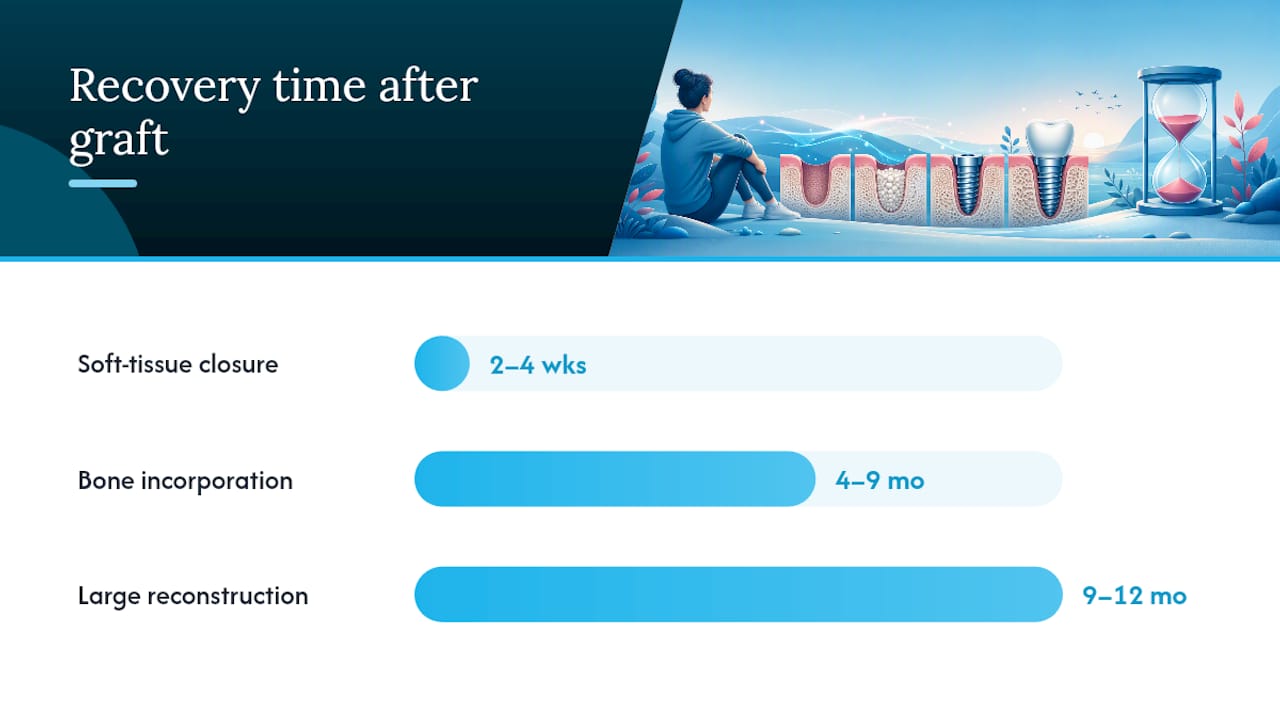
Recovery happens in two distinct phases that patients often confuse. Soft tissue over the graft site closes in 2 to 4 weeks, and that’s usually when discomfort fades and you feel “healed.” But the graft material itself needs far longer to actually fuse with your jaw. Full bone incorporation runs 4 to 9 months for most grafts, stretching to 9 to 12 months for larger reconstructions.
Your dentist confirms readiness with imaging, not guesswork. A follow-up CBCT scan checks bone density at the graft site, and a clinical exam verifies the ridge has the width and firmness needed to support an implant.
- Stick to soft foods and avoid chewing directly on the graft site for the first few weeks.
- Keep the area clean but avoid brushing directly over sutures until your dentist clears you.
- Skip smoking entirely. It’s one of the single biggest threats to graft survival because it restricts blood flow to healing tissue.
- Avoid wearing a removable denture directly over a fresh graft, since pressure can dislodge material before it fuses.
- Call your dentist if you notice increasing pain after day 3, fever, swelling that gets worse instead of better, or persistent drainage.
Pro Tip: Ask your dentist for a temporary flipper or modified denture that doesn’t rest on the graft site. Chronic pressure from an ill-fitting removable appliance is one of the most common, and most preventable, reasons a graft fails to fully integrate.
How Successful Are Bone Grafts for Dental Implants?
The numbers are reassuring when cases are selected and managed properly. Large-scale analyses of implants placed in grafted sites report success rates often exceeding 95% survival in many series, comparable to implants placed in native, ungrafted bone.
Complications exist, but they’re neither common nor mysterious. Infection at the graft site, membrane exposure before soft tissue fully closes, partial graft resorption, and donor-site soreness (for autografts) top the list. None of them are inevitable. The factors you actually control matter enormously here: stopping smoking, keeping diabetes or other systemic conditions managed, and following the aftercare instructions your dentist gives you all measurably improve the odds of a graft maturing on schedule.
How Much Does a Bone Graft for Implants Cost?
Costs swing widely depending on what kind of graft you need and how much bone has to be rebuilt. Socket preservation grafts sit at the lower end of the cost spectrum, since they involve less material and a simpler procedure, while lateral window sinus lifts and block grafts requiring a donor-site harvest land toward the higher end. Geography and the complexity of your specific case both move that number significantly, so a quote from a general guide won’t match your actual estimate.
A few steps keep costs from becoming a surprise:
- Ask your insurance provider for pre-authorization before scheduling, since coverage for grafting varies enormously between plans.
- Request an itemized estimate breaking out the graft material, the surgical fee, and any imaging costs separately.
- Ask about combining procedures (extraction, graft, and future implant planning) in fewer visits to reduce overall cost and time off work.
- Look into HSA or FSA funds, in-office savings plans, or third-party financing if insurance coverage falls short.
How Complete Dental Care Plans Your Bone Graft and Implant Case
Some dental practices use in-house 3D imaging and digital scanning to measure bone volume precisely before recommending grafting, rather than defaulting to it as a routine step. That imaging feeds directly into a treatment plan mapped around your actual anatomy, not a generic protocol. Patients dealing with implant anxiety have access to comfort support and a video library that walks through what grafting and implant placement actually look like before the appointment. Bring your dental records and a list of current medications to your consult. Both speed up diagnosis considerably.
What Patients Get Wrong About Bone Grafting
Most of the anxiety around bone grafts comes from treating them as a separate, optional surgery rather than what they actually are: the first phase of implant treatment for anyone with meaningful bone loss. That reframing changes how you should approach the decision. The question isn’t “do I want to avoid a graft.” It’s “how much time am I willing to add to get an implant that will actually stay stable for decades.”
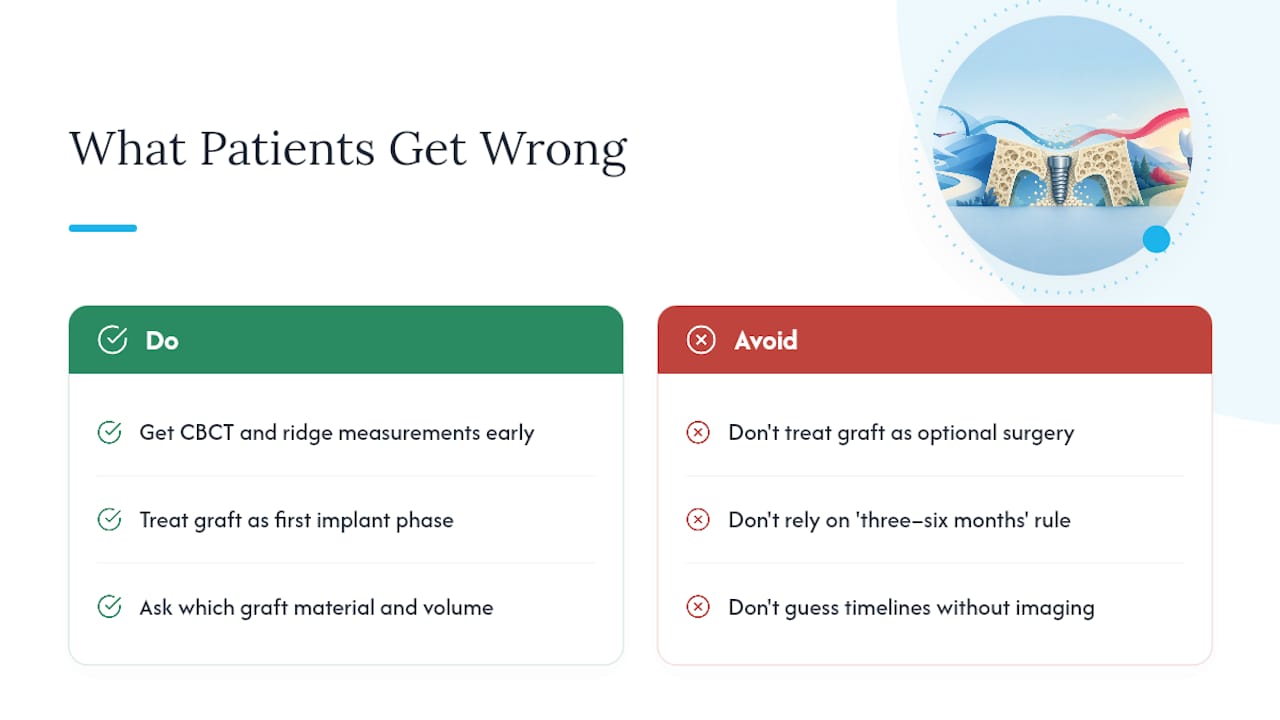
The conventional advice oversimplifies timing into a single number, “wait three to six months,” when the honest answer depends entirely on which graft material went in and how much bone had to be rebuilt. A small allograft socket fill and a lateral sinus lift with xenograft material are not the same wait, and treating them that way sets patients up for frustration when their timeline runs longer than a friend’s did.
What should come first is the imaging, not the anxiety. A proper CBCT scan and ridge measurement tell you exactly what you’re working with, which turns a vague fear into a concrete plan with real numbers attached. Patients who get that clarity early tend to handle the waiting period far better than those who go in guessing.
— Complete Dental Care
Ready to Find Out if You Need a Bone Graft?
If you’re missing teeth and unsure whether your jawbone can support an implant, the only way to know is with real imaging, not a guess based on how long a tooth has been gone. Complete Dental Care builds every implant plan around 3D imaging that measures your actual bone volume, so you get a straight answer instead of a default recommendation to graft.

A first visit for implant consultation typically includes a clinical exam, imaging, a timeline estimate, and possibly a conversation about financing if grafting is necessary. Reviewing what to expect at your first visit beforehand helps you show up with the right questions, and bringing prior dental records or recent X-rays can shortcut the diagnostic process significantly. Schedule a consultation and get a clear answer on whether grafting applies to your case, and what your actual timeline to a finished implant looks like.
This article is general information, not a substitute for advice from a qualified doctor. Consult a qualified healthcare professional about your own circumstances before acting on anything here.
FAQ
How Painful Is a Bone Graft for Dental Implants?
Most patients report mild to moderate soreness for a few days, similar to a tooth extraction, and it’s manageable with over the counter pain relievers or a short course of prescribed medication. Pain that worsens after day 3, rather than improving, is a signal to contact your dentist.
How Much Does an Implant Bone Graft Cost?
Costs vary by procedure type and complexity: simpler socket preservation grafts fall at the lower end, while sinus lifts and block grafts cost more due to added surgical complexity and material volume. Ask for an itemized estimate and pre-authorization from your insurer before scheduling.
How Long Do Bone Grafts Last for Dental Implants?
Once fully integrated, a bone graft becomes part of your natural jawbone through a process called creeping substitution, where your own bone gradually replaces the graft material. At that point it doesn’t have a separate lifespan. It functions as your bone permanently, provided the resulting implant is well maintained.
How Successful Is Bone Grafting for Implants?
Large clinical datasets show implant survival in grafted sites often exceeds 95% when cases are well selected and aftercare is followed, putting grafted-site outcomes in the same range as implants placed in native bone.