Gum disease moves through recognizable stages: gingivitis first, then Stage I through Stage IV periodontitis, each defined by how much bone and tissue support you’ve lost. Gingivitis is the only stage that’s fully reversible with professional cleaning and better home care. Once it progresses to periodontitis, treatment can stop further damage but can’t rebuild the bone you’ve already lost. If your gums bleed when you brush or floss, that’s reason enough to schedule a periodontal exam.
TL;DR:
- Bone loss greater than 60 percent, or damage affecting chewing and tooth stability, usually requires surgical intervention and complex rehabilitation.
- Stage I typically involves bone loss in the top third of the root, while Stage III reaches the middle third, with progression often occurring silently without pain.
- Accurate staging relies on measurements like probing depth, clinical attachment level, radiographic bone loss, and presence of complicating factors such as furcation or tooth mobility.
- Grading based on disease progression over time includes bone loss percentage relative to age and risk factors like smoking or diabetes, influencing treatment intensity.
- Routine exams with advanced imaging and digital scans are crucial for early detection, especially for high-risk groups like diabetics or smokers.
questions about this? we're happy to help.
Every patient's situation is a little different. If you want to talk through what this means for you, our Greenville team is one call away.
schedule a free consultationTable of Contents
- What “staging” and “grading” actually mean
- The four stages of gum disease, explained in plain terms
- How dentists actually measure your stage and grade
- Symptoms of periodontal disease and why early damage hides
- Treatment options at each stage of gum disease
- Prevention and when to book a dental visit
- How modern diagnostics sharpen the diagnosis
- A note on working with your dental team
- Ready to find out where you stand?
- Sources
- FAQ
What “staging” and “grading” actually mean
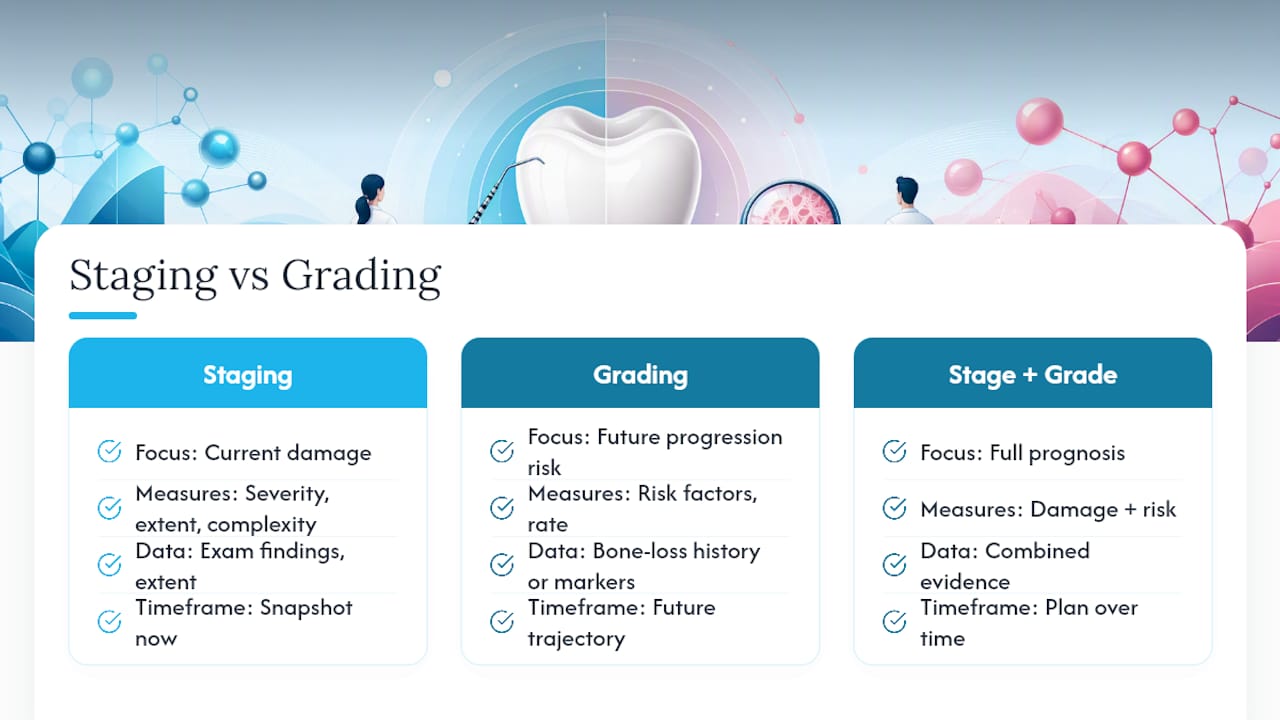
Dentists don’t just say “you have gum disease.” Since 2017, the American Academy of Periodontology and the European Federation of Periodontology have used a two-part system: staging and grading. It sounds bureaucratic, but it’s genuinely useful once you understand what each half is measuring.
Staging describes how much damage has already happened, based on severity, how much of your mouth is affected, and how complicated the case is to treat. Think of it as a snapshot of where you stand right now.
Grading looks forward instead of backward. It estimates how fast the disease is likely to progress and factors in your health history, including things like smoking or diabetes. A dentist grades your case using either direct evidence, such as bone loss documented on X-rays over the past several years, or indirect markers when older records aren’t available.
Put them together and you get a fuller picture than either number alone provides. Two patients can have the same amount of bone loss but very different outlooks: one a slow-moving Grade A case, the other a fast-moving Grade C case that needs closer monitoring and more aggressive care. Stage and grade together decide how intensive your treatment is and how often you’ll need follow-up visits.
The four stages of gum disease, explained in plain terms
Gum disease isn’t one condition with one severity. It’s a spectrum, and where you land on it determines whether the damage can be undone or only managed.
Gingivitis. This is the starting point: red, swollen gums that bleed easily when you brush or floss. There’s no bone loss yet, which is what makes gingivitis the only reversible stage — a good cleaning plus consistent home care can return your gums to full health.
Stage I (initial periodontitis). Early bone loss has begun, typically limited to the coronal third of the root, with clinical attachment loss of about 1 to 2 millimeters. Treatment steps up from a routine cleaning, but the damage is still minor.
Stage II (moderate periodontitis). Bone loss now runs deeper, generally within the coronal third of the root area, with pocket depths increasing around the teeth. This is where non-surgical treatment becomes more intensive and more frequent.
Stage III (severe periodontitis). Bone loss reaches the middle third of the root, in the 30% to 60% range. Complexity factors like pocket depths of 6 millimeters or more, or furcation involvement (where bone loss reaches the point where a tooth’s roots split), often push cases here toward surgical treatment.
Stage IV (advanced periodontitis). Bone loss exceeds 60%, and the damage starts affecting how your teeth actually function, not just how they look. Chewing problems, drifting teeth, and the need for complex rehabilitation, sometimes including implant-based reconstruction, are common at this stage.
Quick reference: Stage I roughly corresponds to bone loss in the top third of the root; Stage III and IV involve loss reaching the middle and beyond, according to the AAP/EFP classification. The jump from Stage I to Stage III often happens quietly, without pain.
How dentists actually measure your stage and grade
None of this staging happens by guesswork. Dentists rely on a handful of specific measurements, and small differences in the numbers can shift you from one stage to the next.
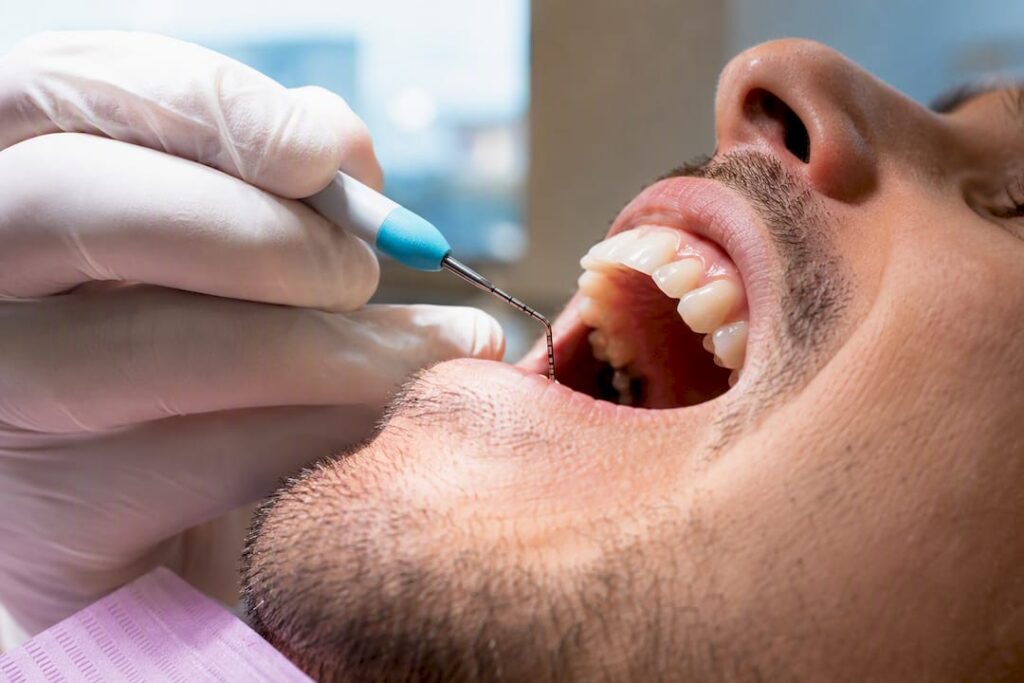
- Probing depth: how far a small measuring instrument slides into the space between your tooth and gum. Healthy pockets measure 1 to 3 millimeters; anything deeper signals attachment loss.
- Clinical attachment level (CAL): the total distance the gum tissue has detached from the tooth, which is the core number used to assign a stage.
- Radiographic bone loss (RBL): measured as a percentage on X-rays, using thresholds at the coronal third, mid-third, and apical third of the root.
- Tooth loss: teeth already lost to periodontal disease count toward the overall severity picture.
- Complexity factors: furcation involvement, tooth mobility, and bite collapse can push a case up a stage even when raw bone-loss percentage looks moderate, because these factors make treatment genuinely harder.
Grading works differently. Clinicians prefer direct evidence of progression, like comparing X-rays taken five years apart, but they’ll use indirect estimates, such as percentage of bone loss relative to age, when older records don’t exist. Risk factors like smoking and uncontrolled diabetes shift the grade upward regardless of what the bone loss alone shows.
Symptoms of periodontal disease and why early damage hides
Bleeding gums are the symptom most people notice first, but they’re far from the only one. Bad breath that doesn’t go away, gums that appear to be pulling back from your teeth, teeth that feel loose, and visible pus around the gumline are all signs worth acting on.
- Gums that bleed during brushing or flossing
- Persistent bad breath or a bad taste
- Gum recession that makes teeth look longer
- Loose or shifting teeth
- Pus or swelling around the gumline
Here’s the uncomfortable part: early periodontitis often causes no pain at all. Bone loss can be well underway before you feel anything different. That’s why probing depths and X-rays matter more than how your mouth feels day to day, and it’s the main reason routine exams catch problems that patients miss entirely. People managing diabetes, smokers, and anyone with an immune condition should know their disease can progress faster and present less obviously than the textbook pattern.
Treatment options at each stage of gum disease
Treatment for periodontal disease isn’t one-size-fits-all. It’s matched to where you fall on the staging scale, and the jump in intensity between stages is bigger than most patients expect.
- Gingivitis: a professional cleaning to remove plaque and tartar, followed by better brushing and interdental cleaning at home. A short-term follow-up visit confirms the gums have actually healed.
- Stage I and II: scaling and root planing, a deeper cleaning below the gumline, sometimes paired with localized antimicrobial treatment. Maintenance visits become more frequent, often every three to four months instead of twice a year.
- Stage III and IV: non-surgical therapy remains the first step, but surgery, bone or tissue regeneration, and in some cases extraction followed by prosthetic rehabilitation become likely. This is where full-arch or single-tooth implant options often enter the conversation.
Pro Tip: Don’t judge your progress by how your gums feel. Bleeding can stop even while pockets stay deep, which is exactly why your dentist keeps remeasuring instead of just asking how you feel.
Whatever stage you’re treated at, periodontal maintenance doesn’t end once symptoms calm down. Periodontitis stays managed, not cured, which means the cleaning schedule you’re given after treatment is really a lifelong plan for keeping the disease from creeping back.
Prevention and when to book a dental visit
Daily habits do most of the heavy lifting: brushing twice a day, cleaning between your teeth once a day, and using a fluoride toothpaste. Layer that with professional cleanings on a schedule matched to your personal risk, more often if you smoke, have diabetes, or have already been diagnosed with periodontitis.
- Bleeding gums that don’t improve within a week or two of better brushing
- Bad breath that persists despite good hygiene
- Teeth that feel loose or a bite that suddenly feels different
Any of those warrants a visit sooner rather than at your next scheduled checkup.
How modern diagnostics sharpen the diagnosis
Complete Dental Care uses 3D imaging and digital scanning to map bone loss with more precision than a standard X-ray allows, which clarifies both stage and prosthetic needs when rehabilitation is on the table. Every plan gets walked through with the patient, sedation options included, before treatment starts. Maintenance visits stay part of the plan long after the initial procedure.

A note on working with your dental team
Bring your full medical history to your exam, including medications and conditions like diabetes. Ask questions. Staging and grading only work well when your dentist has the full picture, and follow-up visits are where long-term success actually gets decided.
— Complete Dental Care
Ready to find out where you stand?
Bleeding gums and loose teeth don’t fix themselves, and waiting usually means a higher stage by the time you get checked. Treatment plans can be built around actual staging and grading results, using digital scanning and 3D imaging to see bone loss clearly instead of guessing from a flat X-ray.

If periodontal disease has already cost you teeth or left you facing extensive rehabilitation, surgical implant dentistry can restore both function and confidence, planned around your specific bone structure rather than a generic template. For earlier-stage concerns, visit Complete Dental Care to schedule a periodontal exam and get a clear read on exactly where your gums stand today.
Sources
- Oral health: fast facts about gum disease | CDC
- Periodontal Disease overview | NCBI Bookshelf (StatPearls / NBK554590)
- Periodontitis – Symptoms and causes | Mayo Clinic
- Consensus report (Workgroup 2) — EFP: Staging and grading framework (Journal of Clinical Periodontology)
This article is general information, not a substitute for advice from a qualified doctor. Consult a qualified healthcare professional about your own circumstances before acting on anything here.
FAQ
What will a dentist do for periodontal disease?
Treatment depends on stage: a professional cleaning for gingivitis, scaling and root planing for early to moderate periodontitis, and surgery, regeneration, or extraction with prosthetic rehabilitation for advanced cases.
Is gum disease curable?
Gingivitis is fully reversible with treatment and better home care, but periodontitis is not curable once bone loss occurs. It can only be managed and kept from progressing further.
How should I clean my teeth if I have periodontal disease?
Brush twice daily, clean between teeth daily, and follow the professional maintenance schedule your dentist sets, often every three to four months for periodontitis patients instead of the standard twice-yearly cleaning.
What are the symptoms of periodontal disease?
Common signs include bleeding gums, persistent bad breath, gum recession, loose teeth, and pus around the gumline, though early-stage disease frequently causes no noticeable symptoms at all.