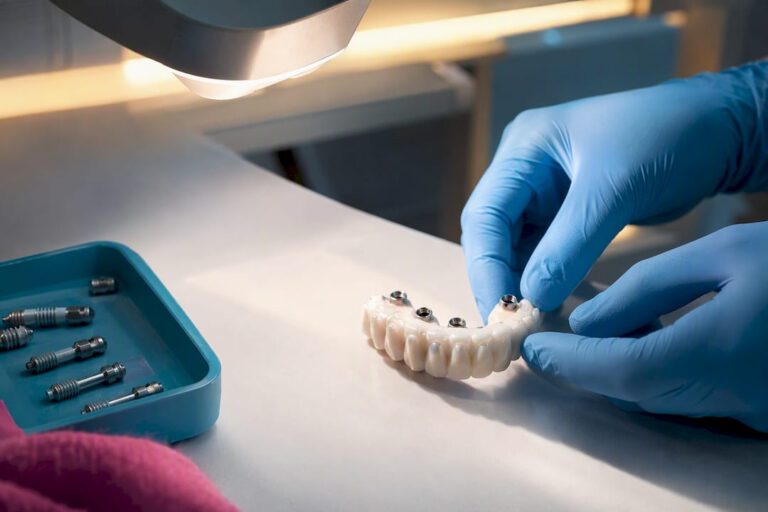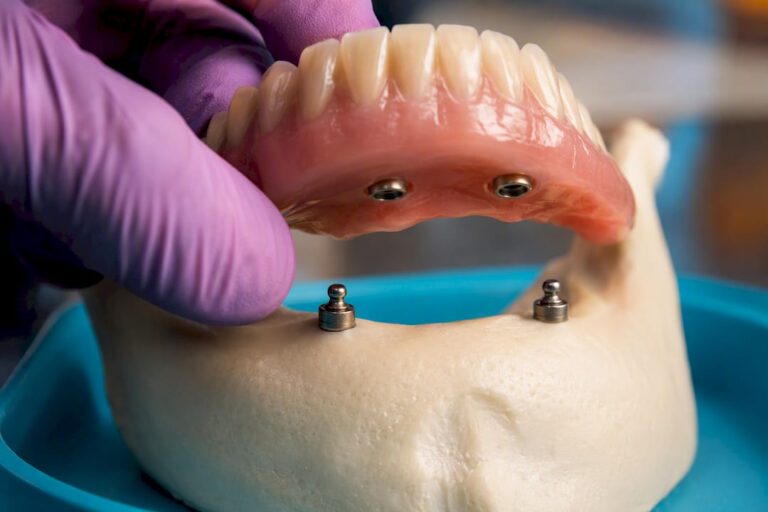
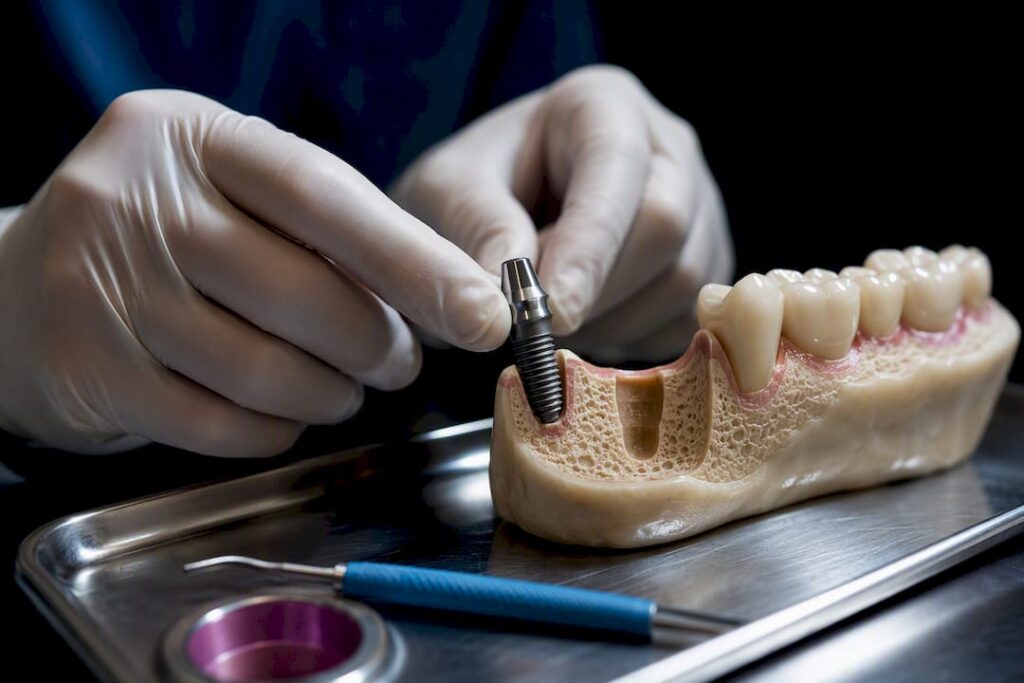
Having gum disease does not permanently disqualify you from dental implants, but implants only get the green light after periodontal disease is fully stabilized. Even then, the risk of complications runs higher than it does for patients with healthy gums, and that risk stays elevated for life without disciplined maintenance. The steps between “I have periodontitis” and “I have a functioning implant” are specific, sequential, and non-negotiable, which is exactly what the rest of this guide walks through.
TL;DR:
- A history of periodontitis increases the risk of peri-implantitis fourfold, making lifelong maintenance and stable gum health essential for implant success.
- Stabilization requires at least six months of healthy gum status after therapy, with imaging and possibly bone grafting before implant placement.
- Signs of peri-implant disease include bleeding, swelling, deep pockets, and bone loss, which require early detection and phased treatment.
- Uncontrolled diabetes, ongoing smoking, severe bone loss, or poor commitment to care often disqualify patients from successful implant outcomes.
questions about this? we're happy to help.
Every patient's situation is a little different. If you want to talk through what this means for you, our Greenville team is one call away.
schedule a free consultationTable of Contents
- How Gum Disease Damages the Support Implants Need
- Getting Implants After Gum Disease: The Stabilization Pathway
- What Peri-Implant Disease Looks Like and How It’s Treated
- Why Supportive Periodontal Therapy Determines Long-Term Success
- How Complete Dental Care Manages Implant Patients With Prior Gum Disease
- When Implants Aren’t the Right Call
- Ready to Talk About Your Implant Options?
- Sources
How Gum Disease Damages the Support Implants Need
Periodontitis destroys the alveolar bone that holds your teeth in place, and that same bone is what an implant depends on for osseointegration. Less bone volume and density means less surface area for the implant to fuse to, which is why a mouth with a history of gum disease often needs bone grafting before anything else happens.
The tissue risk doesn’t disappear once an implant is in, either. Peri-implant mucositis is inflammation confined to the soft tissue around an implant, similar to gingivitis around a natural tooth. Left untreated, it can progress to peri-implantitis, which involves bone loss around the implant itself. Peri-implantitis affects a meaningful share of implant patients overall, but the numbers shift sharply for anyone with a periodontitis history.
The evidence on that shift is stark:
- Patients with treated periodontitis show roughly four times the incidence of peri-implantitis compared to periodontally healthy patients.
- Some cohorts report a notably increased long-term risk of losing the implant entirely.
- The bacteria driving both diseases overlap substantially, so an untreated periodontal pocket elsewhere in the mouth can reseed infection around a new implant.
Statistic to remember: a history of periodontitis roughly quadruples your peri-implantitis risk. That single number is why no responsible clinician places an implant into active gum disease.
Getting Implants After Gum Disease: The Stabilization Pathway
Eligibility isn’t a yes or no question at the first visit. It’s a process, and clinicians follow a fairly consistent sequence before they’ll even discuss implant design.
- Active periodontal therapy removes plaque and calculus below the gumline through scaling and root planing, sometimes paired with antimicrobial treatment.
- Re-evaluation at 4 to 8 weeks checks whether pocket depths have decreased and bleeding on probing has resolved.
- Stabilization confirmation requires sustained improvement, and clinical guidance often calls for at least six months of stable gum health before implant placement.
- Imaging and planning, typically 3D cone-beam scans, map remaining bone volume and flag whether grafting or a staged approach is needed.
- Placement, either immediate or delayed depending on bone quality and infection history.
Bone grafting or socket preservation becomes necessary when periodontitis has already eaten away enough alveolar bone that an implant would lack adequate support. Sinus lifts serve a similar purpose in the upper jaw. None of this is optional cosmetic caution; it’s structural.
Pro Tip: If you smoke or manage diabetes, address both before your consultation. Smoking cessation and stable blood sugar meaningfully change how predictably your gums and bone respond to therapy, and clinicians will often ask you to demonstrate progress on both before scheduling surgery.
What Peri-Implant Disease Looks Like and How It’s Treated
Once an implant is placed, the warning signs to watch for are specific, and catching them early changes the outcome dramatically.
- Bleeding when you brush or floss around the implant
- Gum tenderness, redness, or swelling that doesn’t resolve
- Deepening pockets around the implant on professional probing
- Pus or a bad taste near the implant site
- Visible bone loss on X-rays, or the implant feeling loose
Implants are harder to decontaminate than natural teeth once disease sets in. The roughened surfaces that help implants integrate with bone also give bacterial biofilm more places to hide, and retained cement or an overcontoured crown emergence profile above 30 degrees can trap plaque exactly where you can’t reach it with a toothbrush.
Treatment follows a phased escalation. Mechanical debridement comes first, often paired with chemical or laser decontamination when mucositis is caught early. If bone loss has already started, surgical regeneration may be attempted, though outcomes there are unpredictable, and the American Academy of Periodontology’s own treatment protocols treat this as an iterative cycle rather than a one-time fix. When the implant becomes hopeless, removal is sometimes the more honest path forward.
Why Supportive Periodontal Therapy Determines Long-Term Success
Maintenance is not a suggestion. It’s the variable that separates implants that last decades from ones that fail within a few years.
A 2026 retrospective study tracking over 3,500 implants found 5-year survival at 98.8% for patients who kept up with regular supportive periodontal therapy, versus 96.3% for those who didn’t. That gap widens over time. Long-term data stretching to 20 years shows patients who comply with maintenance can achieve implant survival close to that of people who never had gum disease, while noncompliant patients face dramatically higher odds of implant loss the longer they go without care.
At each recall visit, typically every 3 to 6 months depending on your individual risk, your dental team checks for:
- Bleeding on probing around each implant
- Pocket depth changes compared to baseline
- Plaque accumulation and home-care effectiveness
- Radiographic bone levels every year or two
Home care matters just as much as the office visit. Interdental brushes or water flossers reach where a regular brush can’t, and quitting smoking or tightening glycemic control does more for implant longevity than almost any product you could buy. A daily cleaning routine built specifically for implants closes the gap between office visits.
How Complete Dental Care Manages Implant Patients With Prior Gum Disease
A history of periodontitis is treated as a planning variable rather than a disqualifier. Implant workups often start with 3D imaging and digital scanning to map bone volume before any surgical decision is made, allowing grafting needs or staging decisions to surface early rather than mid-treatment.
Patients coming in with prior gum disease typically go through:
- Coordinated periodontal stabilization before implant scheduling begins
- A staged treatment plan when bone grafting or sinus lifts are needed
- Clear timeline conversations so patients know what each phase requires
- Sedation and anxiety support for patients who’ve had difficult dental experiences
- Financing conversations up front, before treatment decisions get made
The practice sets realistic expectations rather than rushing candidates who aren’t stabilized yet, and every implant patient leaves with a defined recall schedule instead of a vague “come back if something feels off.”
When Implants Aren’t the Right Call
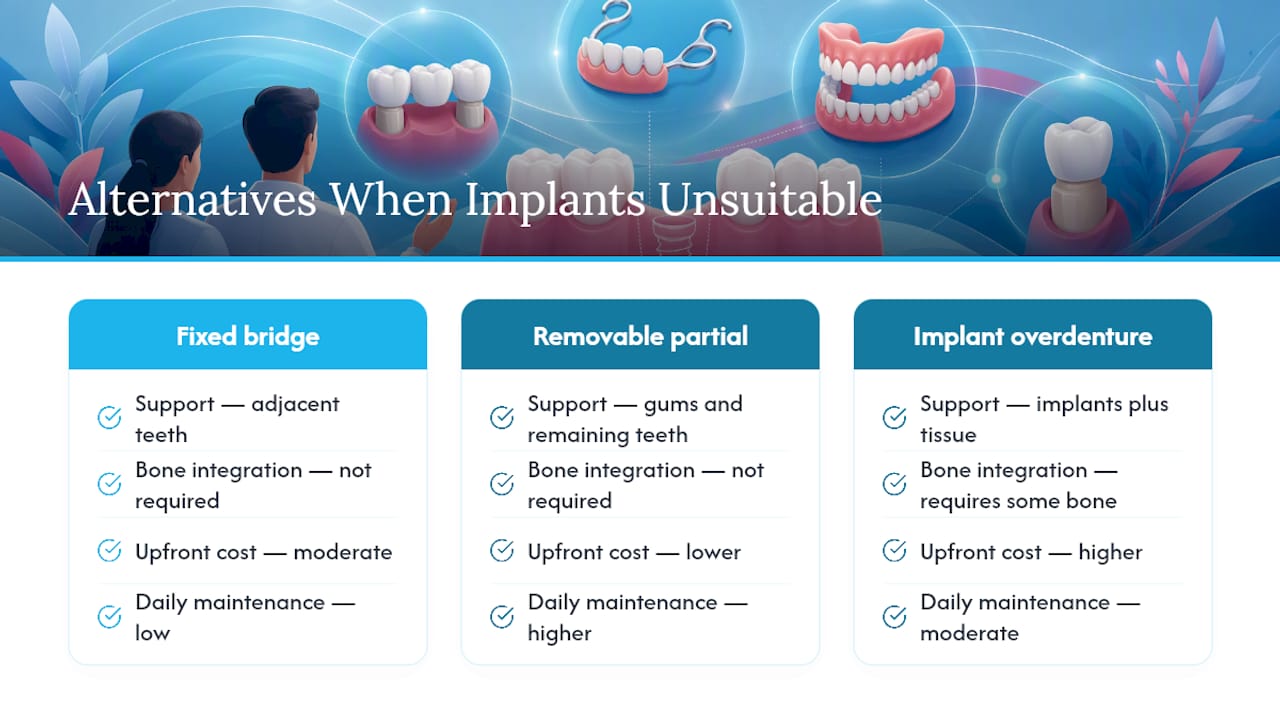
Implants aren’t automatically right for every patient who’s had gum disease treated. Uncontrolled diabetes, active smoking someone won’t address, severe unresolved bone loss, or a patient unwilling to commit to maintenance are all situations where pushing forward on implants sets up predictable failure.
In those cases, a fixed bridge, a well-designed removable partial denture, or an implant-supported overdenture (when at least some bone support remains) can restore function without the same maintenance burden. Bridges rely on adjacent teeth for support and don’t need bone integration. Removable options cost less upfront but require more daily management. The honest sequence is always periodontal health first, restorative choice second. Anyone skipping straight to “which implant should I get” before their gums are stable is asking the wrong question at the wrong time.
— Complete Dental Care
Ready to Talk About Your Implant Options?
If you’ve had gum disease and assumed implants were off the table, that’s usually not the final word. It just means the plan starts with stabilizing your gums, not with picking an implant brand. Complete Dental Care builds that plan around 3D imaging and digital scanning, so bone grafting needs and staging decisions get identified before surgery day, not during it.

A consultation typically starts with your dental and medical history, current periodontal status, and any prior X-rays or scans you can bring. From there, the team maps out whether you need periodontal therapy first, whether grafting fits into the timeline, and what a realistic path to placement looks like. Patients considering full-arch solutions can also ask about Teeth in a Day during that same visit. If cost is a concern, it’s worth reviewing how Medicare handles implant coverage before your appointment so you walk in with real numbers. Schedule a consultation to find out where your gum health stands and what your realistic timeline looks like.
Sources
- History of periodontitis as a risk factor for implant failure and incidence of peri-implantitis: A systematic review, meta-analysis, and trial sequential analysis
- Retrospective study showing maintenance benefit on implant survival (2026)
- Managing peri-implant disease risk — clinical guidance
This article is general information, not a substitute for advice from a qualified doctor. Consult a qualified healthcare professional about your own circumstances before acting on anything here.