

Nitrous oxide sedation is a short-acting, titratable inhaled sedative that reduces dental anxiety and provides mild pain relief while letting patients recover within minutes. It’s the most common form of sedation dentistry precisely because it’s reversible and easy to control. The American Dental Association supports its use when properly administered, and dental teams keep patients under observation before sending them home.
TL;DR:
- Nitrous oxide sedation works best for anxious patients, children, and those with gag reflex issues, but is unsuitable for individuals with severe respiratory or certain medical conditions.
- Proper administration includes pre-oxygenation, careful titration between 30-40% nitrous oxide, and a rapid clearance with oxygen flushing, with safety caps at 70% nitrous oxide.
- Effects typically resolve within minutes after the oxygen flush, allowing most patients to drive home, especially when no other sedatives are used.
- Risks are minimal when used correctly, with mild side effects like nausea or headache, and concerns about B12 deficiency mainly relate to repeated exposure outside clinical settings.
- The real benefit lies in adjustability and quick recovery, making nitrous oxide suitable for short procedures and patients needing controlled sedation.
questions about this? we're happy to help.
Every patient's situation is a little different. If you want to talk through what this means for you, our Greenville team is one call away.
schedule a free consultationTable of Contents
- What Is Nitrous Oxide Sedation and How Does It Work?
- How Dentists Administer Nitrous Oxide Safely
- Who Nitrous Oxide Helps and Who Should Avoid It
- What Nitrous Oxide Does Well, and Where It Falls Short
- Common Side Effects and Rare Risks Worth Knowing
- What to Expect Before, During, and After Your Appointment
- Monitoring Standards and What Makes the Equipment Safe
- Nitrous Oxide for Kids, Pregnancy, and Other Special Cases
- How Fast You Recover and When You Can Drive
- How Complete Dental Care Approaches Sedation and Comfort
- Where to Read More on Nitrous Oxide Safety and Technique
- What Actually Matters When You’re Deciding
- Ready to Talk Sedation Options With Your Dentist?
- Sources
What Is Nitrous Oxide Sedation and How Does It Work?
Nitrous oxide sedation, often called laughing gas sedation, is a mix of nitrous oxide and oxygen delivered through a small nasal hood. It produces anxiolysis (a calming, less anxious state) and mild analgesia rather than unconsciousness, so patients stay awake, breathing on their own, and able to respond to the dentist throughout the procedure.
The gas takes effect fast. Most patients feel the calming effect within three to five minutes of breathing it in, according to Cleveland Clinic. Once the dentist turns off the nitrous oxide and runs pure oxygen for a few minutes, the effects clear from the body almost as quickly as they arrived, usually within several minutes.
That speed is what separates nitrous oxide from other sedation dentistry options. A peer-reviewed review of the technique notes it raises the pain threshold and works well alongside local anesthetic, but it isn’t designed to replace the numbing injection for anything invasive.
Here’s how it stacks up against deeper forms of sedation:
- Nitrous oxide: Conscious the entire time, effects gone in minutes, no needle or IV line required.
- Oral sedation: A pill taken before the appointment, deeper drowsiness, effects can linger for several hours.
- IV sedation: Sedative delivered through a vein, deeper and more adjustable than oral sedation, but recovery takes longer and typically requires a driver.
The depth of sedation is the real distinction. Nitrous oxide sits at the “minimal sedation” end of the spectrum defined by the ADA, while oral and IV options can move into moderate or deep sedation depending on the dose and drug combination.
How Dentists Administer Nitrous Oxide Safely
Administering nitrous oxide follows a predictable, controlled sequence, not a guess-and-check process.
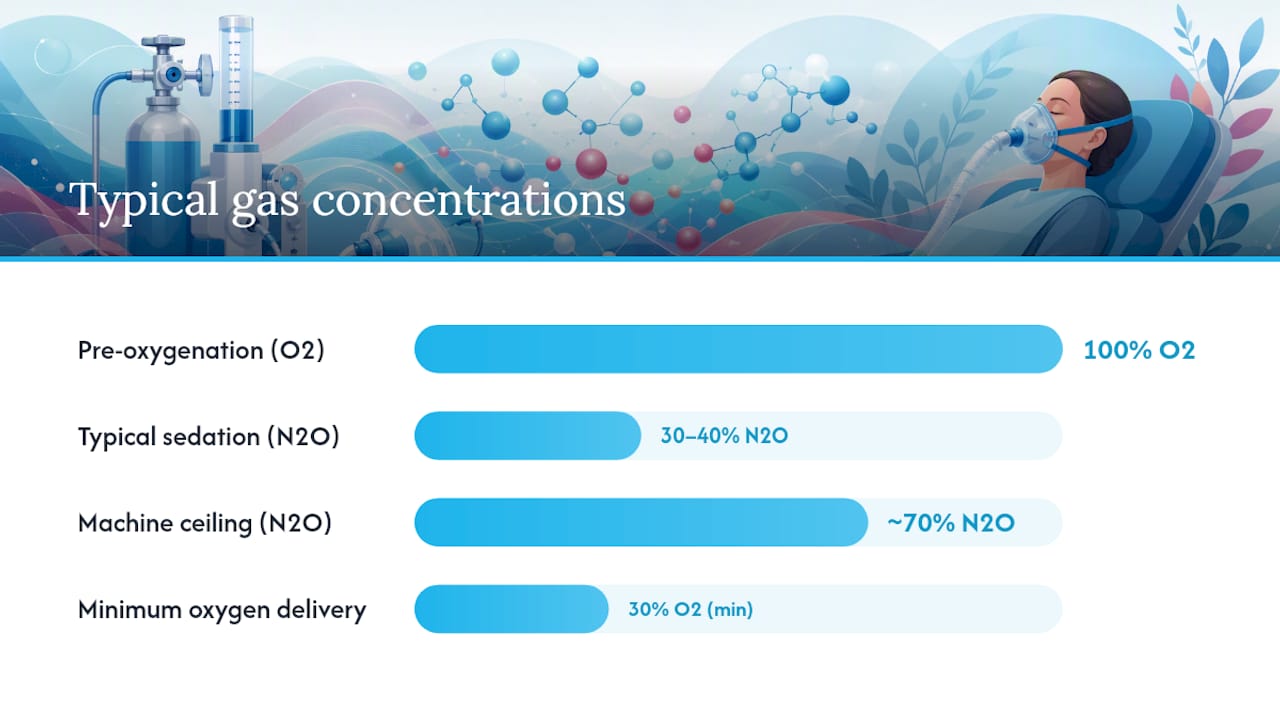
- Pre-oxygenation. The patient breathes 100% oxygen for one to two minutes so the dentist can confirm proper hood fit and airflow.
- Titration begins. Nitrous oxide is introduced in small steps, often around 10% increments, while the dental team watches the reservoir bag and asks how the patient feels.
- Target range reached. Most patients settle into an effective, comfortable sedation level somewhere between 30% and 40% nitrous oxide, according to clinical technique guidance.
- Local anesthetic follows. Once the patient is calm, the dentist administers numbing medication for the actual procedure.
- Oxygen flush at the end. After the work is done, the nitrous oxide is shut off and oxygen flows for several minutes to clear the gas from the system before the hood comes off.
Delivery systems have a built in ceiling. Most units cap out at roughly 70% nitrous oxide to 30% oxygen, and oxygen delivery never drops below that minimum, which is one of the core safety features the ADA points to when it endorses appropriate use of the gas in dental settings.
Scavenging systems, essentially a second layer of suction around the nasal hood, pull excess gas away from the treatment room air rather than letting it accumulate. Combined with routine equipment checks, that scavenging setup is what keeps ambient nitrous oxide levels low for the staff working in that room all day, not just the patient in the chair.
Pro Tip: If you wear contact lenses, mention it before the mask goes on. A poorly sealed nasal hood can dry out your eyes during longer appointments, and the team can adjust the fit or suggest removing lenses beforehand.
Who Nitrous Oxide Helps and Who Should Avoid It
Nitrous oxide sedation tends to work best for people who are anxious about dental visits, kids who need extra calm to sit through a filling, and anyone with a strong gag reflex that makes routine work uncomfortable. It’s also a reasonable fit for minor to moderate procedures where deeper sedation dentistry options would be overkill.
It isn’t right for everyone, though. Talk to your dentist before your appointment if any of the following apply:
- Significant respiratory conditions, including severe COPD or conditions that make nasal breathing difficult.
- Recent middle ear or sinus surgery, since nitrous oxide can affect pressure in closed body spaces.
- Certain vitamin B12 deficiency conditions, where repeated exposure carries added risk.
- Severe psychiatric illness where cooperation or communication during sedation could be compromised.
- Situations where combining nitrous oxide with other sedatives would push past minimal sedation, which the ADA’s sedation policy treats as a different risk category entirely.
A full medical history review at your first visit is what catches most of these issues before they become a problem in the chair.
What Nitrous Oxide Does Well, and Where It Falls Short
The benefits of nitrous oxide come down to speed and control. It kicks in fast, wears off fast, and the dentist can adjust the concentration up or down throughout the visit depending on how the patient is doing. There’s no fasting requirement, no IV line, and no all day drowsiness afterward.
- Fast onset and equally fast recovery, usually within minutes of the oxygen flush.
- Adjustable in real time, so the dentist can dial the dose up or down as needed.
- No needle placement beyond the local anesthetic itself.
- Well suited to children and anxious adults who need help getting through routine care.
The limitation worth understanding up front: nitrous oxide is not a stand in for local anesthetic on anything invasive, and it may not provide enough sedation on its own for long or complex oral surgery. For those cases, oral or IV sedation dentistry options usually make more sense.
Common Side Effects and Rare Risks Worth Knowing
Most people tolerate nitrous oxide sedation with barely any side effects. When they do show up, they’re mild and short-lived: nausea, a mild headache, or a brief lightheaded feeling once the gas takes effect. Adjusting the concentration or slowing the titration usually resolves these within minutes.
Rare complications generally trace back to misuse rather than proper clinical administration. A 2023 review of the technique found no reported deaths tied to properly administered nitrous oxide inhalation sedation, which is a meaningful safety data point given how widely the gas is used.
The bigger nitrous oxide safety concern involves repeated or chronic exposure outside a controlled clinical setting. Recreational misuse, or frequent unsupervised exposure, can oxidize vitamin B12 in the body and lead to neurologic symptoms over time. That’s a very different risk profile than a single dental appointment using properly titrated doses.
Occupational exposure is the other side of the coin. NIOSH research shows that proper ventilation and scavenging can bring ambient nitrous oxide concentrations down to around 25 parts per million during administration, which is the recommended exposure limit for dental staff working around the gas all day.
- Nausea or headache: usually resolves by adjusting concentration.
- Lightheadedness: typically fades within minutes of oxygen flush.
- B12 concerns: relevant mainly with repeated or chronic exposure, not a single visit.
- Staff exposure: managed through scavenging systems and routine equipment maintenance.
What to Expect Before, During, and After Your Appointment
Preparation for nitrous oxide sedation is refreshingly simple compared with other sedation dentistry options. There’s no fasting requirement in most cases, though your dentist may suggest a light meal rather than a heavy one beforehand. The main thing to bring is your full medical history, including any medications, respiratory conditions, or previous reactions to sedation.
- Before the appointment: Disclose your complete health history, including any medications and past sedation experiences, so the team can rule out contraindications.
- Mask placement: The nasal hood is fitted, and pre oxygenation begins before any nitrous oxide is introduced.
- During the procedure: The dentist checks in verbally throughout, adjusting the concentration as needed, and administers local anesthetic once you’re comfortable.
- Oxygen flush: Once treatment wraps up, pure oxygen clears the nitrous oxide from your system over several minutes.
- Observation and discharge: The team confirms you’re alert and steady before you leave, which typically takes only a few extra minutes.
If your visit involves more involved work, like an extraction or implant placement, the same nitrous oxide protocol applies, just alongside a longer local anesthetic plan. Check your insurance details ahead of time if you’re unsure whether sedation is covered under your plan.
Monitoring Standards and What Makes the Equipment Safe
Every step of nitrous oxide administration involves active monitoring, not a set-it-and-forget-it dial. The dental team checks vital signs and responsiveness before starting, watches the reservoir bag and patient reactions throughout, and observes recovery before discharge.
The equipment itself carries built in nitrous oxide safety margins. Delivery systems limit the maximum concentration of nitrous oxide, guarantee a minimum oxygen flow, and include alarms if oxygen delivery drops. The ADA’s guidance on delivery systems specifically calls out these safety features as a reason properly maintained equipment carries a strong track record.
- Continuous verbal check-ins during administration, not just a mask and a timer.
- Reservoir bag observation to confirm proper breathing and gas flow.
- Concentration limits and oxygen minimums built into the delivery hardware itself.
- Scavenging and vacuum systems maintained on a routine schedule.
When a patient’s anxiety or the complexity of a procedure exceeds what minimal sedation can comfortably manage, the right move is referral to a provider trained in moderate or deep sedation, sometimes an anesthesiologist, rather than stacking additional sedatives on top of nitrous oxide.
Pro Tip: Ask your dental team how often their scavenging system is inspected. A well-maintained clinic won’t hesitate to tell you, and it’s a fair question that reflects real occupational safety practice.
Nitrous Oxide for Kids, Pregnancy, and Other Special Cases
Nitrous oxide sedation shows up often in pediatric dentistry because kids frequently need a calmer, more cooperative state to get through fillings or cleanings without distress. The catch is that the technique depends on nasal breathing, so a child with a stuffy nose or difficulty keeping the mouth closed may not get the full benefit.
- Pregnancy: Nitrous oxide is used in some labor and delivery settings, but dental use during pregnancy should be discussed directly with both your dentist and obstetrician first.
- Older adults: Existing respiratory conditions matter more here, so a careful health history review is especially important.
- Repeated exposure: Patients undergoing multiple sedation visits in a short window should flag this, since it ties back to the B12 considerations mentioned earlier.
- Pediatric patients: Works well for most kids, but nasal patency and cooperation affect how well it performs.
How Fast You Recover and When You Can Drive
One of the most practical advantages of nitrous oxide is how quickly it wears off. Most patients clear the effects within minutes once the oxygen flush is complete, and the dental team confirms alertness before letting you go.
- Recovery is typically measured in minutes once oxygen flushing begins.
- Driving after nitrous oxide is usually fine once the team clears you during a short observation period, according to patient guidance from Cleveland Clinic.
- Exceptions apply if nitrous oxide was combined with oral or IV sedatives, which carry their own driving restrictions.
- If your appointment is longer or more involved, plan a little extra time afterward rather than rushing straight to your car.
Compare that to oral or IV sedation dentistry options, which usually come with a firm 24-hour no-driving rule and require a companion to get you home safely.
How Complete Dental Care Approaches Sedation and Comfort
Some dental practices build treatment plans around individual comfort. Advanced imaging and digital scanning can help map out procedures before the appointment, which may reduce surprises and appointment length, benefiting patients with anxiety.
For patients who need extra support, sedation options are discussed as part of a broader anxiety-management conversation, alongside practical tools like comfort dogs in the office. The goal is a calm, well-informed patient who understands exactly what’s happening at each step of their general dentistry care or more involved procedures.
Where to Read More on Nitrous Oxide Safety and Technique
For readers who want the primary sources instead of a summary, the ADA’s guidance on nitrous oxide covers provider standards and delivery-system safety. The peer-reviewed technique review breaks down titration and monitoring in clinical detail. NIOSH’s hazard control page addresses occupational exposure for dental staff specifically.
What Actually Matters When You’re Deciding
The conventional advice on nitrous oxide sedation tends to focus entirely on whether it’s “safe,” as if that’s the only question worth asking. It usually is safe when properly administered, but that framing misses the more useful question: is it the right tool for your specific procedure and anxiety level?
Nitrous oxide’s real strength isn’t that it’s risk-free. It’s that the risk profile is well understood, the effects are short-lived, and the dentist can adjust the dose in real time based on how you’re actually responding, not a fixed plan set before you walked in. That adjustability is what gets undersold in most explainers.
What patients should prioritize first is the conversation about their own medical history, not the gas itself. Respiratory conditions, B12 status, and prior sedation experiences all shape whether nitrous oxide is the right call, and those details only surface if you bring them up before the mask goes on.
— Complete Dental Care
Ready to Talk Sedation Options With Your Dentist?
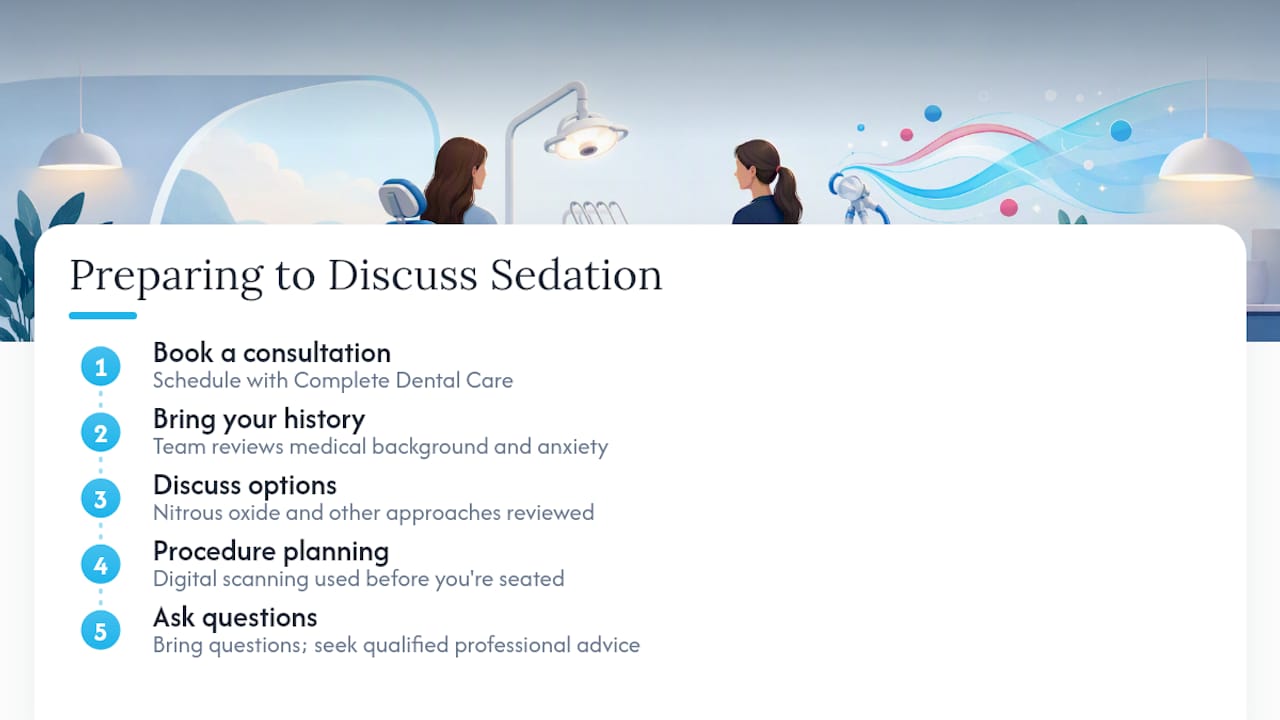
If dental anxiety has kept you from booking the care you need, whether that’s a routine cleaning or something more involved like an implant consultation, some dental practices consider comfort in planning care. Sedation options, including nitrous oxide, may be discussed alongside treatment plans to help manage anxiety.
Because every patient’s history and anxiety level are different, the team reviews your medical background and procedure needs before recommending any sedation approach, including for more involved work like surgical implant dentistry. That same detail-first approach shows up in how the practice uses digital scanning to plan procedures before you’re even in the chair.
If you’re ready to discuss whether nitrous oxide or another sedation option fits your next visit, schedule a consultation with Complete Dental Care and bring your questions with you.
This article is general information, not a substitute for advice from a qualified doctor. Consult a qualified healthcare professional about your own circumstances before acting on anything here.
Sources
- Nitrous Oxide | American Dental Association
- Nitrous Oxide Inhalation Sedation Rapid Analgesia in Dentistry: An Overview of Technique, Objectives, Indications, Advantages, Monitoring, and Safety Profile
- Nitrous Oxide (Laughing Gas): Uses, Side Effects & Safety