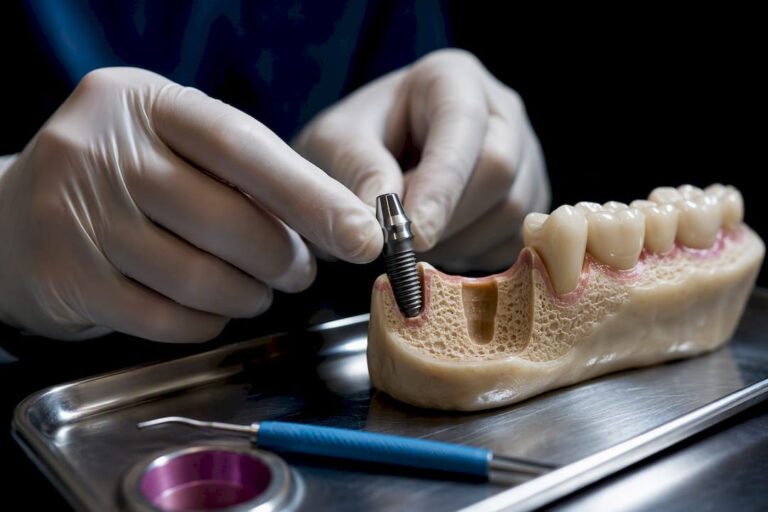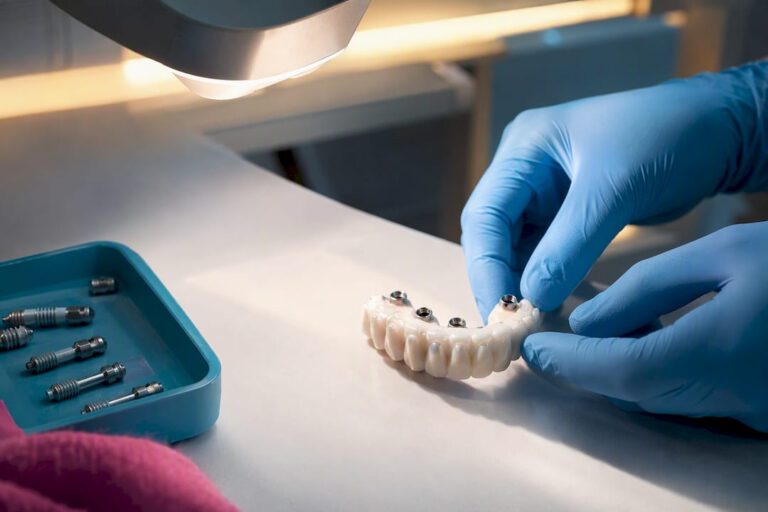
Same-day implants let a well-qualified patient walk out with a fixed tooth on the same visit the implant goes in, but that tooth is almost always a temporary, not the final crown. The real work, osseointegration, still takes months. Success hinges on two things: CBCT-based digital planning and disciplined candidate selection, not marketing language.
TL;DR:
- Successful same-day implants require excellent digital planning and careful patient selection, especially in low-risk, well-vascularized sites.
- The procedure is mainly suitable for anterior single-tooth replacements and full-arch cases with sufficient stability and bone volume.
- Patients must avoid infection, smoking, uncontrolled diabetes, and heavy grinding to reduce early failure risks within the first six months.
- Osseointegration still takes three to six months, during which proper aftercare and soft diet support long-term success.
- Long-term survival rates near 98.9 percent are reported in carefully selected cases, but results may vary with higher-risk patients.
Table of Contents
- What Same-Day Implants Actually Mean
- The Real Benefits of Getting It Done in a Day
- Who Qualifies, and Where It Goes Wrong
- What Happens During Your Same-Day Visit
- What the Research Actually Supports
- Healing, Aftercare, and What Success Looks Like
- Complete Dental Care’s Approach to Same-Day Implants
- Getting Started with Teeth in a Day
- Sources
What Same-Day Implants Actually Mean
Dentists call the true same-day protocol “Type 1A”: the implant goes into the socket immediately after extraction (or into healed bone), and a temporary crown gets attached during that same visit instead of weeks later. That temporary usually isn’t your final tooth. It’s a placeholder shaped and shaded to look right, kept slightly out of biting contact so it doesn’t disturb the implant while the bone fuses around it. The real, lab-fabricated crown comes later, once digital planning and imaging confirm the implant has integrated.
This differs from staged implants, where the socket heals for months before an implant even goes in, followed by more healing before a crown is placed. Same-day approaches show up in two common situations:
- A single front tooth that needs replacing where esthetics matter immediately
- Full-arch cases, where a full set of temporary teeth replaces a failing or missing arch in one visit
Both rely on the same principle: enough bone and stability to support a tooth from day one, even a light-contact one.
The Real Benefits of Getting It Done in a Day
The biggest draw is obvious: you don’t leave the office with a gap, and you skip the removable flipper or partial that staged patients often wear during healing. For anterior cases especially, keeping the socket occupied right after extraction can help preserve the gum and bone contour around the tooth, since collapsed soft tissue is much harder to rebuild later than to maintain.
Fewer visits matters more than people expect. A staged full-arch case can mean four or five separate appointments over the better part of a year; a same-day protocol compresses much of that into one surgical day plus follow-ups.
In well-selected patients, cohort studies report cumulative implant survival rates near 98.9% at three years. That number comes with an asterisk worth remembering: it reflects carefully chosen cases, not everyone who walks through the door.
- No visible gap during healing
- Fewer total appointments
- Better odds of preserving natural gum contour in the front teeth
- Improved day-to-day confidence while the permanent solution finishes forming
Who Qualifies, and Where It Goes Wrong
Same-day implants aren’t a universal option. They work best in low-risk, well-selected sites, and the exclusion list is longer than most marketing pages let on.
- Active infection at the site. Placing an implant into infected bone undermines integration from the start.
- Insufficient bone volume. Without enough bone to achieve primary stability, the implant can’t be loaded immediately, full stop.
- Smoking. Nicotine restricts blood flow to healing tissue and is consistently linked to higher implant failure rates in long-term cohort data.
- Uncontrolled diabetes. Poor glycemic control slows healing and raises infection risk the same way it complicates any surgical procedure.
- Heavy bruxism. Grinding puts forces on a healing implant that even a “light contact” temporary can’t fully absorb.
Most implant failures cluster in the first six months, before osseointegration is complete. If an implant fails early, the standard response is removal, grafting the site if needed, and a healing interval before trying again, which is exactly why the initial screening matters so much.
Anatomy plays a role too. In the front upper jaw, a gap wider than 2mm between the implant and the facial bone wall often needs grafting to get a predictable result, according to the ITI consensus. Patients with periodontal disease at the extraction site face their own set of considerations, which specialist guides on implants and gum disease cover in more depth.
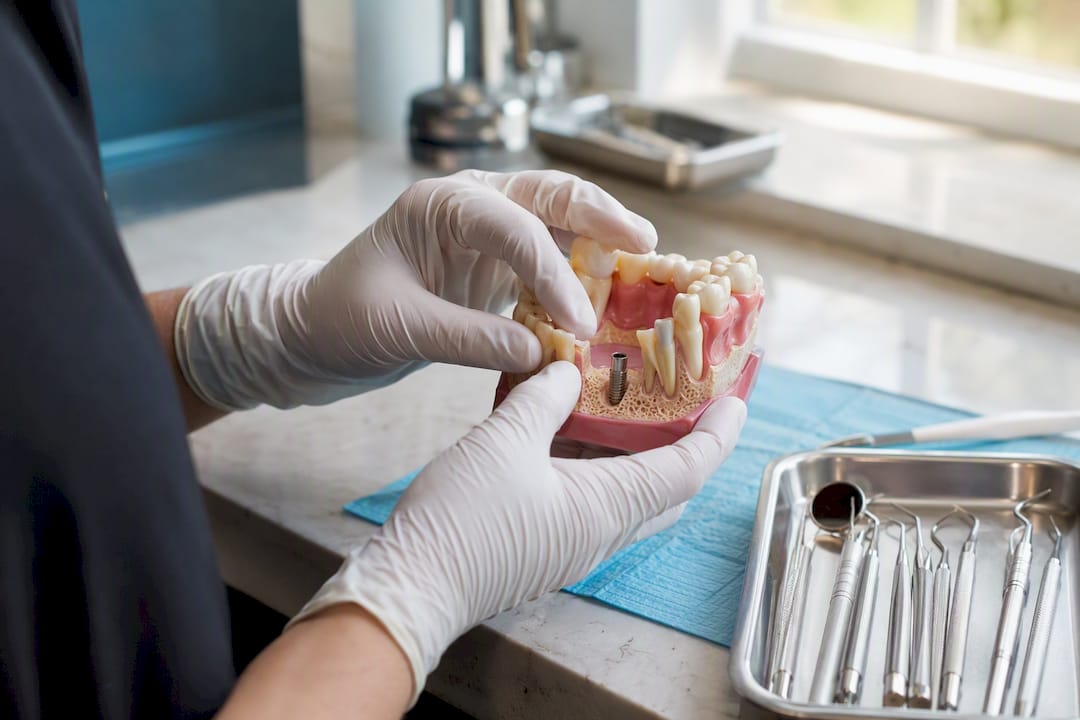
Pro Tip: Ask directly whether your case falls into “low risk” or “medium risk” territory. A borderline site sometimes just needs a staged approach or a small graft first, not a flat no.
What Happens During Your Same-Day Visit
The appointment is longer and more involved than a routine filling, but it follows a predictable sequence.
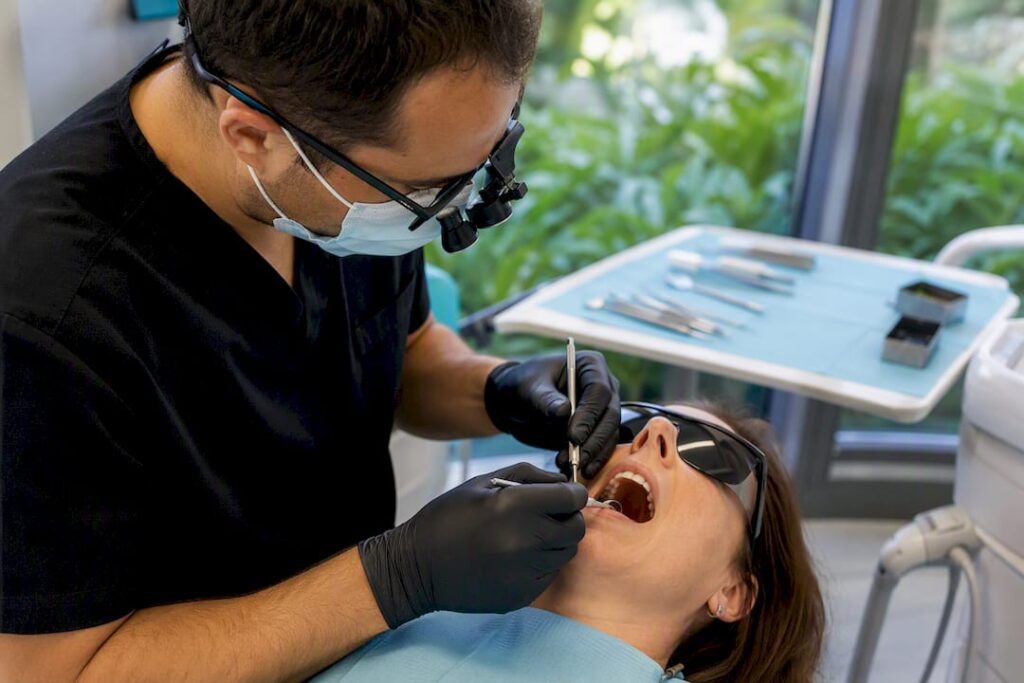
- Pre-op planning. A full medical history review and a CBCT 3D scan map your bone density, nerve position, and sinus location before anyone picks up a drill.
- Digital design. That scan often feeds a surgical guide or a pre-made temporary crown, built ahead of time so it’s ready to attach the same day.
- Extraction, if needed. A failing tooth comes out first, with care taken to preserve as much of the surrounding bone as possible.
- Implant placement. The implant goes into the socket or healed site, and the surgeon checks for primary stability, essentially how firmly it’s holding in the bone right now.
- Temporary attachment. If stability is good, the temporary crown or bridge goes on, adjusted so it sits out of heavy bite contact.
- Contingency plan. If primary stability isn’t there, the surgeon may graft the site and delay loading, placing a healing cap instead and rescheduling the restoration for later.
A single-tooth case might run one to two hours; full-arch cases often take most of a day and typically involve both a surgeon and a restorative dentist working together.
What the Research Actually Supports
The ITI 7th Consensus Conference backs the Type 1A protocol as predictable, but only in carefully selected anterior single-tooth cases, and the panel is explicit that this counts as a complex procedure requiring an experienced surgical and restorative team, not a routine one.
- Digital planning with CBCT reduces surprises during surgery and enables the pre-made temporaries central to same-day workflows
- Large cohort data show strong long-term survival but flag early failure risk concentrated in the months before full integration
- Many published studies favor low-risk sites in their inclusion criteria, so results don’t automatically generalize to every patient
Healing, Aftercare, and What Success Looks Like
Osseointegration, the process where bone actually fuses to the implant surface, typically takes three to six months before the final crown replaces the temporary. What you do during that window matters as much as the surgery itself.
- Stick to a soft diet and avoid biting directly into anything hard or chewy on that side
- Keep the site clean using whatever hygiene routine your dentist demonstrates chairside
- Skip smoking entirely during healing, since it directly slows tissue repair
- Watch for and report swelling, persistent pain, or looseness in the temporary
The American Academy of Periodontology recommends regular follow-up visits so your dentist can confirm stability and healthy surrounding tissue before moving to the final restoration.
Pro Tip: Treat the temporary crown like it’s made of glass for the first few weeks. Patients who ignore the soft-diet instructions are the ones most likely to end up back in the chair early.
Complete Dental Care’s Approach to Same-Day Implants
Complete Dental Care built its full-arch and Teeth in a Day workflows around in-house 3D imaging and digital planning, the same technology behind predictable Type 1A outcomes. Every candidacy decision starts with a real conversation, not a script: what your bone looks like, what your health history means for healing, and whether same-day is genuinely right for you. Patients dealing with dental anxiety have access to comfort supports throughout, because a good outcome depends on you showing up for every follow-up, not just the first visit.
— Complete Dental Care
Getting Started with Teeth in a Day
If your bone and health profile check out, a same-day fixed tooth is one of the more direct paths from a failing smile to a functional one. If they don’t, that’s not a dead end. It just means a short staged plan gets you to the same result more safely.
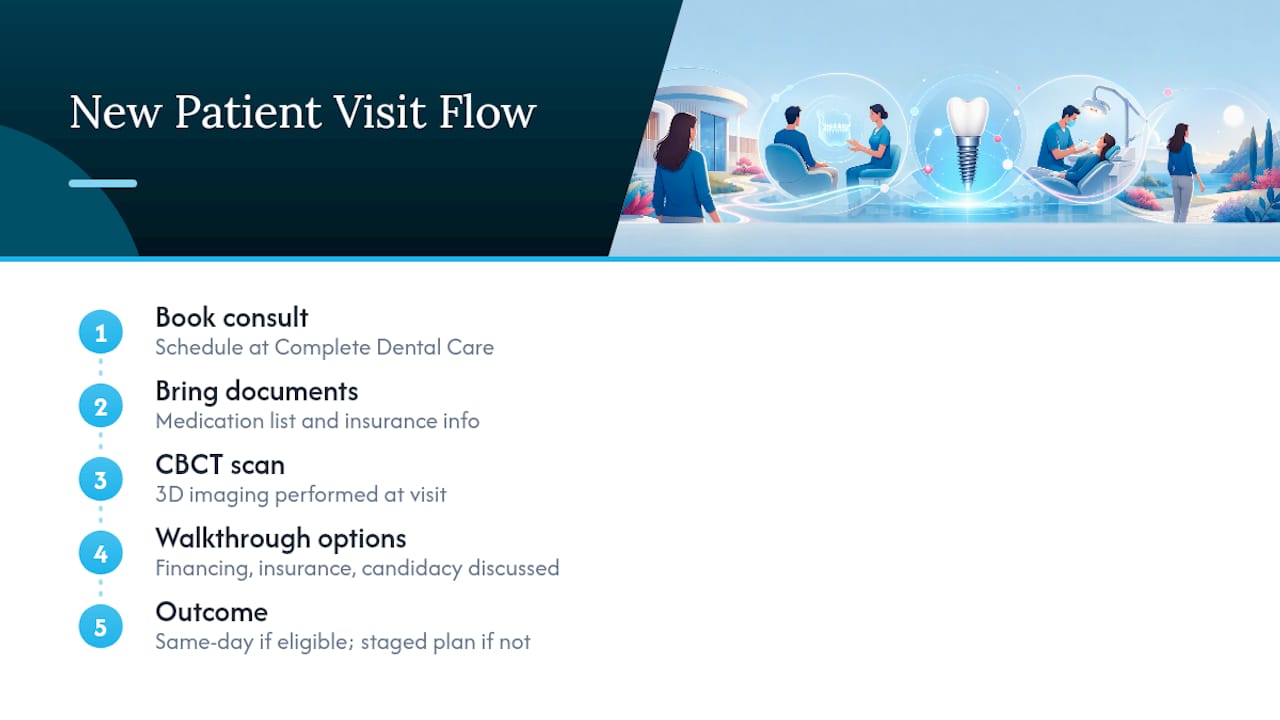
A consult at Complete Dental Care starts with a CBCT scan and a straightforward walkthrough of your options, including financing and how your insurance applies. Bring a list of current medications and your insurance information, and expect the visit to cover exactly where you stand on candidacy, not a generic sales pitch. Details on what to bring and what happens first are laid out on the new patient visit guide.
The Teeth in a Day service page breaks down what full-arch same-day treatment involves at Complete Dental Care, and the surgical implant dentistry page covers the clinical side, including grafting options for patients who need a staged approach instead. If you’re ready to find out which category you fall into, book a consult and get a real answer instead of a guess.
This article is general information, not a substitute for advice from a qualified doctor. Consult a qualified healthcare professional about your own circumstances before acting on anything here.
Sources
- PMCID: PMC9076344 — (article on digital planning and immediate implants)
- Group 5 ITI Consensus Report: Implant placement and loading protocols
- Long term clinical performance of 10,871 dental implants with up to 22 years of follow-up
- American Academy of Periodontology — Dental implant procedures (patient information)