3D printed dentures are a clinically viable option for many patients when made with validated materials and an experienced clinical workflow. Three things are worth knowing before your next appointment:
- Speed and cost: Digital workflows typically reduce the number of appointments and can lower lab costs compared to conventional methods, though price varies widely by clinic, material, and whether the prosthesis is interim or definitive.
- Fit and accuracy: Intaglio (tissue-side) fit is often comparable to conventional dentures and can rival milled devices when scan quality and postprocessing are done correctly.
- Evidence caveats: Outcomes depend heavily on the printer-resin system used and the postprocessing protocol followed. Long-term durability data are still limited, and milled dentures currently show superior flexural strength in most pooled comparisons.
The single most important clinical next step: ask your dentist specifically which printer-resin system they use, whether it follows a manufacturer-validated workflow, and how many try-in appointments are included before final delivery.
Key Takeaways
3D printed dentures are clinically viable for interim and immediate use when made with a validated printer-resin system and proper postprocessing, but long-term definitive performance still lags behind milled options in flexural strength and esthetic stability.
| Point | Details |
|---|---|
| Best current use case | Printed dentures excel as interim, immediate, or baseplate prostheses; definitive use requires validated materials and careful case selection. |
| Milled vs. printed strength | Milled dentures typically show higher flexural strength in pooled comparisons; ask your dentist which fabrication method fits your bite load. |
| Digital record advantage | Stored digital files allow faster, lower-cost remakes without a full restart, a meaningful benefit for future replacements. |
| Key questions to ask | Confirm the printer-resin system is manufacturer-validated, that a try-in is included, and that your file will be archived after delivery. |
| Complete Dental Care’s approach | The practice uses validated digital workflows for interim and diagnostic cases and recommends full-arch implant solutions when long-term fixed results are the goal. |
Table of Contents
- What are 3D printed dentures, exactly?
- How are dentures 3D printed? A step-by-step workflow
- What materials are used in printed dentures?
- What are the real benefits and trade-offs?
- How do 3D printed dentures compare with milled and conventional options?
- What do 3D printed dentures cost, and how long do they last?
- Who is a good candidate for 3D printed dentures?
- What does the clinical evidence actually show?
- How do you care for and repair 3D printed dentures?
- Questions to ask your dentist before getting 3D printed dentures
- When does Complete Dental Care recommend 3D printed dentures over other options?
- Full-arch implant solutions at Complete Dental Care
- Sources
What are 3D printed dentures, exactly?
The term “3D printed dentures” refers to complete or partial removable dental prostheses fabricated through additive manufacturing, meaning material is built up layer by layer from a digital file rather than carved from a block (milling) or shaped by hand. In clinical settings, the broader term is digital dentures, which covers any prosthesis designed with CAD (computer-aided design) software and fabricated digitally, whether printed or milled.
Monolithic vs. split construction is the first distinction worth understanding. A monolithic printed denture is a single piece: the base and the teeth are printed together from one resin, usually in a tooth-shade color. A split (or two-part) denture prints the base and the artificial teeth separately, then bonds them together. Split designs allow the clinician to use a higher-quality tooth resin for esthetics and a tougher base resin for structural support, but the bond between the two parts is a known failure point.
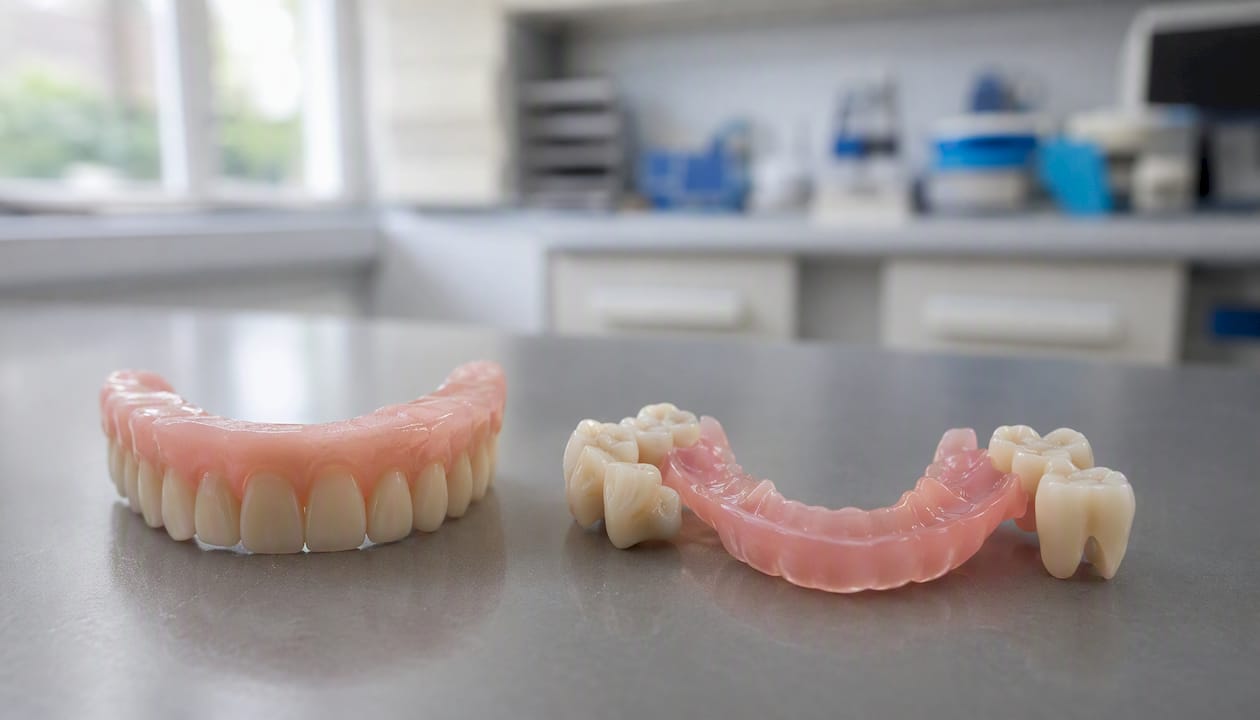
The second distinction is interim vs. definitive use. Immediate or interim dentures are placed right after extractions or as a temporary prosthesis while tissues heal. Printed dentures are particularly well-suited here because the digital file can be produced quickly and replaced as the ridge changes shape. Definitive dentures are meant to be the long-term solution, and this is where the evidence for printed devices is still catching up to milled and conventional options.
How are dentures 3D printed? A step-by-step workflow
The process from first appointment to final delivery typically unfolds across two to four visits, depending on the clinic’s workflow and whether try-ins are included.
- Data capture. The dentist takes a digital impression using an intraoral scanner or digitizes a conventional impression. Scan accuracy at this step directly determines how well the finished prosthesis fits the tissue surface.
- Bite and jaw registration. The vertical dimension of occlusion (how far apart your jaws are when biting) and the relationship between upper and lower jaws are recorded. This is often done with a printed baseplate and wax rim, or with a digital bite registration device. A multi-center clinical trial published in the British Dental Journal found that printed baseplates are particularly useful at this stage, even in workflows that ultimately use conventional or milled final prostheses.
- CAD setup and tooth arrangement. A dental technician or the dentist uses software to arrange virtual teeth on the digital model, set the occlusal plane, and design the denture base contours. This step is where esthetic decisions are made.
- Printing. The file is sent to a dental 3D printer. Most clinical-grade systems use stereolithography (SLA) or digital light processing (DLP), which cure liquid photopolymer resin layer by layer using UV light. Layer height choices often favor a finer resolution for higher accuracy or a coarser one for faster throughput, which affect both the intaglio surface quality and the print time.
- Post-processing. Printed parts are washed in isopropyl alcohol or a proprietary solvent to remove uncured resin, then placed in a post-cure unit under UV light for a specified time. Skipping or shortening this step is one of the most common causes of surface porosity, color instability, and reduced strength.
- Finishing and polishing. The prosthesis is trimmed, polished, and in split workflows, the teeth are bonded to the base using a product-specific adhesive protocol.
- Try-in and adjustment. The patient wears the prosthesis so the dentist can check fit, occlusion, esthetics, and phonetics. Adjustments are made chairside. Even in fully digital workflows, this appointment is not optional.
Pro Tip: Bring your current denture (if you have one) and a photo of your natural smile to the try-in appointment. Both give the technician reference points for tooth position and esthetic goals that no scan can fully capture.
The expert consensus published in the International Journal of Oral Science is direct on this point: the quality of the clinical data captured in steps 1 and 2 matters more than the printing technology itself. A high-resolution printer cannot compensate for an inaccurate scan or a poorly recorded bite.
What materials are used in printed dentures?
Most printed dentures use vat-polymerized acrylate resins, which are photopolymer liquids cured by UV light. Within that category, there are two main classes:
Denture-base resins are designed for the pink (gingival) portion of the prosthesis. They need to balance flexural strength, fracture toughness, and biocompatibility. Many current formulations are modified PMMA (polymethyl methacrylate) or urethane dimethacrylate blends. The trade-off: porosity from incomplete post-cure can harbor bacteria and reduce long-term color stability.
Tooth-shade resins are used for the occlusal (biting) surfaces or the entire tooth in monolithic designs. These prioritize wear resistance and esthetic translucency. In split workflows, some clinicians use prefabricated acrylic or composite teeth bonded to a printed base, which sidesteps some of the wear limitations of fully printed tooth surfaces.
Material selection has real mechanical consequences. A review in the Journal of Prosthetic Dentistry found that many printed base materials show lower flexural strength than milled or heat-cured conventional bases, though newer formulations are narrowing that gap in select studies. The key phrase is “select studies”: the performance is material-specific, not universal.
Why does printer-resin pairing matter so much? Each resin has a validated wavelength, exposure time, and post-cure protocol tied to a specific printer. Using a resin outside its validated system, or cutting post-cure time, produces a chemically incomplete material with unpredictable mechanical properties. The American Dental Association’s denture resources emphasize following manufacturer-specified postprocessing instructions as a baseline requirement for clinical reliability. FDA clearance for dental resins is material- and indication-specific, so asking your dentist whether the resin used in your prosthesis carries clearance for the intended use is a reasonable question.
What are the real benefits and trade-offs?
What patients typically gain
- Fewer appointments. Digital workflows compress the traditional five-to-six-visit conventional process into two to four visits in many cases.
- Reproducible digital record. Once the file exists, a duplicate or replacement can be fabricated without starting from scratch. For older adults or patients with limited access to care, this is a meaningful practical advantage, as noted in a comprehensive review of digitally fabricated complete dentures.
- Good intaglio fit. Tissue-side accuracy is often comparable to conventional dentures and can be excellent when scan quality is high.
- Fast turnaround for interim prostheses. For immediate dentures placed the same day as extractions, printing allows rapid production without the multi-day lab turnaround of conventional fabrication.
- Lower lab costs in some workflows. Automated fabrication reduces manual labor, which can translate to lower prosthesis costs, though clinic markup varies.
Where the trade-offs show up
- Esthetic limitations in monolithic designs. A single-shade printed denture cannot replicate the depth, translucency, and characterization of hand-layered acrylic or high-quality prefabricated teeth. Patients with high esthetic expectations may be better served by milled or conventional approaches.
- Tooth-base debonding in split workflows. This is the most commonly reported clinical complication. Reliable bonding requires surface roughening of the printed base and strict adherence to the adhesive protocol. Practitioners who skip or abbreviate this step see higher debonding rates.
- Color stability over time. Printed resins are more susceptible to staining and color shift than conventional heat-cured acrylic, particularly when post-cure is incomplete.
- Workflow sensitivity. A poor scan, an incorrect bite registration, or a rushed post-cure can each independently compromise the outcome. The technology amplifies both good clinical technique and bad.
Printed dentures are best used today for custom trays, record bases, immediate or interim prostheses, and cases where a fast digital record is the priority. For definitive, long-term prostheses in patients with high esthetic demands or heavy occlusal loading, milled or conventional options remain the more established choice.
How do 3D printed dentures compare with milled and conventional options?
The three fabrication methods each have a different strength profile. Here is how they stack up across the dimensions that matter most to patients:
| Decision factor | 3D printed | Milled (CAD-CAM) | Conventional (heat-cured) |
|---|---|---|---|
| Best for | Interim, immediate, custom trays, fast digital record | Definitive prostheses, high-strength requirements | Definitive prostheses, high esthetic characterization |
| Typical cost per arch | Often lower lab cost; clinic pricing varies widely | Moderate to high; milling equipment is expensive | Variable; depends on lab and number of visits |
| Expected lifespan | Limited long-term data; interim use well-supported | Comparable to conventional for definitive use | 5–10 years with proper care; established benchmark |
| Fit and comfort | Intaglio fit often good; comfort outcomes mixed in trials | Generally good; comparable to conventional | Established; clinician-dependent |
| Production time | 2–4 appointments; fast lab turnaround | 2–4 appointments; milling adds lab time | 5–6 appointments; longer lab cycle |
| Key risk factor | Material/workflow dependence; debonding in split designs | Equipment cost; resin block availability | Clinician skill; longer chair time |
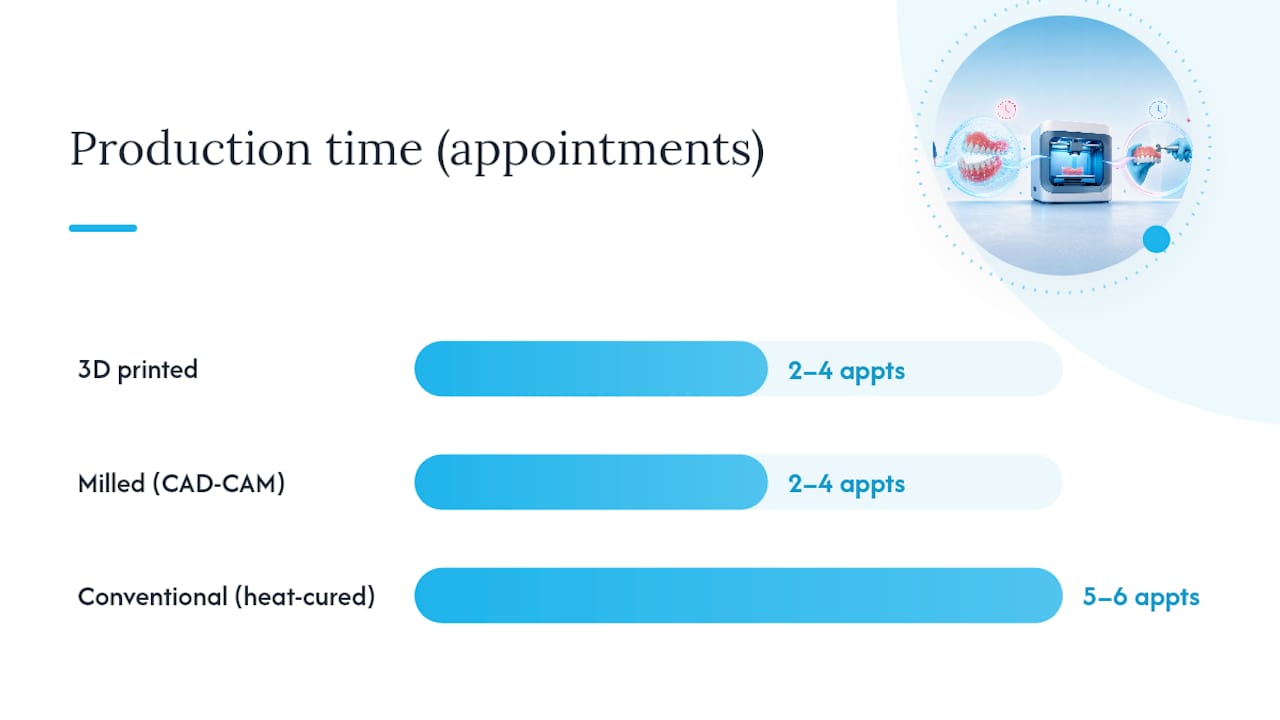
A systematic review and meta-analysis found that digital dentures (milled and printed combined) showed better retention and required fewer appointments than conventional dentures, with no consistent difference in patient-reported quality of life. The comprehensive review cited in PubMed adds the important caveat that milled dentures typically show higher flexural strength in pooled comparisons, which matters most for patients with strong biting forces or a history of prosthesis fracture.
Choosing between them: If you need a prosthesis quickly after extractions, printed is often the fastest and most cost-effective path. If you are planning a definitive prosthesis and have high esthetic expectations or a heavy bite, ask your dentist whether milled or conventional fabrication is more appropriate for your specific case.
What do 3D printed dentures cost, and how long do they last?
Pricing in the U.S. varies enough that any single number is misleading. A printed complete denture per arch can range from roughly $1,000 to $3,500 or more depending on whether the clinic fabricates in-house or sends to a lab, whether the design is monolithic or split, the material quality, and how many appointments are included. Interim printed dentures tend to sit at the lower end of that range; definitive prostheses with higher-quality materials and more clinical visits push toward the top.
What drives the price up:
- Split designs with separate tooth materials and bonding steps
- In-office digital scanning (versus conventional impressions sent to a lab)
- Multiple try-in appointments
- Premium resins with better color stability or strength profiles
- Geographic location and clinic overhead
Whether a plan reimburses for a digitally fabricated denture at the same rate as a conventional one depends on the specific plan language. Ask your insurer whether the CDT code your dentist plans to use (commonly D5110 or D5120 for complete dentures) is covered at the same benefit level regardless of fabrication method. Some plans have not yet updated their fee schedules to distinguish digital from conventional fabrication.
Lifespan: Published estimates for conventional complete dentures typically cite 5–10 years with proper care. For printed dentures, the honest answer is that long-term data are limited. Short-term and interim performance is well-supported in the literature, but there are no large, long-term randomized controlled trials tracking printed definitive dentures over five or more years. The digital record advantage is real: if the file is stored, a replacement can be fabricated faster and at lower cost than starting over from scratch.
Who is a good candidate for 3D printed dentures?
Not every patient is an equally good fit for a printed prosthesis. Here is what clinicians typically evaluate:
- Patients needing immediate or interim dentures. This is the strongest clinical use case. Printed prostheses can be fabricated quickly, placed at the extraction appointment, and replaced as the ridge remodels.
- Patients who want a fast digital record. Anyone who travels frequently, has limited access to dental care, or wants the security of a stored file for future remakes benefits from a digital workflow.
- Patients with adequate ridge anatomy. A well-defined alveolar ridge supports better retention and a more accurate intaglio fit. Severely resorbed ridges may need implant support regardless of fabrication method.
- Implant-supported prosthesis candidates. When implants are placed, a printed overdenture or interim prosthesis can be fabricated to fit the implant positions precisely from the digital plan.
Contraindications and caution cases:
- Severely resorbed ridges without implant support. Retention will be poor regardless of how well the prosthesis fits.
- Heavy bruxers. Until long-term strength data for printed materials are more robust, patients with significant parafunctional habits may be better served by milled or conventional prostheses with established fracture resistance.
- High esthetic demands. Patients who want detailed tooth characterization, custom shading, or lifelike translucency may find monolithic printed options fall short. A split design with quality prefabricated teeth or a milled prosthesis is worth discussing.
- Patients with complex occlusal relationships. Accurate jaw registration is harder in cases with significant vertical dimension loss or temporomandibular joint involvement, and errors at that step propagate through the entire digital workflow.
The expert consensus in the International Journal of Oral Science recommends careful case selection as a prerequisite for reliable digital denture outcomes, not an afterthought.
What does the clinical evidence actually show?
The literature on 3D printed dentures has grown quickly, but it is still maturing. Here is an honest summary of what systematic reviews and clinical trials have found.
Where the evidence is consistent:
Digital dentures (printed and milled combined) reduce the number of clinical appointments and can lower overall costs compared to conventional fabrication. Retention tends to be equal or better than conventional dentures. Patient satisfaction scores are generally comparable across fabrication methods. The comprehensive review published in Materials (MDPI) highlights the reproducibility and digital record benefits as clinically meaningful, particularly for patients who may need future remakes.
Where milled devices still have an edge:
Flexural strength. In most pooled comparisons, milled denture bases outperform printed ones. This is not a minor technical footnote; it affects how likely a prosthesis is to fracture under normal use. The PubMed systematic review is consistent on this point.
The evidence gaps:
Most studies are short-term, use small sample sizes, and test a specific printer-resin combination that may not reflect what your clinic uses. The PMC comprehensive review concludes that 3D printing is clinically viable for dentures but that outcomes are highly material- and workflow-dependent, with postprocessing and bonding protocols critically influencing performance. That conclusion appears consistently across the literature.
Practical takeaway: Ask your clinician which specific printer and resin system they use, whether it is manufacturer-validated for complete dentures, and what their postprocessing protocol looks like. Those three questions will tell you more about your likely outcome than any general statistic.
How do you care for and repair 3D printed dentures?
Printed resin bases require slightly different care than conventional acrylic, and knowing the differences protects both the prosthesis and your tissue health.
Daily cleaning:
- Use a soft-bristle denture brush and a non-abrasive denture cleaner. Standard toothpaste is too abrasive for printed resin surfaces and will scratch them, increasing staining and bacterial adhesion over time.
- Soak overnight in a non-bleach denture soaking solution. Bleach-based products can degrade the resin and accelerate color shift.
- Rinse thoroughly before reinserting. Residual cleaner irritates oral mucosa.
- Avoid ultrasonic cleaners unless your dentist confirms the specific resin is compatible. Some printed materials are damaged by ultrasonic vibration.
Common repairs:
- Tooth-base debonding is the most frequent issue in split printed dentures. A dentist can re-bond the tooth chairside using the appropriate adhesive, but the repair is only reliable if the surfaces are properly prepared. This is not a DIY fix.
- Base fracture is less common than in conventional acrylic but does occur, particularly in monolithic designs under heavy occlusal load. Repair requires the digital file or a new scan; a stored file makes this significantly faster.
When to reline or remake: As the alveolar ridge resorbs over time, the intaglio fit loosens. A reline (adding material to the tissue surface) extends the prosthesis life. With a stored digital record, a remake can often be produced with fewer appointments than the original fabrication.
Pro Tip: Ask your dentist at delivery whether your digital file will be stored and for how long. Some clinics archive files indefinitely; others purge them after a set period. Knowing this upfront lets you plan for future remakes.
Questions to ask your dentist before getting 3D printed dentures
Bring this list to your consultation. The answers will tell you whether the clinic’s workflow matches the clinical evidence.
About the workflow and materials:
- Which printer and resin system do you use, and is it manufacturer-validated for complete dentures?
- Does the resin carry FDA clearance for the intended use (interim vs. definitive)?
- What is your post-cure protocol, and how do you verify it is complete?
About the clinical process:
- How many appointments will I need, and is a try-in included before final delivery?
- Will I receive a printed baseplate for jaw registration, or is that step done conventionally?
- How do you handle adjustments after delivery?
About longevity and cost:
- What is the expected lifespan of this prosthesis for my specific case?
- What is your warranty or repair policy if a tooth debonds or the base fractures?
- Will my digital file be stored, and for how long?
Items to bring:
- Your current denture, if you have one
- Photos of your natural smile (even old ones are useful)
- A list of current medications and known allergies
- Your insurance card and a summary of your major restorative benefits
Red flags: No planned try-in appointment, vague answers about which resin is used, no mention of post-cure validation, and no clear warranty policy are all reasons to ask more questions or seek a second opinion. Visit the Your First Visit page at Complete Dental Care to see what a thorough initial consultation looks like.
When does Complete Dental Care recommend 3D printed dentures over other options?
At Complete Dental Care, the decision to use a printed prosthesis versus a milled or implant-supported solution comes down to what the patient actually needs right now versus what will serve them best long-term. Printed dentures earn their place in specific clinical situations: immediate prostheses placed the same day as extractions, interim devices worn during implant osseointegration, and diagnostic baseplates used to verify jaw registration before committing to a definitive design. In those roles, the speed and reproducibility of 3D dentistry are genuine advantages.
For patients who want a definitive, long-term solution, the practice’s preference leans toward either milled prostheses with validated materials or, when anatomy and health allow, implant-retained full-arch solutions. The reason is straightforward: the long-term strength and esthetic data for printed definitive dentures are still accumulating, and the practice does not want to place a prosthesis that may need replacement sooner than a patient expects.
Every material and workflow used at Complete Dental Care follows manufacturer-validated protocols, including post-cure verification. When a patient’s case involves heavy occlusal loading, significant ridge resorption, or high esthetic expectations, the clinical team will say so directly and recommend the fabrication path that fits the evidence, not just the one that is fastest to produce.
Full-arch implant solutions at Complete Dental Care
Removable printed dentures solve real problems, but they are not the only path to restoring a full arch. For patients whose ridge anatomy, bone volume, or lifestyle makes a fixed solution more appropriate, Complete Dental Care’s full-arch implant services offer a permanent alternative to removable prostheses of any kind.
The practice’s Teeth in a Day protocol places implants and delivers a functional full-arch prosthesis in a single appointment, using the same 3D imaging and digital planning technology that underlies printed denture workflows. Patients who have been managing with loose or ill-fitting removable dentures often find this the more durable, lower-maintenance path. Financing options and insurance coordination are available, and the video library includes procedural walkthroughs for patients who want to see the process before booking. To review your specific options, schedule a consultation at Complete Dental Care in Greenville, TX.
Sources
The following sources were used to build this article. Readers who want to review the original evidence directly can access each one:
- A Review of Current Systems, Materials, and Protocols for 3D‐Printed Splints, Crowns, and Dentures – PMC
- Expert consensus on digital restoration of complete dentures | International Journal of Oral Science
- Assessment of Conventionally and Digitally Fabricated Complete Dentures: A Comprehensive Review
- Current challenges for 3D printing complete dentures: experiences from a multi-centre clinical trial | British Dental Journal
Ask your clinician about any printer- or material-specific FDA clearances relevant to the prosthesis being fabricated for you. Clearance is indication-specific and not universal across all printed dental resins.
This article is general information, not a substitute for advice from a qualified doctor. Consult a qualified healthcare professional about your own circumstances before acting on anything here.