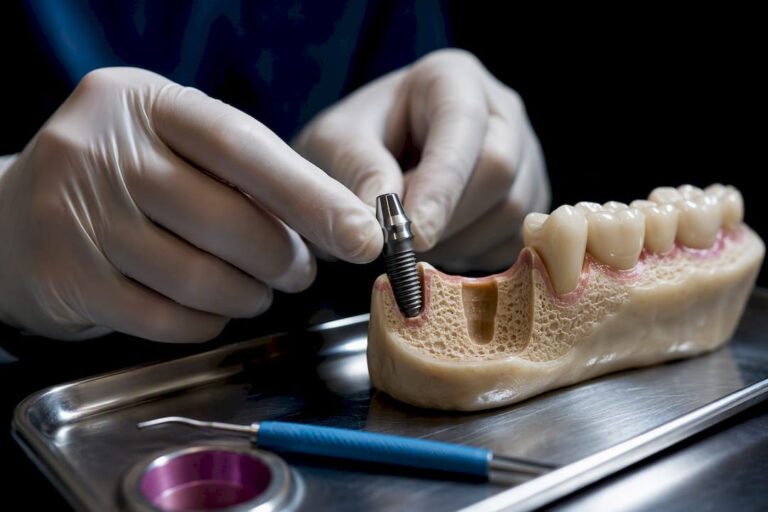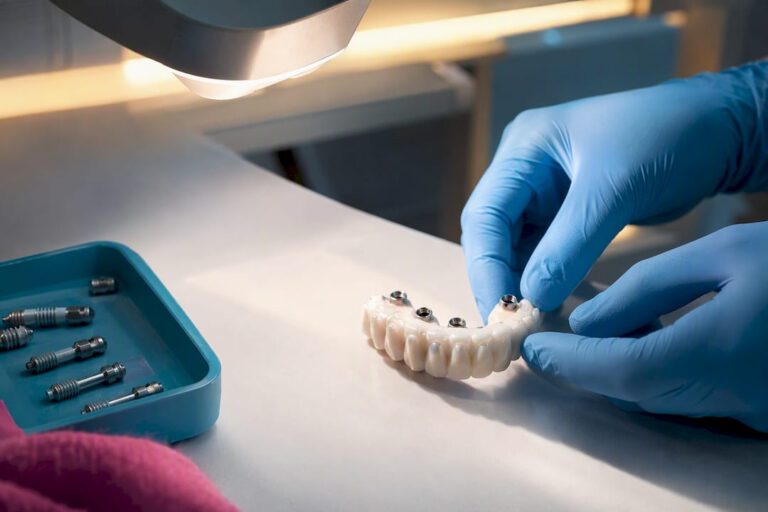
Your HSA can pay for dental implants — but only when the procedure is documented as medically necessary and the expense is not already reimbursed by insurance. That single condition is what separates a clean reimbursement from a taxable distribution.
Before you pay, run through this checklist:
- You are enrolled in a qualifying High-Deductible Health Plan (HDHP) with an active HSA at the time of the expense.
- Your dentist has documented the implant as medically necessary (not cosmetic) per IRS Publication 502 standards.
- The amount you claim from your HSA is not already covered or reimbursed by your dental insurance.
Pro Tip: Keep three documents together from day one: the itemized invoice from your dentist, the Explanation of Benefits (EOB) from your insurer, and a written medical-necessity note from your provider. You will need all three if your HSA custodian or the IRS ever asks.
Key Takeaways
HSAs can pay for dental implants when the procedure is medically necessary, the HSA was open at the time of the expense, and the amount claimed is not already reimbursed by insurance.
| Point | Details |
|---|---|
| Medical necessity is required | Your dentist must document a functional or clinical reason — not cosmetic intent — for the implant. |
| Run insurance first | File your dental claim and wait for the EOB before drawing from your HSA. |
| Keep itemized records | Retain the provider invoice, EOB, proof of payment, and any clinical notes or LMN. |
| HSA beats FSA for multi-stage cases | HSA funds roll over indefinitely; FSA funds often expire at year-end, making HSAs better for phased implant treatment. |
| Complete Dental Care provides documentation support | The practice prepares pre-treatment letters, itemized billing, and imaging exports to support HSA reimbursement. |
Table of Contents
- Can your HSA pay for dental implants? The IRS eligibility test
- Which implant-related costs usually qualify — and which often don’t
- HSA vs FSA vs HRA: which account best covers implant costs?
- How to pay with your HSA and document everything correctly
- What happens if your HSA reimbursement is questioned or denied
- Dentist-ready documentation: a practical template for HSA reimbursement
- A provider’s perspective on helping patients use HSA funds
- Complete Dental Care makes HSA reimbursement straightforward
- Sources
Can your HSA pay for dental implants? The IRS eligibility test
The governing rule comes from IRS Publication 502 and IRC Section 213(d), which define medical and dental expenses eligible for tax-advantaged accounts. Under that definition, qualifying expenses include payments for the prevention and alleviation of dental disease and for treatments that affect the structure or function of the body. Artificial teeth — including implants — fall squarely within that language when they serve a restorative or functional purpose.
The clinical-justification test is straightforward: does the implant restore function, treat disease, prevent bone loss, or repair trauma? If yes, it qualifies. If the sole purpose is cosmetic appearance, it does not.
Four indicators that typically satisfy the medical-necessity standard:
- A missing tooth causing documented chewing difficulty or bite misalignment
- Bone loss that requires grafting to preserve jaw structure
- Tooth loss from trauma, infection, or disease requiring replacement
- A failing tooth whose extraction and replacement are clinically indicated
Here is the contrast in plain terms. A patient who loses a molar to decay, develops bone loss, and receives an implant to restore chewing function — that is a restorative procedure. A patient who requests an implant to replace a tooth that is structurally sound but aesthetically displeasing — that is cosmetic and would not qualify.
The Congressional Research Service notes that while HSA-qualified expenses generally follow IRC Section 213(d) and Publication 502, individual plan administrators may apply stricter rules. Always confirm with your HSA custodian before assuming a procedure qualifies.
Which implant-related costs usually qualify — and which often don’t
Most of the costs in a standard implant case are eligible when the procedure itself is medically necessary. The table below reflects guidance from MetLife and LegalClarity.
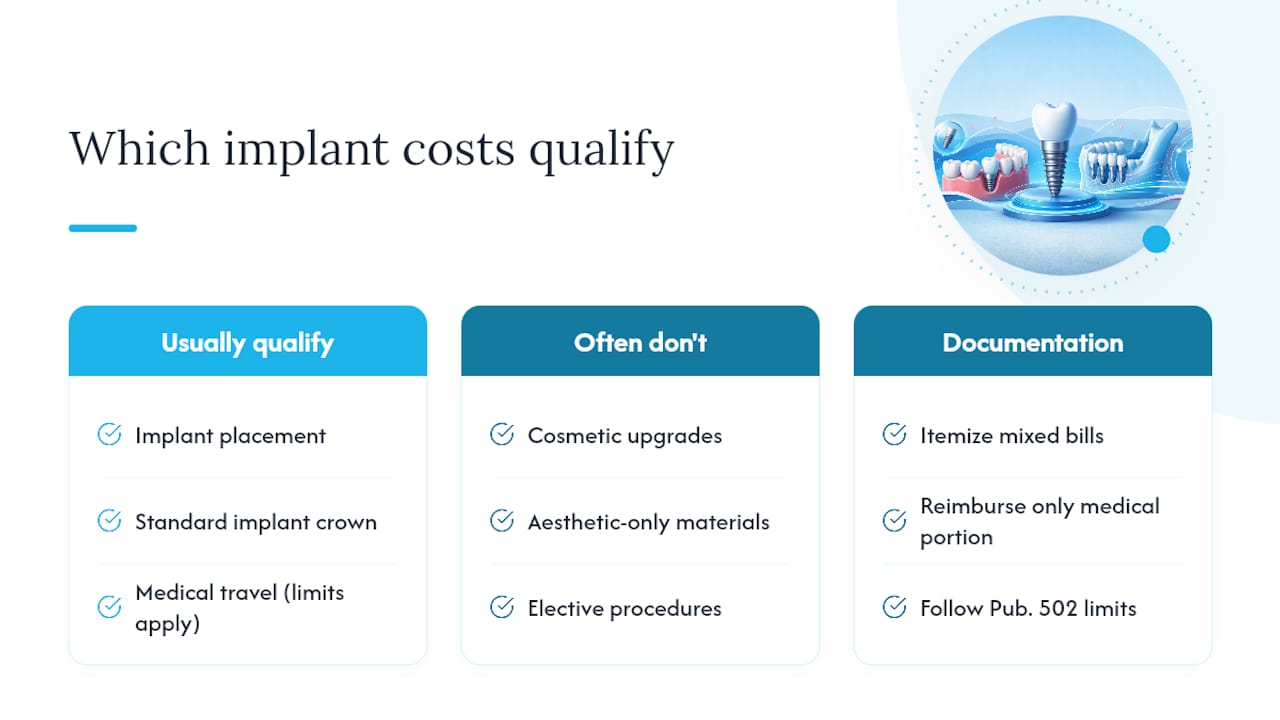
Mixed bills are common. If your treatment plan includes both a standard implant crown (eligible) and an upgraded ceramic material chosen purely for aesthetics (potentially ineligible), ask your dentist to itemize those charges separately. Pay the cosmetic portion with after-tax dollars and reimburse only the medically necessary portion from your HSA.
Medical travel also has a place here. Publication 502 covers rules for travel and lodging when you must travel primarily for medical care, including mileage and lodging limits. If you travel specifically for implant surgery at a specialist’s office, those costs may be eligible up to the limits the publication specifies.
HSA vs FSA vs HRA: which account best covers implant costs?
For a high-cost procedure like implants, the account type matters more than most patients realize.
- HSA: Funds roll over indefinitely, travel with you when you change employers, and can be invested. This makes an HSA the strongest vehicle for planning a multi-stage implant case over 12–18 months. Contribution limits apply annually for self-only and family coverage, with additional catch-up contributions available for older account holders.
- FSA: Most FSAs are use-it-or-lose-it within the plan year (some plans allow a small rollover or grace period). They work for implant costs you can time within the plan year, but they are a poor fit for multi-stage cases that span two calendar years.
- HRA: Employer-funded and employer-controlled. The employer sets which expenses qualify, and some HRA plans exclude certain dental procedures. Check your plan documents before counting on HRA funds for implants.
Pro Tip: Always file your dental insurance claim first and wait for the EOB. Then use your HSA or FSA only for the patient-responsibility amount — the deductible, copay, or coinsurance your insurer did not cover. Paying the full bill from your HSA before the insurer processes the claim creates a documentation headache and risks over-reimbursement.
Fidelity’s guidance reinforces this sequence: run the insurance claim first, then apply benefit-account funds to the remaining balance.
How to pay with your HSA and document everything correctly
You have two options at the point of service: swipe your HSA debit card directly, or pay out of pocket and reimburse yourself later. Both are valid. The critical rule for the second option: your HSA must have been open and active on the date the expense occurred. You cannot open an HSA today and reimburse yourself for an implant placed last year.
Here is the preferred sequence:
- Verify with your dental insurer whether any portion of the implant is covered and request a pre-authorization if your plan requires one.
- Ask your dentist for an itemized treatment plan and a pre-treatment letter of medical necessity before the procedure begins.
- Have the procedure. Collect the itemized provider statement showing each charge by date of service.
- Submit the claim to your dental insurer and wait for the EOB.
- Pay or reimburse yourself from your HSA for the patient-responsibility amount only.
- File IRS Form 8889 with your annual tax return to report HSA distributions.
Documentation your HSA custodian or the IRS may request:
- Itemized provider statement (each service, date, and charge listed separately)
- EOB from your dental insurer showing what was paid and what remains your responsibility
- Proof of payment (HSA debit card receipt or bank statement)
- Clinical notes or letter of medical necessity if the procedure’s eligibility is not obvious
LegalClarity confirms that you can reimburse yourself months or even years after the expense, as long as the HSA was open when the expense occurred and you have kept the documentation.
Pro Tip: Before any non-emergency implant procedure, ask your dentist to write a pre-treatment letter of medical necessity. One page from the provider, written before the procedure, prevents most reimbursement disputes.
What happens if your HSA reimbursement is questioned or denied
The four most common denial reasons:
- Missing or insufficient documentation (no itemized invoice, no EOB)
- Procedure coded or described as cosmetic rather than restorative
- Expense already reimbursed by insurance (double-dipping)
- Expense incurred before the HSA was established
If your claim is denied or questioned, take these steps:
- Contact your plan administrator in writing and request the specific denial reason.
- Gather your itemized invoice, EOB, and clinical notes.
- Ask your dentist for a Letter of Medical Necessity (LMN) if one was not already provided.
- Submit the additional documentation as a formal appeal.
- If the distribution was genuinely a mistake, repaying it to the HSA before the tax filing deadline can avoid the income inclusion and 20% penalty.
Appeal documentation checklist: itemized provider statement, EOB, LMN from the treating dentist, proof of payment, and any CBCT or imaging reports that support medical necessity.
Dentist-ready documentation: a practical template for HSA reimbursement
Clinics that provide thorough, well-organized documentation materially improve the chance of administrative approval. A strong clinical note covers four elements: the clinical problem, objective exam findings, the medical-necessity conclusion, and the planned procedures with dates and codes.
Sample clinical note structure:
- Problem: Patient presents with [missing tooth/failing tooth/bone loss] at [site], causing [chewing difficulty/bite instability/progressive bone resorption].
- Exam findings: [Radiographic evidence of bone loss, periapical pathology, or trauma; probing depths; mobility scores as applicable.]
- Diagnosis: [ICD-10 code, e.g., K08.109 — complete loss of teeth, unspecified cause.]
- Medical necessity: Implant placement is indicated to restore masticatory function, prevent further alveolar bone loss, and maintain adjacent tooth stability. This is a restorative, not cosmetic, procedure.
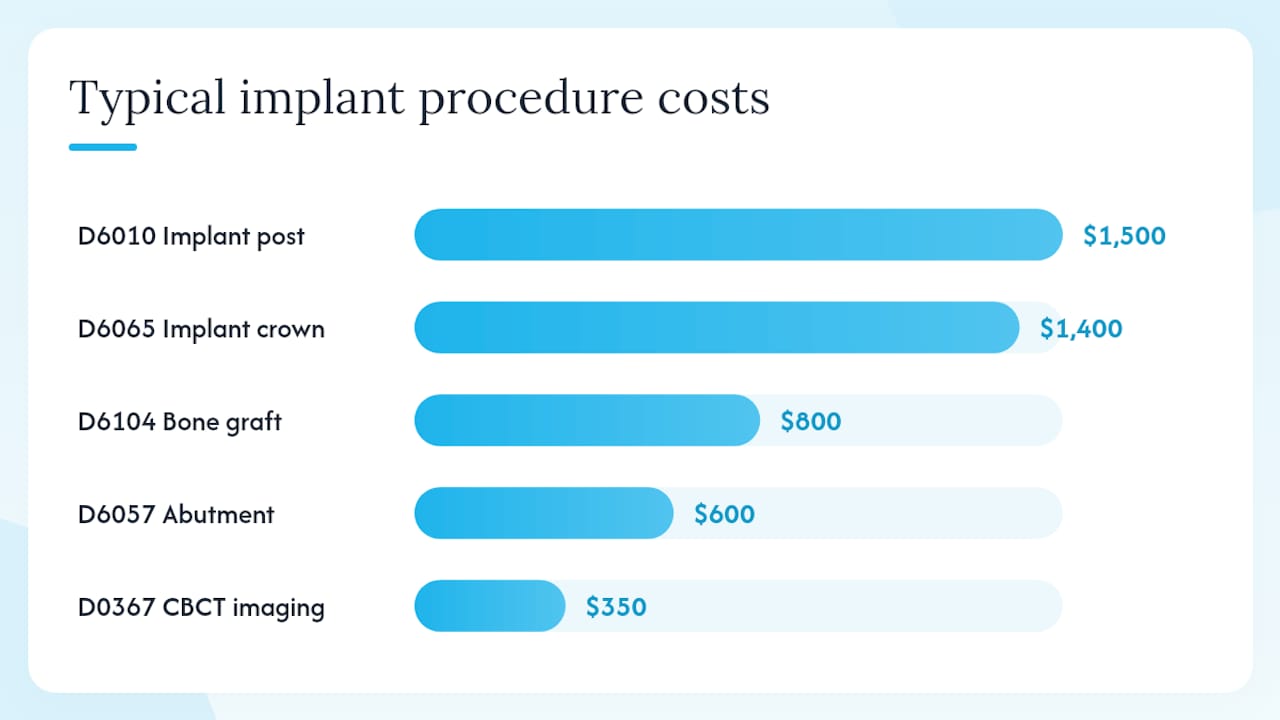
- Planned procedures: [D6010 — surgical placement of implant body; D7310 — alveoloplasty; D6104 — bone graft; D0367 — CBCT imaging; dates and fees listed separately.]
Sample invoice line items:
- D0367 CBCT imaging: $350
- D7140 Extraction: $180
- D6104 Bone graft: $800
- D6010 Implant post (surgical placement): $1,500
- D6057 Abutment: $600
- D6065 Implant crown (porcelain): $1,400
- Anesthesia (IV sedation, per hour): $500
Separating each line item by CDT code lets the patient and the HSA custodian see exactly what was charged and why. For full-arch implant cases, this level of detail is especially useful given the number of procedures involved.
Pro Tip: Dental staff: attach CBCT or intraoral scan images to the documentation package when submitting to an HSA administrator. Imaging is often the single most persuasive evidence for bone graft and implant-placement necessity.
A provider’s perspective on helping patients use HSA funds
The questions patients ask most often are not about the implant itself — they are about the paperwork. Will the HSA cover this? What do I need to bring? Can you write a letter?
At Complete Dental Care, the answer to all three is yes. The practice prepares itemized invoices with CDT codes, writes pre-treatment letters of medical necessity, and exports 3D imaging documentation that patients can submit directly to their HSA custodian. Staff also walk patients through the insurance-first sequence: file the dental claim, receive the EOB, then reimburse from the HSA for whatever the insurer did not cover.
For patients considering dental implants and oral surgery, having that documentation ready before the procedure starts removes the most common obstacle to reimbursement.
Complete Dental Care makes HSA reimbursement straightforward
Patients planning to use HSA funds for implants get more than a procedure at Complete Dental Care — they get the paperwork that makes reimbursement work. The practice provides pre-treatment letters of medical necessity, itemized billing with CDT codes, CBCT imaging exports, and staff support for insurance and EOB coordination. For larger cases like full-arch restorations, the team also discusses financing options that complement HSA balances when the implant cost exceeds what’s currently in the account.
Ready to move forward? Schedule a consultation at Complete Dental Care and ask the front desk for a pre-treatment documentation package. The team will prepare everything your HSA custodian needs before your first procedure date.
Sources
Confirm plan-specific rules with your HSA custodian — the sources below are the authoritative starting points, but individual plan administrators can impose stricter restrictions than IRS guidance alone.
- Can an HSA Be Used for Dental Expenses? | MetLife
- Publication 502, Medical and Dental Expenses
- Health Savings Account (HSA) Qualified Medical Expenses (Congressional Research Service)
- Health savings account (HSA) eligible medical expenses | Fidelity
Your HSA custodian has final say on plan-specific eligibility. When in doubt, submit the dentist’s clinical documentation and request a written determination before the procedure — not after.
This article is general information, not a substitute for advice from a qualified financial advisor. Consult a qualified financial professional about your own circumstances before acting on anything here.