Yes, veneers are a widely used and effective option for many peg lateral incisors when enough enamel and space exist and the case is planned conservatively with a diagnostic mock-up. Strong candidates have healthy enamel, a stable bite, and either adequate room between adjacent teeth or a plan to create that room with orthodontics first. A mock-up that previews shape and proportion before any enamel is touched is what separates a predictable result from a disappointing one.
TL;DR:
- Radiographs should check for missing teeth and impacted canines; one study found opposite lateral incisors absent in 55% of patients with unilateral peg laterals.
- When space is too tight, orthodontics should come first; opening a gap or correcting tooth angle prevents bulky veneers and can reduce bite strain.
- A diagnostic wax up and in mouth mock up let patients approve proportions before enamel removal; choose no prep or minimal prep whenever anatomy allows.
- Feldspathic and lithium disilicate veneers showed about 96% survival at roughly 10 years, while fracture and debonding remained common failures.
- Composite bonding costs less per tooth than porcelain and preserves enamel for small changes, but it stains and wears faster over time.
questions about this? we're happy to help.
Every patient's situation is a little different. If you want to talk through what this means for you, our Greenville team is one call away.
schedule a free consultationTable of Contents
- What Are Peg Lateral Incisors and How Common Are They
- Can Veneers Fix Peg Laterals: Candidacy and When to Be Cautious
- Why Peg Laterals Develop and What a Full Exam Checks
- Proportion, Measurement, and the Diagnostic Mock-Up
- Do You Need Orthodontics Before Veneers?
- Veneer Types and Materials for Peg Laterals
- Step-by-Step: The Clinical Workflow for Peg Lateral Veneers
- Longevity, Maintenance, and Common Complications
- Cost and Practical Considerations
- Conservative Alternatives to Veneers
- How We Approach Peg Lateral Veneer Planning
- Ready to Explore Veneers for Your Peg Laterals
- FAQ
- Sources
What Are Peg Lateral Incisors and How Common Are They
Peg laterals are upper lateral incisors that develop smaller and more conical than their neighbors, often tapering toward the biting edge instead of having the normal rectangular shape. The condition stems from a developmental variation in tooth formation and shows up most often in the two teeth flanking the upper front teeth.
Peg-shaped maxillary lateral incisors occur in roughly 1.72% to 1.8% of the general population, with a higher occurrence in women and in certain populations, reaching up to 3.1% in some groups and in orthodontic patients specifically.
A few things tend to travel with peg laterals and matter for treatment planning:
- Missing or absent teeth on the same side of the mouth, including the second lateral incisor itself in some cases.
- Displaced or impacted canines, since the canine’s eruption path is often guided by the lateral incisor next to it.
- Uneven spacing across the front teeth that shows up only once the peg lateral’s small size is addressed.
Can Veneers Fix Peg Laterals: Candidacy and When to Be Cautious
Veneers work well on peg laterals when the underlying tooth has enough sound enamel to bond to and when there is either natural space or an orthodontic plan to create it. Good candidates typically want a modest size and shape correction rather than a dramatic change, and they have healthy gums and a bite that will not overload a thin restoration.
Clear signs that veneers are a sound choice include:
- A peg lateral with intact enamel and no prior large fillings or root canal treatment.
- Enough mesiodistal space, or a willingness to complete short-term orthodontic movement first.
- Realistic expectations about size, shape, and shade rather than a demand for a different tooth entirely.
Factors that call for caution or a different plan:
- Heavy grinding or clenching that puts repeated stress on thin ceramic or composite.
- Severely limited space that would require aggressive enamel removal to fit a natural-looking veneer.
- Active gum disease or inflammation that needs treatment before any cosmetic work begins.
Pro Tip: Ask your dentist to show you a mock-up before agreeing to any enamel preparation. It’s the easiest way to confirm the planned shape will look natural on your face.
Why Peg Laterals Develop and What a Full Exam Checks
Peg laterals arise from a disruption in tooth development that reduces the size of the tooth bud for that specific incisor, a process that happens well before the tooth erupts. Because this developmental variation often affects more than one tooth, a single peg lateral is frequently a clue rather than an isolated finding.
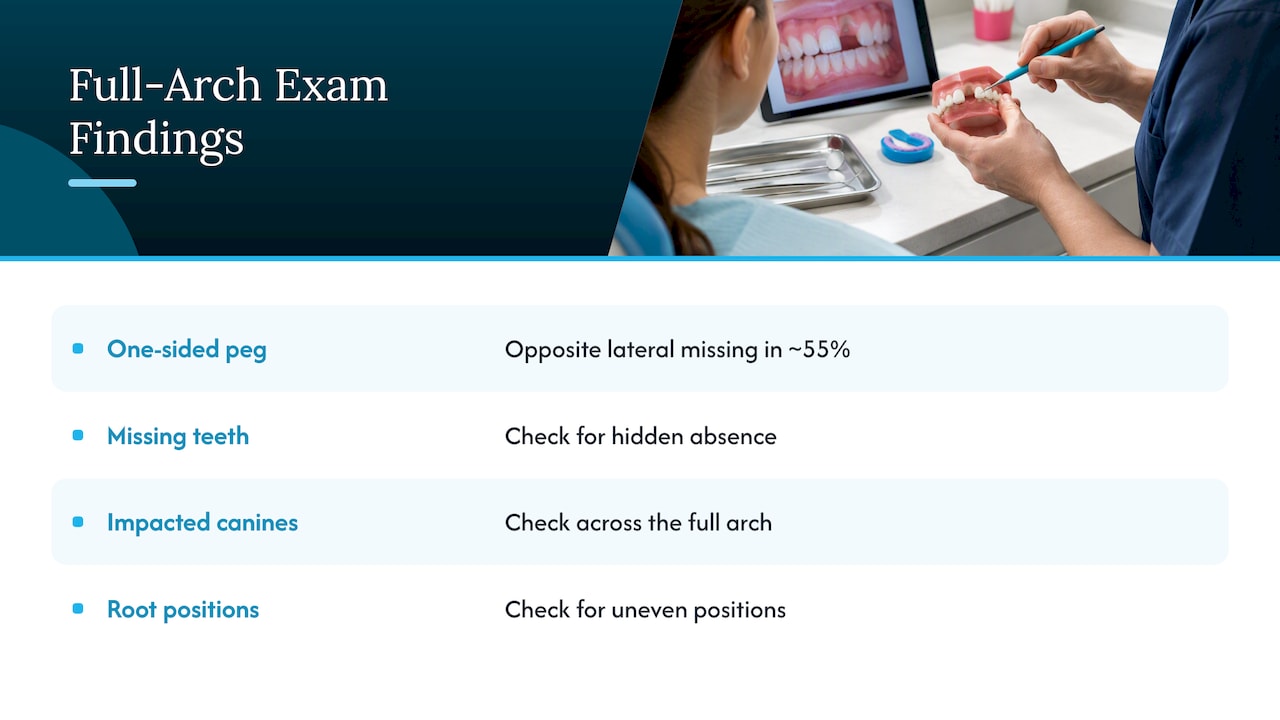
Associated anomalies are common enough that they change how a case gets planned. One retrospective study found that patients with a one-sided peg lateral had a missing contralateral lateral incisor in roughly 55% of cases, which is why a full exam and radiographs typically precede any cosmetic treatment rather than following it. Checking the whole arch for hidden missing teeth, impacted canines, or uneven root positions keeps the eventual veneer plan from running into a surprise mid-treatment.
Proportion, Measurement, and the Diagnostic Mock-Up
Before any tooth structure is touched, a diagnostic wax-up translates the planned new shape into a physical or digital model, letting everyone see how a wider, more rectangular lateral incisor will sit next to the central incisor and canine. A mock-up then transfers that design directly onto the teeth in the mouth, usually with a temporary material, so the patient can test the look and feel before committing to anything irreversible.
The planning sequence generally follows these steps:
- Measure the current width-to-height ratio of the peg lateral against the neighboring teeth to find a natural target proportion.
- Build a wax-up or digital design that widens and reshapes the tooth gradually rather than all at once.
- Try the mock-up in the mouth, checking smile line, midline symmetry, and how the new shape reads when talking and smiling.
- Capture digital scans and photographs of the approved design so the lab or in-house system can fabricate veneers that match.
Gum position factors into this proportion work too, since an uneven gum line can make an otherwise well-sized veneer look off. When that’s part of the picture, gum contouring may be discussed alongside the veneer plan.
Do You Need Orthodontics Before Veneers?
Orthodontics usually comes first when there isn’t enough space to build a peg lateral up to a natural width without over-bulking it, or when the tooth sits at an angle that a veneer alone can’t correct. Moving the adjacent teeth to open a proper gap, or straightening the peg lateral’s angulation, lets the final veneer have normal proportions instead of looking like an add-on.
Short-term tooth movement with clear aligners or limited braces is common for this kind of spot correction, and timelines tend to run shorter than a full orthodontic case since the goal is opening or adjusting one or two spaces rather than realigning the whole arch. Combining orthodontic movement with the restorative plan from the start avoids the alternative: a veneer so bulky it looks unnatural or strains the bite.
Veneer Types and Materials for Peg Laterals
The two main material choices are composite resin and porcelain or ceramic, and each fits a different kind of peg lateral case.
Composite bonding is applied directly to the tooth in a single visit, requires little to no removal of enamel, and costs less upfront. It’s a strong fit for smaller corrections or for patients who want to preview a shape change before committing to ceramic, though it tends to pick up stain and wear faster than porcelain over the years.
Porcelain and ceramic veneers come in several forms:
- Lithium disilicate (LDS), a glass-ceramic known for a strong balance of strength and translucency.
- Feldspathic porcelain, prized for its natural light-handling but typically thinner and more technique-sensitive to bond.
- Leucite-reinforced glass ceramic (LRGC), a mid-strength option used in some conservative preparations.
A pooled analysis of long-term outcomes found survival rates near 96% for feldspathic and lithium disilicate veneers at roughly 10 years, with lithium disilicate showing slightly fewer long-term complications than the other ceramic types studied. That data point matters for peg laterals specifically, since the reshaping these teeth need often calls for a touch more material thickness than a simple whitening veneer, and LDS’s strength profile tends to hold up well in that scenario.
Preparation design, meaning how much enamel is removed and in what shape, also affects fracture risk. No-prep and minimal-prep designs preserve more enamel and are the preferred starting point whenever the tooth size allows it, while a slightly deeper preparation or a three-quarter design is reserved for cases that need more structural support.
Step-by-Step: The Clinical Workflow for Peg Lateral Veneers
A typical peg lateral veneer case moves through a predictable sequence.
- Assessment and imaging. Radiographs, photos, and digital scans establish the tooth’s enamel thickness, root health, and position relative to its neighbors.
- Diagnostic mock-up. A wax-up or digital design is tried in the mouth so the patient can approve shape and proportion before anything is prepared.
- Preparation, if needed. Minimal or no-prep designs are used whenever the tooth size and space allow it, preserving as much natural enamel as possible.
- Provisional phase. If the tooth was prepared, a temporary veneer protects it while the final restoration is fabricated, either by a dental lab or through same-day digital design and milling.
- Try-in and bonding. The final veneer is checked for fit, shade, and bite before being bonded in place, with the bite rechecked immediately after to confirm even contact.
Pro Tip: Bring a photo of a smile shape you like to your consultation. It gives the design team a concrete reference point beyond measurements alone.
Longevity, Maintenance, and Common Complications
Ceramic veneers hold up well over time when they’re planned and bonded correctly. The same long-term review that reported roughly 96% survival at 10 years also identified fracture and debonding as the two most common failure modes, both tied closely to enamel preservation, occlusion management, and material choice.
Risk factors that raise the odds of a complication include:
- Thin remaining enamel from a previous aggressive preparation or old fillings.
- Grinding or clenching habits that repeatedly overload thin ceramic.
- A bite that wasn’t fully checked and adjusted at the final bonding appointment.
Maintenance is straightforward: regular brushing and flossing, routine dental visits, and a night guard for anyone who grinds their teeth. That last step matters more than it sounds, since nighttime grinding is one of the most preventable causes of veneer fracture.
Cost and Practical Considerations
Veneer pricing varies by material, the amount of reshaping needed, and whether orthodontics is part of the plan. Composite bonding generally costs less per tooth than porcelain, largely because it requires one visit and no lab fabrication, while porcelain and ceramic veneers cost more due to lab fees and the extra appointments involved in design and fitting.
Factors that tend to raise the total cost of a peg lateral case:
- Orthodontic treatment added before veneers to create proper spacing.
- Lab fabrication fees for custom porcelain or lithium disilicate veneers.
- Sedation, when a patient needs it for comfort during longer appointments.
- Multiple visits for try-in, adjustment, and final bonding rather than a single-visit composite approach.
Dental insurance generally treats veneers as a cosmetic procedure and excludes or limits coverage for them, so most patients pay out of pocket or use financing. An in-house membership plan can help offset the routine care and maintenance visits that go alongside cosmetic work, even when it doesn’t cover the veneer itself.
Conservative Alternatives to Veneers
Veneers aren’t the only route to a better-proportioned lateral incisor, and a few less invasive options are worth knowing about.
- Direct composite bonding reshapes the tooth without removing enamel, making it a good first step for smaller corrections or for patients who want a reversible trial before committing to porcelain.
- Three-quarter crowns cover more of the tooth than a veneer but less than a full crown, and get chosen when a tooth needs more structural support than bonding or a thin veneer can provide.
- Orthodontics alone, or combined with minimal bonding, can sometimes resolve the appearance issue by closing gaps or adjusting angulation enough that a full veneer becomes unnecessary.
Each of these trades some cosmetic flexibility for a smaller footprint on the natural tooth, which is worth weighing against how dramatic a change you actually want.
How We Approach Peg Lateral Veneer Planning
We build every peg lateral case around individualized planning rather than a standard template, using 3D imaging and digital mock-ups so you can see a preview of your new smile before we touch any enamel. Our focus stays on enamel-preserving techniques and clear communication, because a patient who understands the plan makes better decisions about shape, material, and timeline.
If grinding, spacing, or gum position factor into your case, we’ll walk through those details at your consult, along with financing and membership options that support long-term maintenance.
— Complete Dental Care
Ready to Explore Veneers for Your Peg Laterals
If a peg-shaped lateral incisor has been on your mind, our cosmetic dentistry services include veneers alongside digitally guided mock-ups that let you preview your new smile before any permanent change is made.
- We fabricate and fit porcelain, lithium disilicate, and composite veneers based on what your specific tooth and bite actually need.
- Our planning process starts with scans and photos, not guesswork, so the proportions line up with the rest of your smile from the first mock-up.
- Readers weighing broader cosmetic goals, including fit and maintenance for existing restorations, may also find value in local options like Kybella treatment for complementary facial aesthetics through our partner practice.
Schedule a first visit to start with a diagnostic mock-up appointment, and we’ll walk you through exactly what your peg lateral veneers would look like before any enamel is removed.
This article is general information, not a substitute for advice from a qualified doctor. Consult a qualified healthcare professional about your own circumstances before acting on anything here.
FAQ
How rare are peg lateral teeth?
Peg-shaped lateral incisors are uncommon but not rare, affecting roughly 1.72% to 1.8% of the general population, with a higher rate in women.
How much does peg lateral bonding cost?
Composite bonding costs vary by provider, tooth size, and region, and no fixed industry-wide figure applies to every case. Because pricing depends on individual factors, the most reliable number comes from a consult where your specific tooth and goals are assessed.
What does “peg lateral” mean in dentistry?
A peg lateral is an upper lateral incisor that developed smaller and more cone-shaped than a typical rectangular tooth, tapering toward the biting edge. The cause is a developmental variation that occurs before the tooth erupts, and it often appears alongside other dental anomalies like missing teeth or displaced canines.
How can I fix peg-shaped lateral teeth?
Options range from conservative composite bonding to porcelain or ceramic veneers, with orthodontics sometimes needed first to create proper spacing. A diagnostic mock-up helps confirm which approach will give the most natural result before any enamel is permanently altered, and our cosmetic dentistry team can walk through which fits your case.
Sources
- Prevalence of peg-shaped maxillary permanent lateral incisors: A meta-analysis
- Survival and Complication Rates of Feldspathic, LRGC, LDS and Zirconia Ceramic Laminate Veneers: A Systematic Review and Meta-Analysis
- Clinical survival rate and laboratory failure of dental veneers: A narrative literature review
questions about this? we're happy to help.
Every patient's situation is a little different. If you want to talk through what this means for you, our Greenville team is one call away.
schedule a free consultation