

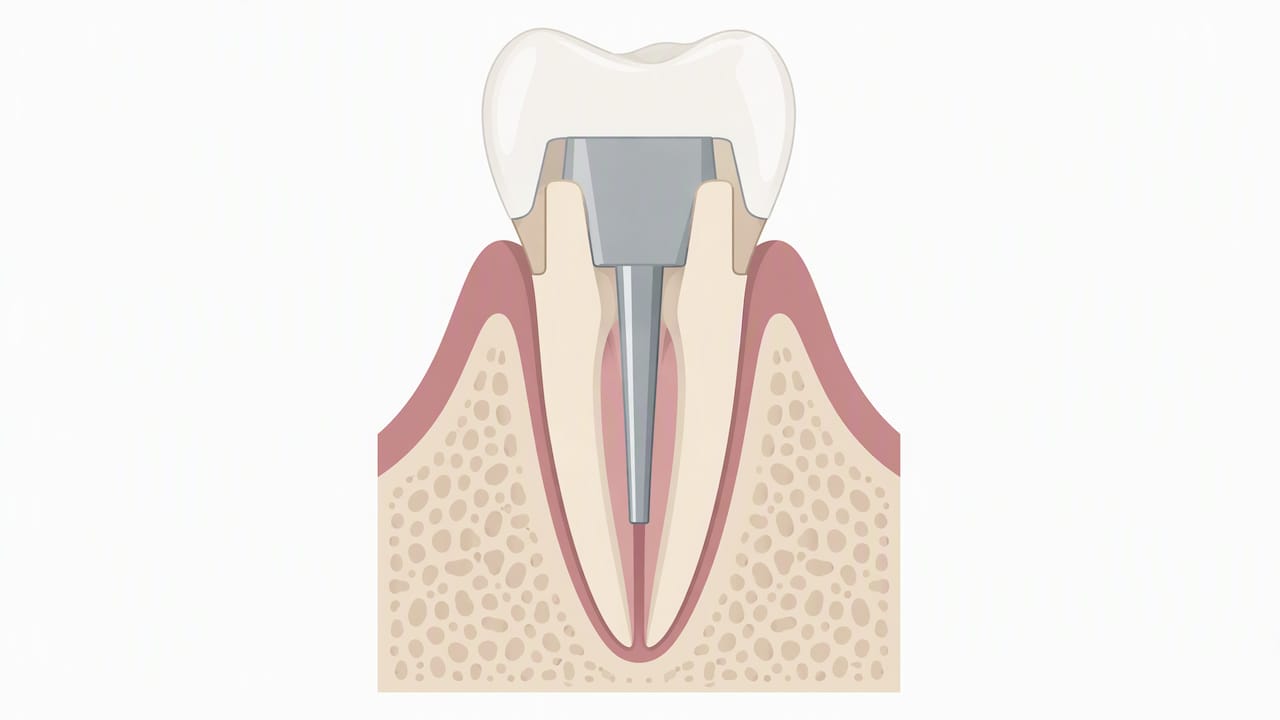
A post and core rebuilds a tooth after root canal treatment when too little natural structure remains to hold a crown in place. The post anchors inside the root canal; the core sits above it, rebuilding the missing tooth shape so a crown has something solid to grip. Not every root-treated tooth needs one, and sometimes an implant is the better long-term answer.
TL;DR:
- Ask your dentist to show the ferrule on imaging: crowns need 1.5 to 2 millimeters of healthy tooth, and less may require crown lengthening.
- Front teeth with major structural loss often need a post, while molars may not if their pulp chamber and surrounding walls can retain the core.
- Metal posts showed higher pooled survival than fiber posts after five years, but catastrophic failure rates were similar; fiber posts are easier to remove.
- Dentists leave at least 4 millimeters of root canal filling at the root tip to preserve the seal during post placement.
- A vertical root fracture, very little remaining tooth, or a failed prior post can make an implant more predictable than another rebuilding attempt.
questions about this? we're happy to help.
Every patient's situation is a little different. If you want to talk through what this means for you, our Greenville team is one call away.
schedule a free consultationTable of Contents
- What is a post and core, and how do the parts work together?
- Who needs a post and core: indications and the ferrule rule
- Types of posts and materials: patient-facing pros and cons
- What to expect during the procedure, step by step
- Risks, complications, and what affects long-term success
- Recovery and timeline: appointments, pain, and caring for the temporary
- Cost and alternatives: when to consider an implant instead
- Questions to bring to your dental appointment
- Why the ferrule matters more than the post material
- How we approach post and core decisions
- FAQ
- Sources
What is a post and core, and how do the parts work together?
Three separate pieces work as a team, though patients often lump them together as one procedure. The post is a thin rod placed into the space left by root canal treatment, inside the root. The core is the filling material built up around and over that post to recreate the shape of the tooth above the gumline. The crown then caps the whole structure, restoring the biting surface and appearance.
A common misunderstanding is that the post makes the tooth stronger. It does not. Its job is retention, giving the core something to hold onto, not reinforcement of the root itself. A tooth with a post is not sturdier than one without; it is simply rebuilt enough to support a crown.
- The post sits inside the root canal space and anchors the core.
- The core fills in the missing coronal (above-gum) tooth structure.
- The crown covers the core and restores chewing function and appearance.
Who needs a post and core: indications and the ferrule rule
Whether you need a post often comes down to a single measurement: the ferrule. This refers to the band of healthy, natural tooth structure, typically 1.5 to 2 millimeters, that remains above the gumline and can be wrapped by a crown. A sound ferrule anchors the crown to real tooth rather than to rebuilt material, and research on prefabricated fiber posts has linked a complete circumferential ferrule to meaningfully higher success rates than teeth without one.
You are more likely to need a post and core if extensive decay or a large old filling has removed most of the crown portion of the tooth, especially on front teeth with a single, fairly straight canal. You are less likely to need one if enough of the pulp chamber and surrounding walls remain to retain a filling material on their own, which happens more often in molars with multiple canals and a naturally wider chamber.
- Front teeth with a single canal and significant structural loss often require a post.
- Molars with intact chamber walls can sometimes skip the post entirely.
- A tooth with less than 1.5 millimeters of sound structure all around may need crown lengthening first.
Pro Tip: Ask your dentist to show you the ferrule on your X-ray before agreeing to a post. If they can point to it, you understand your own case better than most patients ever do.
Types of posts and materials: patient-facing pros and cons
Material choice shapes how the tooth looks, how it behaves under bite force, and how easy it is to redo the work later if something goes wrong.
Fiber posts flex somewhat like natural dentin, which can distribute chewing stress more evenly, and they bond well with tooth-colored core materials, making them popular for front teeth where esthetics matter. The tradeoff is less certainty in some studies about movement or long-term adaptation compared to rigid systems. A meta-analysis comparing post types found metal-based posts had a higher pooled survival rate than fiber-reinforced posts after more than five years, though catastrophic failure rates were similar between the two.
Metal posts, whether prefabricated or custom-cast, have a long clinical track record and tend to hold up well under heavy bite forces in back teeth. They are not always as easy to remove cleanly if the tooth later needs retreatment, and cast posts require an extra lab step and temporary restoration while the permanent one is made.
Ceramic or zirconia posts offer strong esthetics, useful under very thin or translucent crowns, but they are difficult to remove if a root canal needs to be redone, which makes them a less flexible choice for a tooth with an uncertain long-term prognosis.
- Fiber posts: esthetic, flexible, generally easier to remove.
- Metal posts: proven durability, better suited to posterior teeth, variable retrievability.
- Ceramic or zirconia posts: excellent appearance, hardest to remove if retreatment is needed.
Dentists weigh tooth location, how much dentin preparation would be required, and how easily the post could be removed later if trouble develops.
What to expect during the procedure, step by step
The process usually unfolds in a predictable sequence, though the number of appointments depends on your case and your dentist’s workflow.
- Evaluation and planning. Your dentist reviews X-rays, measures the ferrule, and decides whether crown lengthening is needed first.
- Post space preparation. A portion of the root canal filling is removed to make room, while at least 4 millimeters of gutta-percha is left at the bottom to preserve the seal.
- Post cementation. The chosen post is bonded or cemented into the prepared space.
- Core buildup. Filling material is shaped around the post to recreate the tooth’s form.
- Impression or digital scan. The rebuilt tooth is scanned or impressed for the final crown.
- Temporary crown placement. A temporary protects the core while the permanent crown is fabricated.
- Final crown cementation. The permanent crown is checked for fit and bite, then cemented in place.
Isolation matters throughout; following strict infection-control standards helps keep the procedure safe and effective as described in how to prevent Legionella in dental unit waterlines. A rubber dam keeps saliva and bacteria away from the open canal space during preparation, and if a barrier is placed over the remaining gutta-percha, it reduces the chance of contamination between visits.
Pro Tip: If your treatment will be staged across visits, ask what barrier material protects the canal filling in between, and confirm your temporary crown feels fully seated before you leave the office.
Risks, complications, and what affects long-term success
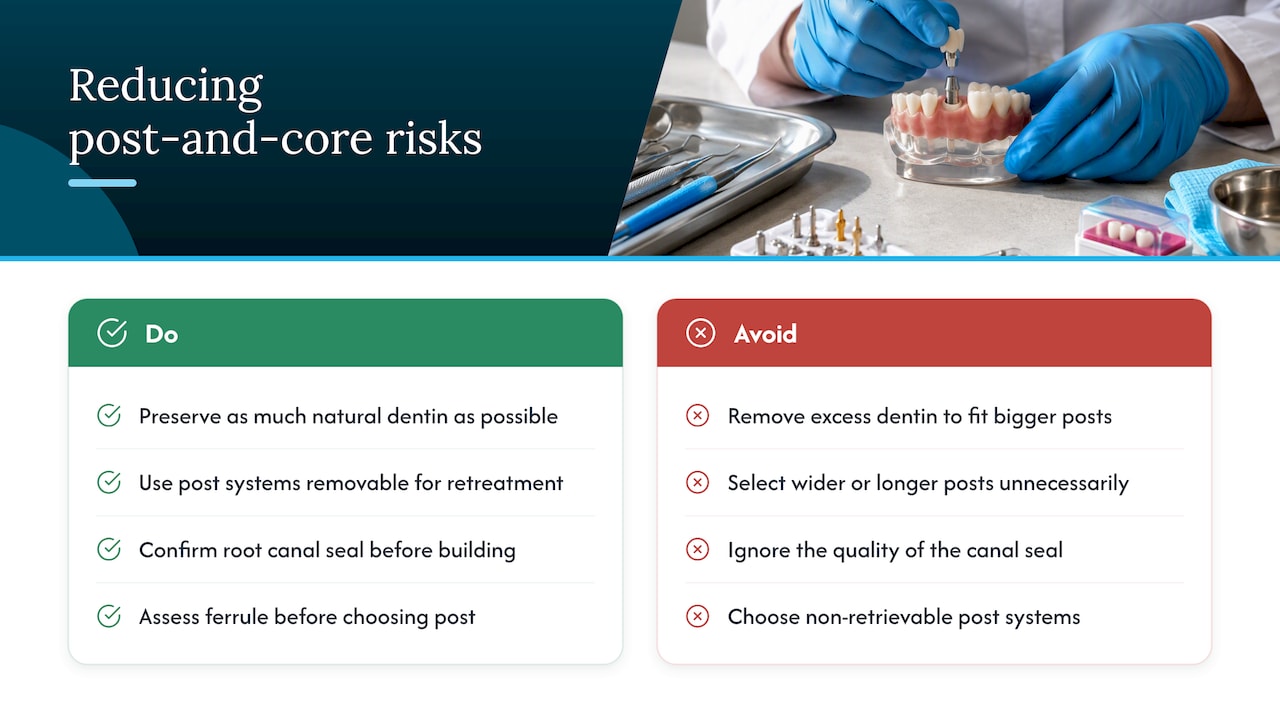
The most common problems are root fracture, perforation during post space preparation, post loosening, and reinfection if the seal around the gutta-percha fails. Fracture risk rises when too much dentin is removed to fit a wider or longer post than necessary, which is why conservative preparation is a consistent priority in professional guidance.
A 2022 systematic review found that endodontically treated teeth restored with a post and core had significantly lower failure rates than comparable teeth restored without one, reinforcing that the post’s value lies in giving a severely weakened tooth a stable foundation, not in strengthening the root itself.
To reduce these risks, dentists generally preserve as much natural dentin as possible, favor post systems that can be removed cleanly if retreatment becomes necessary, and confirm the root canal seal is sound before building anything on top of it. Ferrule remains one of the strongest predictors of how long the restoration lasts, which is why it gets assessed before any post is chosen.
Recovery and timeline: appointments, pain, and caring for the temporary
Most post and core cases take one to three restorative visits after root canal treatment, depending on whether crown lengthening is needed and whether the dentist uses same-day digital scanning or sends impressions to an outside lab.
Mild soreness around the gumline or some sensitivity to pressure is common for a few days and typically responds to over-the-counter pain relievers like ibuprofen or acetaminophen. Sharp or worsening pain is not expected and is worth a call to your dentist.
- Avoid chewing directly on the temporary crown, especially sticky or hard foods.
- Keep the area clean with gentle brushing and floss threaded rather than snapped between teeth.
- Don’t delay the final crown appointment. A temporary left in place too long raises the odds of leakage, loosening, or reinfection.
Cost and alternatives: when to consider an implant instead
Cost depends on several moving parts: which tooth is involved, the post material chosen, whether crown lengthening or bone grafting is needed first, and the type of final crown. Front teeth with straightforward anatomy tend to cost less overall than molars needing extra preparation or lab work.
A post and core is not always the right call. If a tooth has very little remaining structure, a vertical root fracture, or has already failed one post and core attempt, rebuilding it may just delay an inevitable extraction. In those cases, a single-tooth implant can offer a more predictable long-term outcome, and understanding how long dental implants typically last helps put that tradeoff in perspective.
- Saving the natural tooth preserves bone and sensation but depends on a sound root and adequate ferrule.
- An implant involves surgery and a longer total timeline but does not rely on existing root structure.
- Repeated post and core failures on the same tooth are a signal to discuss extraction and replacement rather than a third attempt.
Questions to bring to your dental appointment
Walking into the conversation with the right questions changes how much control you have over the outcome.
- Ask whether you have enough ferrule, and ask to see it on your X-ray.
- Ask whether the proposed post is retrievable if the root canal ever needs to be redone.
- Ask which material is recommended for your specific tooth and why.
- Ask how soon the final crown will be placed after the core buildup.
Practices using digital scanning and 3D imaging can often show you the remaining tooth structure directly on screen, which makes these questions easier to answer together rather than relying on description alone. If your case involves a cracked root, a previously failed post, or anatomy your general dentist isn’t confident treating, asking for a referral to an endodontist or prosthodontist, or simply requesting a second opinion, is a reasonable step before committing to treatment.
Why the ferrule matters more than the post material
The conventional conversation around post and core treatment spends too much time on material brand names and not enough on the one factor that actually predicts success: how much healthy tooth structure remains before anyone drills anything. Fiber versus metal versus ceramic matters, but it matters less than whether there’s a solid ferrule to work with in the first place.
The bigger failure in how this procedure gets explained to patients is treating it as a given once a root canal is finished. It isn’t automatic, and it isn’t always the right move. A tooth with minimal remaining structure, a prior failed post, or a vertical fracture is often better served by extraction and an implant than by a third attempt at rebuilding something that keeps breaking down.
If you take one thing from this, prioritize the ferrule conversation over the material conversation. Ask to see your own X-ray before you ask what the post is made of.
— Complete Dental Care
How we approach post and core decisions
We treat every post and core case as a question worth answering carefully, not a default next step after root canal treatment. Using digital scanning and 3D imaging, we assess how much natural tooth structure remains, walk through what a realistic ferrule looks like on your own X-ray, and lay out options in plain terms before recommending anything.
When a tooth isn’t a good candidate for rebuilding, we talk through surgical and implant dentistry options, including single-tooth implants, as a clinical alternative worth comparing. When the tooth is a good candidate, our general dentistry team handles the restorative work from core buildup through final crown. If you want a clear-eyed evaluation of your own case, schedule a consultation and we’ll walk you through the imaging together.
This article is general information, not a substitute for advice from a qualified doctor. Consult a qualified healthcare professional about your own circumstances before acting on anything here.
FAQ
How painful is a post and core procedure?
Most patients feel pressure rather than sharp pain during the procedure itself, since the tooth has already been numbed and the nerve removed during root canal treatment. Mild soreness around the gum for a few days afterward is common and usually manageable with over-the-counter pain relievers.
How long does a post and core procedure take?
The clinical appointment for post placement and core buildup typically takes one visit, though the full process from root canal through final crown often spans one to three restorative visits. Timing depends on whether crown lengthening is needed and whether your dentist uses same-day digital scanning or an outside lab for the crown.
How much does a post and core cost?
Cost varies based on the tooth involved, the post material chosen, and whether additional procedures like crown lengthening or bone grafting are needed first. Because pricing depends on these individual factors, it’s best discussed directly during a consultation and is available on request from your dental provider.
Is a post and core better than an implant?
Neither option is universally better; a post and core preserves your natural tooth root when enough healthy structure remains, while an implant may be the more predictable choice when a tooth is fractured, has failed a previous post, or lacks adequate ferrule. A systematic review found post-and-core restorations lower failure rates compared to no post, but that benefit depends entirely on the tooth being a reasonable candidate in the first place.
Sources
- Systematic review on outcomes of post-and-core restorations
- Meta-analysis comparing metal and fiber posts
- Systematic review on ferrule effect with prefabricated fiber posts
- Colleagues for Excellence: Core buildups and posts (AAE)
questions about this? we're happy to help.
Every patient's situation is a little different. If you want to talk through what this means for you, our Greenville team is one call away.
schedule a free consultation