Gum contouring reshapes the gum line to correct a gummy smile, expose more tooth structure for a crown, or treat tissue overgrown from periodontal disease. It can be purely cosmetic or medically necessary, and the right technique, whether that’s tissue removal, bone recontouring, orthodontics, or lip surgery, depends entirely on an accurate diagnosis of what’s causing the excess tissue. Healing takes a few weeks, but final tissue position often isn’t stable until three to six months after surgery.
TL;DR:
- The stability of gum contouring results depends on proper diagnosis, technique, and patient factors like tissue phenotype, oral hygiene, and smoking status.
- Rebound or recession risks are higher in thin, scalloped gum phenotypes or with poor oral hygiene, requiring careful preoperative assessment of bone and tissue levels.
- Flapless laser techniques often cause less discomfort and bleeding, but the choice must be based on whether bone involvement exists, as soft-tissue-only approaches are insufficient for bone issues.
- Longer healing and tissue stabilization generally take three to six months, with relapse more likely if gum or bone conditions are not properly managed.
- Costs vary greatly depending on surgical complexity, with insurance coverage often limited to procedures linked to medical needs rather than purely cosmetic contouring.
questions about this? we're happy to help.
Every patient's situation is a little different. If you want to talk through what this means for you, our Greenville team is one call away.
schedule a free consultationTable of Contents
- Related terms: gingivectomy, crown lengthening, and gum grafting explained
- How clinicians diagnose the cause before recommending treatment
- Treatment options: gingivectomy, laser techniques, and crown lengthening
- What happens before, during, and after your procedure
- Risks, complications, and how stable the results really are
- What drives cost, and how to check your insurance coverage
- When gum contouring alone isn’t the answer
- How we approach gum contouring at Complete Dental Care
- Checklist of questions to ask at your consultation
- Ready to talk through your options? Here’s how to start
- FAQ
- Sources
Related terms: gingivectomy, crown lengthening, and gum grafting explained
“Gum contouring” is an umbrella term, and the specific name matters because it signals what the clinician is actually doing.
- Gingivectomy: cutting away excess gum tissue, typically for cosmetic reshaping or to remove overgrowth.
- Gingivoplasty: reshaping the contour of the gum without necessarily removing large amounts of tissue.
- Esthetic crown lengthening: removing gum tissue and sometimes bone to expose more of the tooth, often before placing a crown or veneer.
- Apically positioned flap: a surgical flap technique that repositions gum tissue lower on the tooth, usually combined with bone recontouring.
Soft-tissue-only procedures work when the excess is purely gingival. When the bone sits too close to the gum edge, flap surgery with bone recontouring becomes necessary to achieve a stable result. How long results last depends on factors beyond the surgery itself: tissue phenotype (thick versus thin and scalloped), daily oral hygiene, and smoking all influence whether the new contour holds or drifts back toward its original position.
How clinicians diagnose the cause before recommending treatment
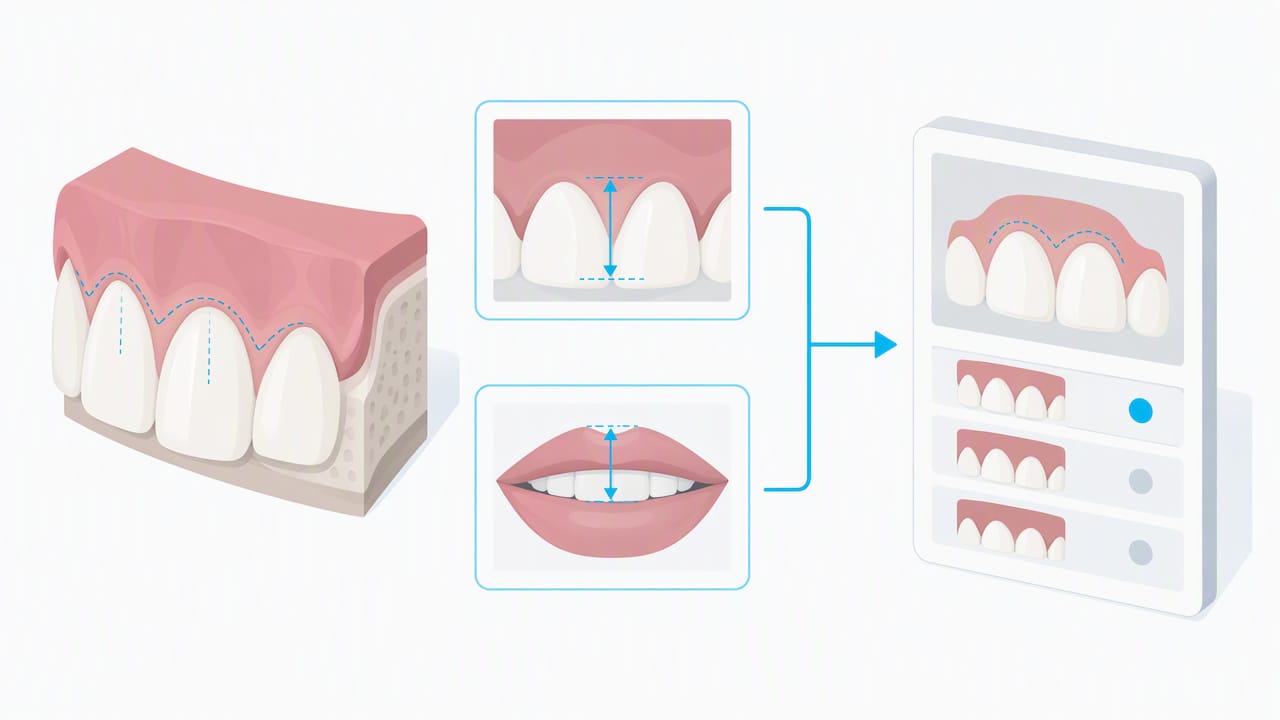
A gummy smile can come from several unrelated sources, and treating the wrong one won’t fix the problem. Diagnosis starts with a structured assessment.
- Measure tooth display both at rest and during a full smile.
- Assess upper lip mobility, since a hypermobile lip can mimic a gum problem that isn’t a gum problem at all.
- Perform periodontal probing to check pocket depth and tissue health.
- Take radiographs, and a CBCT scan when bone position near the root needs closer evaluation.
The underlying cause is usually one of a short list: altered passive eruption, where the gum simply never receded to its adult position; a hypermobile upper lip that rises too far during a smile; vertical maxillary excess, a skeletal issue; drug-induced gingival overgrowth; or periodontal pockets from gum disease. A 2023 review on excessive gingival display found that altered passive eruption often calls for crown lengthening, while a hypermobile lip is better addressed with lip repositioning, not gum removal. Cutting gum tissue when the lip is the real culprit will not solve the aesthetic problem.
Pro Tip: Ask your clinician to show you the measurements behind your diagnosis, tooth display numbers and lip mobility, not just a verbal impression.
Treatment options: gingivectomy, laser techniques, and crown lengthening
Once the cause is clear, several techniques can correct it, each with different recovery profiles and trade-offs.
- Gingivectomy or gingivoplasty: best for isolated soft-tissue excess with no bone involvement; recovery is typically quicker than flap surgery.
- Laser-assisted flapless approaches: use a laser instead of a scalpel and flap to reshape tissue with less cutting.
- Esthetic crown lengthening with open-flap surgery: lifts the gum and, when needed, removes a small amount of bone to expose more tooth structure permanently.
- Combined care: orthodontics, lip repositioning surgery, or orthognathic surgery when the cause sits outside the gum tissue itself.
A meta-analysis of randomized trials comparing open-flap and flapless esthetic crown lengthening found flapless techniques associated with less bleeding on probing and smaller changes in gingival margin position in some outcomes, though overall results were broadly comparable between the two approaches. A recent randomized study found flapless Er, Cr:YSGG laser-assisted crown lengthening produced less postoperative discomfort and shorter procedure time than open-flap surgery in selected patients with altered passive eruption. The right choice still comes back to diagnosis: bone involvement generally rules out a soft-tissue-only approach, regardless of which instrument is used.
What happens before, during, and after your procedure
The process follows a predictable sequence, though the length of each stage varies by technique and how much tissue or bone is involved.
- Consultation and imaging: your dentist examines tooth display, lip movement, and probing depths, and takes radiographs or a CBCT scan if bone position is uncertain.
- Treatment planning: you receive a written estimate and procedure codes before scheduling, along with anesthesia or sedation options.
- The procedure itself: local anesthesia numbs the area, tissue is removed or a flap is raised, bone is recontoured if needed, and sutures or a protective dressing close the site.
- Early healing: soreness and sensitivity are common for the first one to two weeks.
- Tissue maturation: contour continues shifting over the following three months, with most cases reaching final stability by around six months.
Aftercare during recovery includes:
- Taking prescribed or over-the-counter pain medication as directed.
- Brushing gently around the surgical site rather than skipping it entirely.
- Sticking to soft foods for the first few days.
- Watching for warning signs like worsening pain, pus, or fever.
Risks, complications, and how stable the results really are
Most patients experience manageable soreness, minor bleeding, or swelling in the days after surgery, and these typically resolve on their own. According to Cleveland Clinic, severe or worsening pain, uncontrolled bleeding, pus, or fever should prompt a call to your clinician right away rather than waiting it out.
Longer-term concerns include gum recession, root exposure, changes to the small triangle of gum between teeth, and relapse, where tissue gradually rebounds toward its original position. Risk climbs with a thin gum phenotype, smoking, and inconsistent oral hygiene. A systematic review and meta-analysis of crown-lengthening outcomes found the evidence base still limited and heterogeneous, with healing outcomes depending heavily on surgical design and tissue phenotype, which is why follow-up visits matter more than a single post-op check.
- Thicker tissue phenotypes tend to show more coronal rebound after surgery.
- Thinner, scalloped phenotypes are more prone to recession instead.
- Careful bone assessment and flap positioning reduce both risks.
Pro Tip: If your gum tissue sits less than 1 millimeter above the bone before surgery, ask how your surgeon plans to manage rebound, since that margin strongly influences how much the contour shifts afterward.
What drives cost, and how to check your insurance coverage
Price varies with the number of teeth involved, whether bone recontouring is needed, sedation choices, the type of clinician performing the work, and regional differences in fees. Purely cosmetic reshaping is commonly excluded from dental insurance, while the same procedure can be covered when it’s tied to a documented medical need, like exposing a fractured tooth for a crown; more details on dental insurance options and coverage mechanics can help you understand your benefits.
Before scheduling, it helps to:
- Get a clear diagnosis in writing, not just a verbal recommendation.
- Ask for the specific CDT procedure codes your dentist plans to bill.
- Request a written cost estimate and a benefit determination from your insurer.
Our insurance information page walks through how procedure codes and benefit determinations typically work if you want to understand the process before your consultation.
When gum contouring alone isn’t the answer
Sometimes the gum tissue itself isn’t the real problem, and contouring won’t produce a lasting fix. A hypermobile lip often responds better to lip repositioning surgery than to gum removal. Vertical maxillary excess, a skeletal issue, may require orthognathic surgery. Misaligned teeth sometimes need orthodontics before any gum work is considered, and veneers or cosmetic bonding can adjust the visual proportion of teeth without touching gum tissue at all.
- Skeletal causes are typically addressed first, before periodontal or restorative work begins.
- Orthodontic movement can change how much gum shows without any surgery.
- Decisions hinge on how permanent you want the result, how invasive you’re willing to go, and your overall restorative goals.
Sequencing matters: starting with gum surgery before an underlying skeletal or orthodontic issue is resolved can mean redoing the work later.
How we approach gum contouring at Complete Dental Care
We use digital imaging and scanning to evaluate tooth position, bone level, and gum contour before recommending a technique, which helps us plan whether crown lengthening, implant restoration, or a soft-tissue-only approach fits your case.
- Digital planning lets us sequence periodontal and restorative work, including implants, in the right order.
- Sedation options and clear, step-by-step communication help patients who feel anxious about dental surgery.
- Comfort support, including the option to have a support animal present, is part of how we try to make procedures less stressful.
Checklist of questions to ask at your consultation
Before agreeing to any technique, a short list of questions can protect you from an unnecessary or mismatched procedure.
- What specific cause did you diagnose, and how did you measure it?
- Will this involve bone recontouring, or soft tissue only?
- How much rebound should I expect, and when will results be final?
- Can I get a written estimate before scheduling?
A clinician who can’t answer these clearly, or who pushes a technique before taking imaging, is a sign to get a second opinion.
— Complete Dental Care
Ready to talk through your options? Here’s how to start
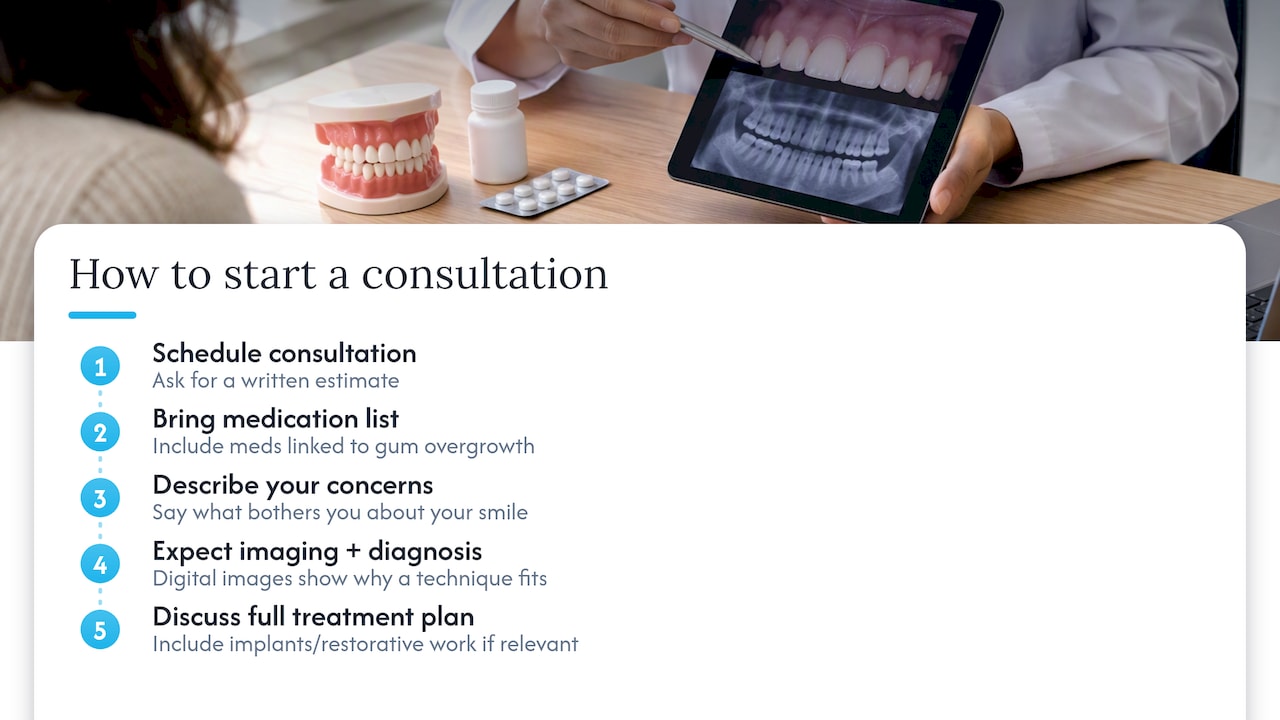
If you’re dealing with a gummy smile, uneven gum line, or tissue that’s getting in the way of a crown or veneer, we combine digital imaging with a straightforward diagnosis so you know exactly why a particular technique is being recommended, not just that it’s an option. Our cosmetic dentistry services cover everything from crown lengthening through veneers and whitening, so contouring can be planned as one piece of a larger smile plan rather than an isolated fix.
Bring a list of any medications you take, especially ones linked to gum overgrowth, and be ready to discuss what bothers you about your smile so we can match that to the right diagnosis. If implants or restorative work are part of your picture, our Teeth in a Day page outlines how full-arch solutions fit into a combined treatment timeline. Reach out to schedule a consultation and request a written estimate before anything is scheduled.
This article is general information, not a substitute for advice from a qualified doctor. Consult a qualified healthcare professional about your own circumstances before acting on anything here.
FAQ
How long does gum contouring last?
Results are usually permanent when the underlying cause was diagnosed correctly and the right technique was used. That said, tissue position can keep shifting for up to three months after surgery, with full stability typically reached by around six months, and relapse becomes more likely with smoking or inconsistent oral hygiene.
Does gum contouring have risks?
Yes. Short-term effects like soreness, sensitivity, and minor bleeding are common and usually resolve within one to two weeks. Longer-term risks include recession, root exposure, and tissue rebound, with thinner gum types more prone to recession and thicker types more prone to rebound.
What does gum contouring do?
It reshapes the gum line to correct excess tissue covering the teeth, whether that’s for cosmetic reasons like a gummy smile or functional ones like exposing enough tooth structure for a crown. The specific approach depends on whether the cause is soft tissue alone, bone position, or something outside the gum entirely, like lip mobility.
How painful is gum contouring?
Discomfort is generally mild to moderate and manageable with the pain medication your dentist recommends. Flapless or laser-assisted techniques have been associated with less postoperative discomfort and shorter procedure time than open-flap surgery in some studies, though the right technique for you still depends on your diagnosis rather than comfort alone.
Sources
- Causes and tailored treatment approaches for excessive gingival display (2023 review)
- Periodontal tissue changes after crown lengthening surgery: systematic review and meta-analysis (2023)
- Open-Flap and Flapless Er, Cr:YSGG Laser-Assisted Esthetic Crown Lengthening: A Comparative Study of Patient Perceptions
- Gum Contouring: Surgery, Recovery & What To Expect — Cleveland Clinic
questions about this? we're happy to help.
Every patient's situation is a little different. If you want to talk through what this means for you, our Greenville team is one call away.
schedule a free consultation