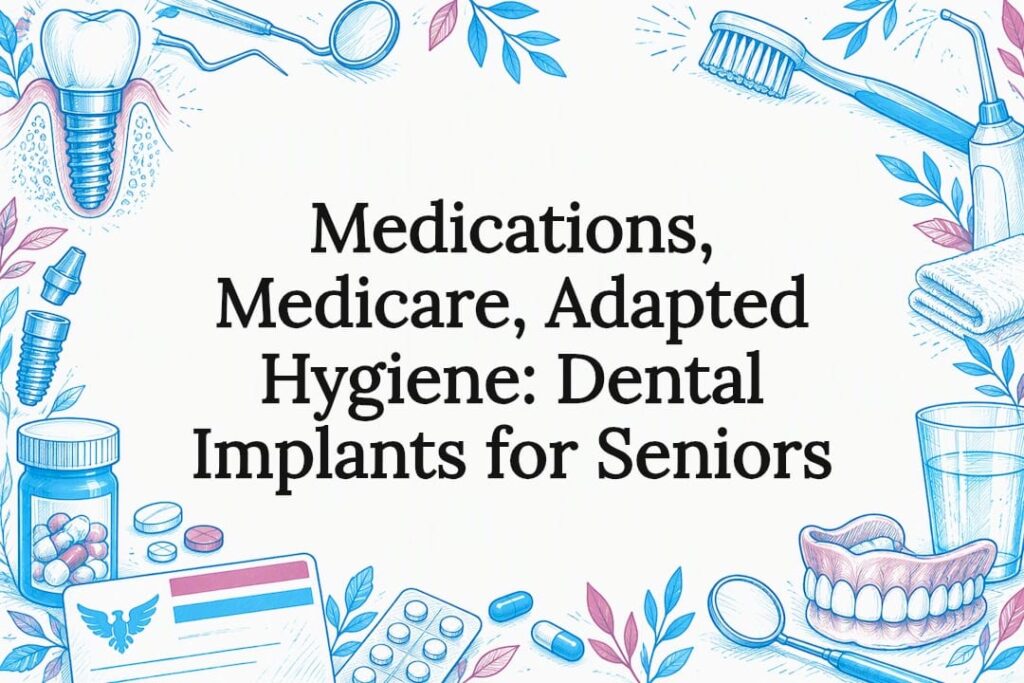
Seniors are usually eligible for dental implants. Age alone isn’t the issue: overall health, gum disease control, bone volume, and certain medications decide candidacy. High-level evidence on implant survival in older patients supports this when risk factors are managed well. The right first step is a consultation that includes a full medical history and current medication list.
TL;DR:
- Most seniors remain good candidates for dental implants when overall health, gum disease, bone volume, and medication use are well-managed.
- Implant choices vary from single-tooth replacements to full-arch solutions, with treatment time and costs increasing with complexity and grafting needs.
- Proper maintenance, including professional recalls every three to six months and daily cleaning, significantly reduces risks of peri-implant disease and failure.
- Medicare typically does not cover dental implants, but HSA, FSA, or financing options can help offset costs for eligible seniors.
- Uncontrolled chronic conditions and certain medications, especially bisphosphonates, require coordination with healthcare providers before implant procedures.
questions about this? we're happy to help.
Every patient's situation is a little different. If you want to talk through what this means for you, our Greenville team is one call away.
schedule a free consultationTable of Contents
- What dental implants are and the options seniors encounter
- Eligibility: how clinicians assess candidacy in older adults
- Procedure steps and a realistic timeline for seniors
- Risks and medical considerations seniors should know
- Implants versus dentures: what actually improves for seniors
- Costs, insurance, and Medicare realities for seniors
- Aftercare and long-term maintenance for seniors with implants
- When to see a dentist and red flags after treatment
- Our approach to treating seniors with dental implants
- Ready to find out if implants are right for you
- Clinical guidelines and key studies cited
- Sources
- FAQ
What dental implants are and the options seniors encounter
An implant has three parts: a titanium post placed in the jawbone, an abutment that connects to it, and the visible restoration on top, either a crown or an overdenture. For seniors, the choice usually comes down to how many teeth are missing and how much bone support remains.
Options typically discussed at consultation include:
- Single-tooth implants, used to replace one missing tooth without touching neighboring teeth.
- Implant-supported overdentures, which snap onto two or more implants for a removable denture that no longer slips.
- Full-arch solutions, sometimes called Teeth in a Day or All-on-4, which replace an entire arch of teeth on a small number of implants, often with same-day provisional teeth.
- Mini implants, a narrower option sometimes used to stabilize a lower denture when bone volume is limited.
Each option carries different healing timelines and costs, which a dentist narrows down after imaging.
Eligibility: how clinicians assess candidacy in older adults
Clinicians weigh medical and oral factors together rather than relying on a birthdate. Diabetes control, cardiovascular status, smoking habits, and any condition that suppresses immune response all factor into the medical review, since uncontrolled diabetes, active periodontitis, and current smoking are statistically significant risk factors for peri-implant disease and implant failure, and treatment is often delayed until these are stabilized.
On the oral health side, dentists assess:
- Periodontal status, since active gum disease needs treatment before implant surgery.
- Jawbone quality and volume, which determines whether grafting or a sinus lift is needed first.
- Medication history, particularly bisphosphonates or denosumab, which carry warnings about osteonecrosis of the jaw with invasive dental work.
- Overall healing capacity, reviewed alongside a primary care provider when systemic disease is present.
Age itself rarely disqualifies a patient. Systematic reviews and meta-analyses report implant survival around 97.7% at one year and roughly 96% at three to five years in elderly patients, which is why most dentists focus the eligibility conversation on health status rather than years lived. Bring a full medication list and recent lab results (such as A1c, if diabetic) to the first visit so the team can assess candidacy accurately.
Procedure steps and a realistic timeline for seniors
Treatment unfolds in stages, and older adults often need a bit more time built into each one.
- Consultation and imaging. A 3D CBCT scan maps bone volume and nerve position, showing whether grafting is needed before implants can be placed.
- Surgical placement. The implant is set into the jawbone, sometimes alongside grafting; some patients qualify for immediate temporary teeth the same day, while others wait for a separate restoration visit.
- Healing and osseointegration. Bone fuses to the implant surface over a period that commonly runs several months, and conditions like diabetes or smoking can extend it.
- Restoration. Once healing is confirmed, the abutment and final crown, bridge, or overdenture are attached.
Most patients need three to five visits total, with coordination alongside a primary care physician when a medical condition needs monitoring during healing.
Risks and medical considerations seniors should know
Peri-implant mucositis (inflammation of the gum around an implant) and peri-implantitis (inflammation that reaches the bone) are the most common long-term complications, and clinical consensus notes these conditions tend to progress faster than ordinary gum disease, which is why the EFP S3 level clinical practice guideline recommends structured maintenance and risk-based recall intervals rather than a one-time cleaning schedule.
Medication interactions deserve particular attention in older patients:
- Bisphosphonates and denosumab, common for osteoporosis, carry FDA labeling warnings that invasive dental procedures, including implants, are associated with osteonecrosis of the jaw, so coordination with the prescribing physician matters before surgery.
- Uncontrolled diabetes slows healing and raises infection risk.
- Smoking reduces blood flow to healing tissue and measurably raises failure risk.
- Active periodontal disease should be treated first; our guidance on implants after gum disease walks through that preparatory process.
Pro Tip: Ask your prescribing doctor directly whether any medication you take carries a jaw-healing warning, and bring their answer in writing to your dental consultation.
Implants versus dentures: what actually improves for seniors
Implants restore chewing force that traditional dentures can’t match, which often translates into a wider, easier diet and clearer speech. Because the implant post stimulates the jawbone the way a natural tooth root does, it also helps preserve bone volume that dentures alone cannot maintain.
That said, the comparison isn’t one-sided:
- Function and confidence improve markedly for most implant patients, since the restoration doesn’t shift while eating or speaking.
- Bone preservation continues for as long as the implant remains in place, unlike a denture resting on the gum.
- Maintenance is non-negotiable, requiring daily cleaning and regular professional checkups.
- Removable dentures can still be the right call for patients with very limited bone, significant medical risk, or budget constraints that rule out surgery.
Costs, insurance, and Medicare realities for seniors
Implant cost depends on how many implants are placed, whether grafting or a sinus lift is needed, the lab work for the final restoration, and regional pricing differences. A full-arch case naturally costs more than a single tooth replacement, and grafting adds a separate fee on top of either.
A few payment realities are worth knowing upfront:
- Original Medicare generally excludes routine dental implants, since it treats most dental care as outside standard medical coverage.
- Medicare Advantage and supplemental dental plans vary widely, so checking the specific plan’s implant coverage, waiting periods, and annual maximums before treatment is worth the phone call; a clear breakdown of Medicare’s implant coverage rules and a separate look at dental coverage within Medicare plans both cover the nuances in more detail.
- HSA or FSA funds can often be applied toward implant treatment; our guide to using an HSA for implants explains what documentation to keep.
- In-house financing or membership plans can spread cost over time for patients without dental insurance.
Ask for a detailed written estimate before committing, and ask whether staged treatment (implants now, restoration later) is an option if budget is tight.
Aftercare and long-term maintenance for seniors with implants
Maintenance is the part of implant care that gets the least attention and causes the most trouble when skipped. Clinical consensus points to recall intervals of roughly every three to six months for higher-risk seniors, scaled to individual risk factors like diabetes control or history of gum disease, rather than a universal annual cleaning.
Daily home care matters just as much as professional visits:
- Electric toothbrushes remove more plaque with less wrist effort than manual brushing.
- Interdental brushes and water flossers reach around the implant collar where plaque accumulates fastest.
- Modified grips or built-up handles help patients with arthritis or reduced hand strength maintain a thorough routine.
- Caregiver-assisted hygiene should be considered and the caregiver briefly trained when dexterity limits a patient’s ability to clean effectively alone.
Our daily implant cleaning routine breaks the steps down further, and our guide to checkup frequency explains how recall intervals get set.
Pro Tip: If brushing twice a day feels like a stretch some days, a water flosser used once daily still removes far more plaque around an implant than skipping cleaning altogether.

When to see a dentist and red flags after treatment
Most implant recoveries go smoothly, but a few signs call for a prompt call to the treating office rather than a wait-and-see approach.
- Increasing pain, swelling, or pus more than a few days after surgery suggests infection rather than normal healing.
- A loose implant or visible exposed bone is never normal and needs same-week attention.
- New symptoms appearing months or years later (bleeding gums, bad taste, visible gum recession around the implant) often point to peri-implant disease rather than a surgical issue.
- Any symptom alongside poorly controlled diabetes or a recent medication change warrants a call to both the dental office and primary care provider.
Write down when symptoms started and what they feel like before calling: it speeds up triage and often gets you seen faster.
Our approach to treating seniors with dental implants
We plan full-arch and single-implant cases using in-house 3D imaging, which lets us map bone volume and nerve position before a single drill touches a tooth. That planning, paired with sedation and comfort options for anxious patients, tends to shorten chair time and reduce the guesswork that makes implant treatment feel intimidating for older patients.
— Complete Dental Care
Ready to find out if implants are right for you
A consultation is the only way to know where you stand, and it costs you nothing but an hour of your time. Bring your current medication list, any recent imaging you have, and a short list of questions about healing time and cost. For patients who qualify, our Teeth in a Day option replaces a full arch of teeth in a single visit, and our membership plan offers a lower-friction way to budget for treatment without traditional insurance. Schedule a visit and get a straight answer about what your case actually needs.
Clinical guidelines and key studies cited
- EFP S3 level clinical practice guideline for peri-implant diseases
- Systematic review: implant outcomes in elderly patients
- FDA drug label: bisphosphonate safety and ONJ warnings
- Study: risk factors for peri-implant disease
- JADA analysis: implant trends in adults 50+
This article is general information, not a substitute for advice from a qualified doctor. Consult a qualified healthcare professional about your own circumstances before acting on anything here.
Sources
- Study: Risk factors for peri-implant disease
- EFP S3 level clinical practice guideline for peri-implant diseases
- Systematic review: implant outcomes in elderly patients
- FDA drug label: bisphosphonate safety and ONJ warnings
- JADA analysis: trends in dental implants in adults 50+ (1999–2020)
FAQ
Is there an age limit for getting dental implants?
There’s no upper age limit written into clinical guidelines. Candidacy depends on overall health, bone volume, and gum disease control rather than chronological age, and research shows strong implant survival rates in elderly patients when those factors are managed.
Does Medicare cover dental implants for seniors?
Original Medicare generally does not cover routine dental implants, since it treats most dental procedures as outside standard medical coverage. Some Medicare Advantage or supplemental dental plans offer partial coverage, so checking the specific plan’s terms before treatment matters.
Can seniors on bisphosphonates or denosumab safely get implants?
It depends on the dose, duration, and reason for the medication, which is why FDA labeling for these drugs flags invasive dental work, including implants, as a recognized risk factor for osteonecrosis of the jaw. Coordinating with the prescribing doctor before surgery is the standard approach rather than ruling implants out automatically.
How long do dental implants typically last for older adults?
Well-maintained implants can last decades, and survival data for older patients runs comparable to younger adults when peri-implant health is maintained. Our detailed look at implant lifespan covers what affects longevity in more depth.
What’s the biggest risk factor for implant failure in seniors?
Uncontrolled diabetes, active gum disease, and smoking are the factors most consistently linked to higher implant failure risk, not age itself. Stabilizing these conditions before surgery is the step that most improves long-term outcomes.
questions about this? we're happy to help.
Every patient's situation is a little different. If you want to talk through what this means for you, our Greenville team is one call away.
schedule a free consultation