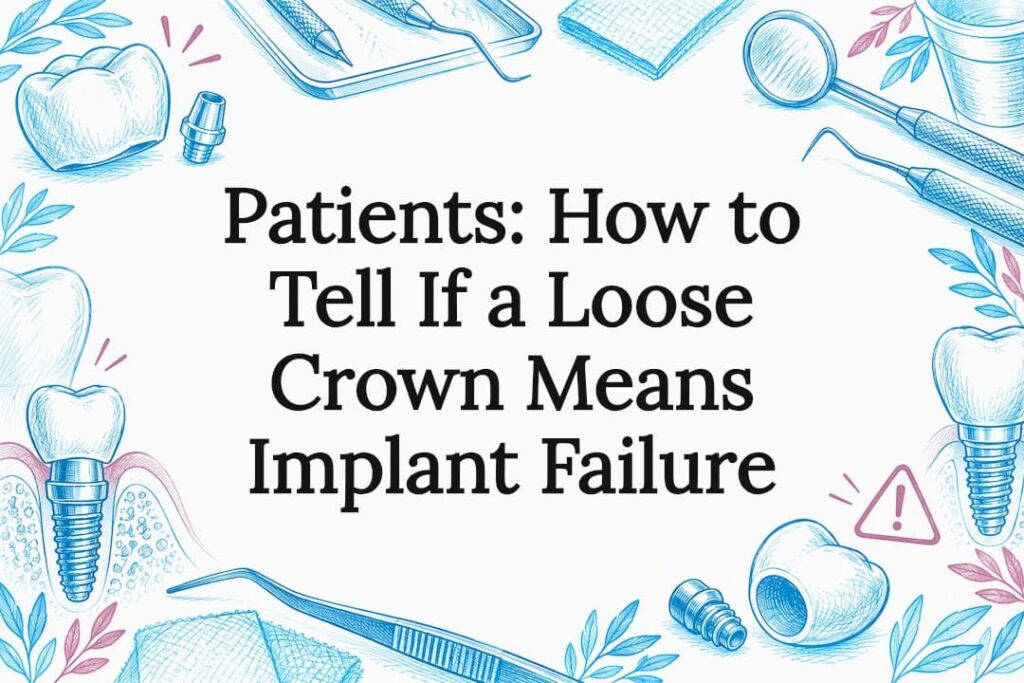
A loose implant crown usually means the crown, the connecting abutment, or the screw holding it in place has loosened, not that the titanium implant itself has failed. Many cases are repairable in a single dental visit. Certain signs, though, point to a deeper problem that needs prompt attention. Keep any detached pieces, avoid chewing on that side, and call your dentist as soon as you notice movement.
TL;DR:
- Most loose implant crowns are due to screw or cement failure, not implant failure, and are often repairable in a single visit if identified early.
- Visual, tactile, and radiographic exams are necessary to differentiate crown or abutment mobility from actual implant loosening or failure.
- Causes of loosening include insufficient torque, cement issues, occlusal overload, parafunction, and laboratory errors, with proper technique greatly reducing risk.
- Symptoms such as wobbling or biting changes should prompt prompt professional assessment, and DIY fixes or household glues should be avoided.
- Peri-implant disease signs, like bleeding and swelling with mobility, require different treatment, emphasizing the importance of early detection and regular maintenance.
questions about this? we're happy to help.
Every patient's situation is a little different. If you want to talk through what this means for you, our Greenville team is one call away.
schedule a free consultationTable of Contents
- What a loose implant crown actually is
- Common mechanical and technical causes of loosening
- Signs and symptoms to check and what they suggest
- Immediate at-home steps and when to seek urgent care
- How dentists diagnose and fix a loose implant crown
- Preventing future loosening with better habits and maintenance
- When loosening signals peri-implant disease
- How Complete Dental Care approaches diagnosis and repair
- Getting your loose crown checked and repaired
- Sources
- FAQ
What a loose implant crown actually is
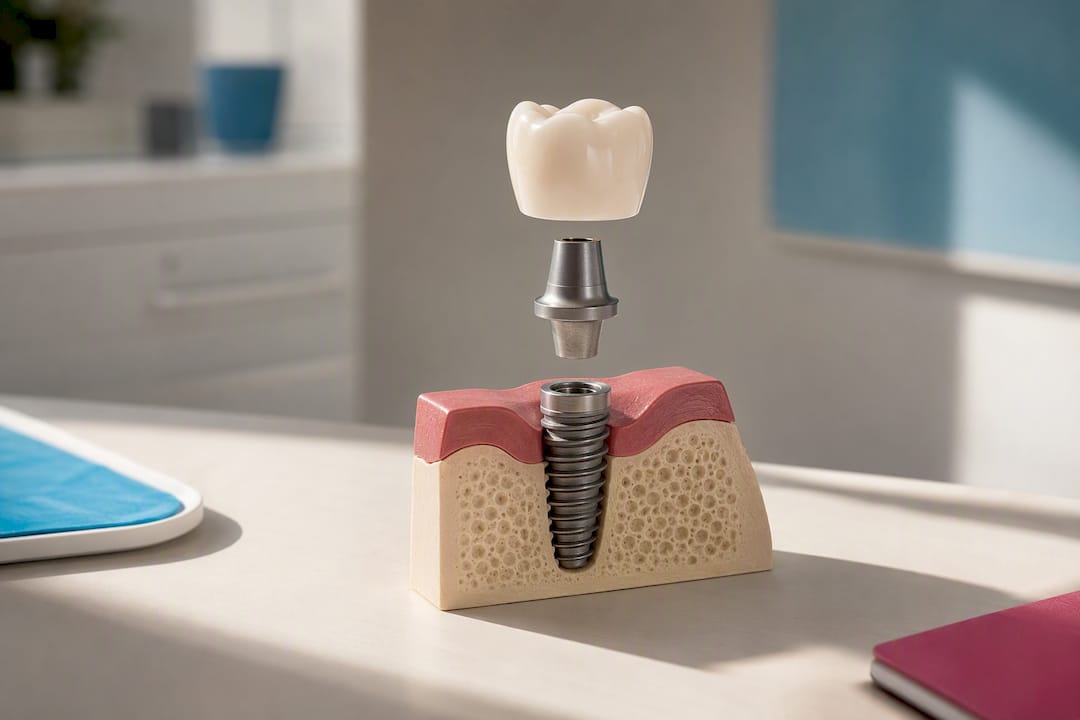
A dental implant restoration has three parts: the titanium implant fused to the jawbone, the abutment that connects to it, and the crown on top. Each piece can loosen on its own, which is why a wobbly crown does not automatically mean the implant has failed. The visible crown or its screw is the most common point of failure, while the implant underneath usually stays firmly integrated with bone.
Dentists tell the two apart with a combination of visual inspection, gentle manual pressure, and a radiograph to check bone levels around the implant. Distinguishing crown or abutment mobility from true implant-body mobility requires this kind of clinical exam. It cannot be judged from how a tooth feels alone.
When you call your dentist, describe:
- When the looseness started and whether it happened suddenly or gradually
- Whether any piece has come off completely, and whether you still have it
- Any pain, bleeding, swelling, or bad taste around the area
- Whether you can still bite down normally on that side
Common mechanical and technical causes of loosening
Most loose implant crowns trace back to one of a few mechanical issues, and knowing which one applies helps set expectations for the fix.
- Abutment-screw loosening: the small screw holding the abutment to the implant backs out, often because the initial torque was insufficient or the connection lacks solid anti-rotation features.
- Cement failure: for cement-retained crowns, contamination during seating, the wrong cement type, or technique issues can let the crown detach from the abutment.
- Occlusal overload and parafunction: grinding, clenching, or a bite that puts uneven force on the crown, particularly with wide occlusal surfaces, cantilevered designs, or steep cusp angles, stresses the screw and cement over time.
- Laboratory or clinical errors: a crown that does not fit precisely, or a screw that was not torqued to the manufacturer’s specification at seating, sets up loosening later.
A systematic review of abutment-screw loosening found that when proper anti-rotation features and manufacturer-specified torque are used, the complication is uncommon, with estimated complication-free rates of about 97% for both external- and internal-connection implants at three years. A separate cross-sectional study of single-implant crowns found screw loosening in a noticeable minority of cases based on the study sample, and linked it to non-axial loading, wider occlusal tables, steep cuspal inclines, cantilevering, and grinding habits.
Pro Tip: If you grind your teeth at night, mention it to your dentist even if your crown feels fine. Parafunction is one of the most common hidden contributors to future loosening.
Signs and symptoms to check and what they suggest
A short self-check can help you describe the problem clearly, but it should never replace a professional exam.
- Wobble felt with your tongue or a fingertip: usually points to a loose screw or a failed cement bond rather than implant failure.
- A change in your bite or food trapping around the crown: suggests the crown has shifted position, even slightly.
- Pain when chewing: often a mechanical issue with the crown or abutment, though sharp or deep pain can signal a problem reaching the implant itself.
- Bleeding, swelling, or discharge around the gum line: raises concern for infection or peri-implant disease rather than a purely mechanical issue.
- Worsening pain over days rather than staying steady: a sign to seek care sooner rather than waiting for your next scheduled visit.
Check gently, once, without repeatedly wiggling the crown or trying to remove it yourself. Repeated manipulation can worsen a cement bond that is only partially failed or push a loose screw further out of position.
Immediate at-home steps and when to seek urgent care
If a crown or piece comes loose, a few safe actions protect you until you’re seen.
- Keep the crown and any detached parts in a small container. Your dentist may be able to reuse them.
- Avoid chewing on that side and stick to softer foods until your appointment.
- Continue gentle brushing and flossing around the area unless it causes significant pain, consistent with ADA guidance on maintaining oral hygiene during dental problems.
- Call your dentist promptly rather than waiting for a routine cleaning.
Do not use household glue, over-the-counter dental cement, or attempt to re-tighten a screw yourself. Reviews of chairside repair materials show no clearly superior option and substantial inconsistency across studies, which supports leaving these fixes to a professional evaluation rather than a DIY attempt.
Treat it as an emergency if you have severe pain, facial swelling, fever or other signs of spreading infection, uncontrolled bleeding, or if the crown has fully detached and poses a choking risk.
Pro Tip: When you call the office, have ready: when the looseness started, whether any piece is missing, and a description of your pain on a simple scale like mild, moderate, or severe. It speeds up scheduling the right kind of visit.
How dentists diagnose and fix a loose implant crown
A dental visit for a loose crown typically follows a predictable sequence.
- Clinical exam and radiograph to check bone levels and rule out implant-body mobility.
- Removal of the crown to directly inspect the abutment and screw, since visual and tactile checks alone can miss the exact cause.
- Assessment of the surrounding gum tissue for signs of mucositis or peri-implantitis that might explain or accompany the mechanical problem.
Once the cause is clear, treatment usually falls into one of these categories:
- Re-torquing or replacing the abutment screw to manufacturer specification
- Recementing the existing crown, or remaking it if the fit or shape is contributing to the problem
- Retrieving a broken or seized screw, which ADA reporting notes adds visits and complexity to an otherwise routine repair
- Treating peri-implant disease with scaling, antimicrobial therapy, or surgery when biological factors are involved, with implant replacement considered only in advanced bone loss
Cases get more complex when a screw has fractured below the gumline, when bone loss requires grafting before any restoration work, or when staged care across multiple visits becomes necessary. Full details on grafting and implant replacement procedures are covered on the surgical and implant dentistry page.
Preventing future loosening with better habits and maintenance
A few consistent habits meaningfully lower the odds of a repeat problem.
- Brush and floss daily around the implant, and use interdental brushes to clear debris the crown’s shape can trap. A full daily cleaning routine is worth reviewing if you’re not sure your technique is thorough.
- If you grind or clench, ask about a custom nightguard and whether your bite needs adjustment.
- Keep regular periodontal maintenance visits. ADA guidance recommends individualized recall intervals, with higher-risk patients seen more frequently to monitor attachment, pocket depth, bleeding, and mobility.
- Discuss prosthetic design with your dentist. Avoiding cantilevered extensions and correcting uneven bite forces reduces long-term stress on the screw and cement.
Understanding realistic expectations for how long a well-maintained restoration should last also helps you spot a problem early. Details on typical implant lifespan are useful context for what “normal wear” looks like.
When loosening signals peri-implant disease
Not every loose crown is purely mechanical. The American Academy of Periodontology distinguishes peri-implant mucositis, reversible inflammation of the soft tissue around an implant, from peri-implantitis, which includes loss of the supporting bone and usually needs surgical treatment once advanced.
- Bleeding, swelling, or discharge combined with any mobility raises concern that bone loss is involved, not just a loose screw.
- The AAP notes that mobility alone doesn’t identify the cause. Clinicians assess both the prosthesis and the surrounding tissue to separate a mechanical problem from a biological one.
- Early treatment, ranging from professional cleaning to surgical intervention, along with consistent maintenance, is central to preventing recurrence. Readers managing gum disease alongside implants may find our guide to implants after gum disease useful for that overlap.
How Complete Dental Care approaches diagnosis and repair
A loose crown visit typically starts with 3D imaging and digital scanning to pinpoint whether the issue is mechanical or tissue-related before any work begins. That upfront clarity means fewer guesswork visits. At your first appointment, expect an exam, imaging, a clear explanation of what’s causing the looseness, and a proposed fix with a realistic timeline and payment options discussed before treatment starts.
— Complete Dental Care
Getting your loose crown checked and repaired
Loose implant crowns can be treated from both angles: mechanical repairs like re-torquing a screw or remaking a crown, and managing peri-implant disease when tissue or bone is involved. If your crown feels off, don’t wait for it to worsen.
- Book an exam and bring any detached crown or screw pieces with you.
- Expect imaging as part of the visit, not an extra step tacked on later.
- Ask about a full treatment plan, including cost and timeline, before agreeing to any repair.
For readers facing more extensive rebuilding needs, our Teeth in a Day option and full surgical and implant dentistry services cover everything from single-crown repair to full-arch solutions. Schedule a first visit to get a clear answer on what your crown actually needs.
This article is general information, not a substitute for advice from a qualified doctor. Consult a qualified healthcare professional about your own circumstances before acting on anything here.
Sources
- Abutment screw loosening in single-implant restorations: a systematic review
- Peri-implant diseases – American Academy of Periodontology
- Factors associated with abutment screw loosening in single implant supported crowns: A cross-sectional study
- ADA guidance on periodontitis and maintenance
FAQ
Can a loose implant crown be tightened?
Yes, in many cases a dentist can remove the crown, re-torque or replace the abutment screw, and reseat it in a single visit. If the crown was cement-retained and the bond failed, it may simply need recementing rather than a screw adjustment.
Is a loose implant crown an emergency?
It is not always an emergency, but it should be treated promptly rather than left alone. Seek urgent care if you have severe pain, swelling, signs of infection, uncontrolled bleeding, or a crown piece that could be swallowed or inhaled.
How much does it cost to tighten an implant screw?
Cost depends on what’s causing the looseness and whether it’s a simple re-torque or a more involved repair like a broken screw retrieval. Pricing is typically provided during an exam once the specific cause is identified, and treatment plans are discussed before any work begins.
Is it normal for an implant crown to wiggle?
No, a healthy implant crown should feel completely stable, so any wiggle is a sign something needs attention. It’s usually a loosened screw or failed cement rather than a failing implant, but it should still be checked to rule out peri-implant disease.
questions about this? we're happy to help.
Every patient's situation is a little different. If you want to talk through what this means for you, our Greenville team is one call away.
schedule a free consultation