Silver diamine fluoride is a liquid treatment that stops many cavities from getting worse without a drill or a needle, but it permanently turns the treated decay black. Dentists typically use a 38% concentration, and the American Academy of Pediatric Dentistry conditionally recommends it for specific situations in children’s teeth. The trade-off is simple: you get a fast, painless way to arrest decay, and in exchange, the tooth shows a dark stain where the cavity was.
TL;DR:
- Repeated applications of SDF twice annually increase the chances of successfully arresting cavities, especially in primary teeth and young children.
- SDF is most effective for accessible, small to moderate cavities in patients who cannot tolerate drilling or require interim treatment.
- The primary aesthetic trade-off is permanent black staining of decay, which is more acceptable on back teeth but problematic on front teeth for many parents.
- SDF is contraindicated for patients with silver allergies and is not suitable for teeth with decay reaching the pulp or requiring extensive reconstruction.
- Regular follow-up and reapplication are essential, as arrested decay can reactivate, especially if not monitored and maintained properly.
questions about this? we're happy to help.
Every patient's situation is a little different. If you want to talk through what this means for you, our Greenville team is one call away.
schedule a free consultationTable of Contents
- What silver diamine fluoride is and how it works
- What the evidence says: effectiveness for arresting and preventing cavities
- Who is a good candidate for SDF and when dentists recommend it
- What to expect during and after an SDF appointment
- Safety, side effects, and aesthetic trade-offs parents must know
- Alternatives and how SDF fits into a longer treatment plan
- A dentist’s perspective: how we use SDF and counsel families
- Long-term outcomes and retreatment protocols after SDF application
- Age and patient condition considerations beyond children
- Common myths and misconceptions about SDF
- Environmental and disposal considerations for SDF products
- What matters most when weighing SDF for your child
- How Complete Dental Care helps families considering SDF
- FAQ
- Sources
What silver diamine fluoride is and how it works
Silver diamine fluoride, usually shortened to SDF, combines three active ingredients: silver, fluoride, and ammonia, which keeps the silver and fluoride stable in a liquid solution. The silver ions act against the bacteria living inside a cavity, and the fluoride supports remineralization of the softened tooth structure around it. Together, these two actions are what dentists mean when they say SDF “arrests” a cavity: the decay process slows or stops, rather than the tooth being restored to its original shape.
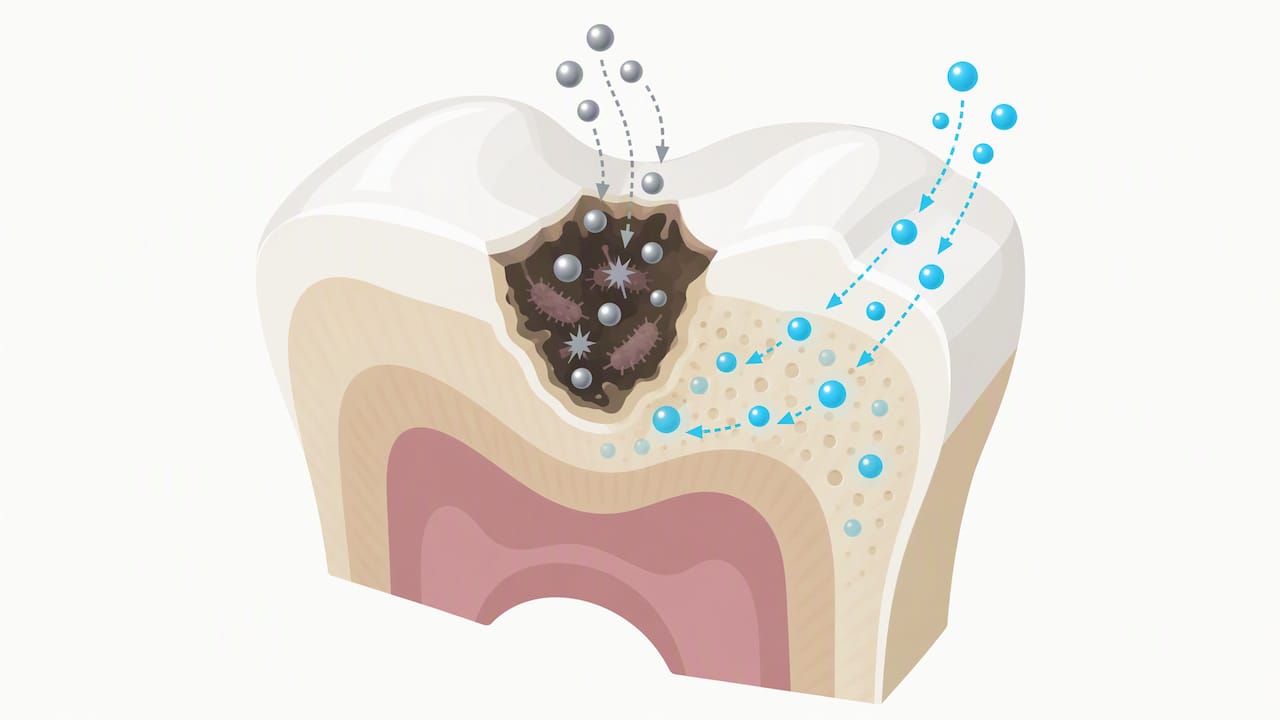
In clinics, the standard product is 38% SDF, the concentration cited throughout AAPD’s clinical guidance and most published research. Products containing SDF have received FDA 510(k) clearance in the United States, though that clearance is officially for use as a tooth desensitizer, not specifically as a cavity-arresting agent. Dentists who apply SDF to stop decay are using a well-studied, guideline-supported practice, even though the formal labeling reflects an older use case.
What this means for your family in the chair:
- SDF requires no drilling, anesthesia, or injections, which makes it useful for young or anxious children.
- The treatment takes only minutes, so a child does not need to sit still for long.
- It works best on cavities that are accessible and not too deep, rather than on advanced decay near the nerve.
- Because it is a liquid painted onto the tooth, it can be reapplied easily at follow-up visits.
A dentist typically chooses SDF because it solves an access or cooperation problem: a cavity that cannot easily be filled right now, a child who cannot yet tolerate a longer procedure, or a family that needs a bridge until more involved treatment is possible.
What the evidence says: effectiveness for arresting and preventing cavities
Parents reasonably want to know whether SDF actually works, and the research base has grown substantially in recent years. A 2024 systematic review concluded that SDF is effective at preventing and arresting dental caries in primary teeth and permanent first molars, and that repeated applications, given annually or twice a year, produced better outcomes than a single treatment. That finding matters because it reframes SDF not as a one-time fix but as an ongoing part of caries control.
A more recent updated systematic review and meta-analysis compared 38% SDF directly against sodium fluoride varnish, the other common preventive liquid used in dental offices. The pooled data showed higher odds of arresting early childhood caries with SDF than with sodium fluoride varnish, with an odds ratio of approximately 1.4 favoring SDF. Many of the trials included in that review reported arrest in more than 60% of lesions when SDF was applied repeatedly over time.
Nearly 1.4 times higher odds of caries arrest were reported for 38% SDF compared with sodium fluoride varnish, according to the pooled meta-analysis data. That gap helps explain why SDF has become a first-line option for arresting visible cavities rather than simply preventing new ones.
A few things temper how confidently parents should read these numbers:
- Most of the supporting trials were conducted in young children with primary teeth, so the evidence is thinner for permanent teeth and adult populations.
- Study quality varies, and reviewers have flagged heterogeneity in how “arrest” was defined and measured across trials, which affects how precise the pooled estimates really are.
- Outcomes depend heavily on follow-up: a single application is less effective than scheduled reapplications, usually twice yearly.
- Arrest does not mean the tooth looks or functions like a healthy one. it means the active decay process has stopped.
For parents, “arrest” is a clinical term worth understanding plainly. It means the dentist examines the lesion and finds it hard, dry, and no longer progressing, rather than soft and active. It does not mean the hole in the tooth disappears or that the tooth returns to its original color. Realistic expectations matter here: SDF buys time and stops damage, and in many cases that is exactly what a family needs, but it is not cosmetic repair.
The Evidence-Based Dentistry literature has described SDF similarly: effective at halting decay, well tolerated, and best understood as one tool within a longer-term prevention and treatment plan rather than a stand-alone cure.
Who is a good candidate for SDF and when dentists recommend it
SDF tends to fit certain situations particularly well, and dentists weigh a handful of factors before recommending it.
- Young children who cannot yet tolerate a filling appointment, especially toddlers and preschoolers.
- Children or adults with special health care needs where sedation or lengthy procedures carry added risk.
- Patients at high risk for new cavities who need an interim measure while a broader prevention plan takes hold.
- Families without immediate access to restorative dental care, where arresting decay now prevents a bigger problem later.
- Multiple small cavitated lesions that would otherwise require several separate filling appointments.
SDF is not the right tool for every cavity. It is generally avoided for patients with a known silver allergy, since the treatment contains silver ions that could trigger a reaction. It is also not appropriate for teeth where decay has reached the pulp, the living tissue at the center of the tooth, since those cases usually need a root canal or extraction rather than surface treatment. Teeth that are extensively broken down and need to be rebuilt for normal chewing function are better served by a filling or crown that restores shape, not just stops decay.
Pro Tip: Ask your dentist whether a specific cavity is a good SDF candidate or whether it has already progressed too far for a surface treatment to help.
SDF works best as one piece of a larger plan. A dentist assessing a child’s caries risk will typically combine it with professional fluoride varnish applications, sealants on healthy molars, coaching on brushing and diet, and traditional restorations for teeth that need them. Thinking of SDF as one tool in that toolkit, rather than a universal substitute for fillings, sets the right expectations from the start.
What to expect during and after an SDF appointment
The procedure itself is short and usually well tolerated, even by young children who are nervous about dental visits.
- The dentist or hygienist dries the tooth and isolates it with cotton rolls or a similar barrier to keep the liquid off the surrounding gum and cheek tissue.
- A small brush applies the SDF liquid directly onto the cavity, and the whole application typically takes under five to ten minutes per tooth.
- The liquid is allowed to air dry briefly on the tooth surface.
- Staining becomes visible almost immediately, since the chemical reaction between the silver and the softened decayed tissue happens quickly.
- Clothing and skin protection matter during application, since SDF can stain fabric, skin, or countertops if it drips, so clinics take care with bibs and careful technique.
The black staining that appears is permanent on the areas of decay that were treated. It does not fade or wash out over time, and it will not go away unless the stained portion of the tooth is later removed by a filling or crown. This is the central trade-off parents need to understand before treatment begins. healthy tooth structure around the lesion is not affected, but the treated decay itself will stay dark for the life of that tooth or until it is restored.
Most guidance, including the AAPD’s clinical recommendation, calls for reapplication roughly twice a year to maintain arrest and catch any lesions that start progressing again. Between applications, the dentist checks the treated teeth visually and with a dental instrument to confirm the area still feels hard and dry rather than soft, which would signal the decay is active again. Radiographs, when needed, help the dentist see whether decay is approaching the nerve or whether a tooth that once seemed arrested needs a different approach. Routine checkup scheduling keeps this monitoring on track so problems get caught early rather than at the next symptomatic flare-up.
Safety, side effects, and aesthetic trade-offs parents must know
The permanent black staining of treated decay is, by a wide margin, the most significant and most discussed side effect of SDF, and it deserves a direct conversation before treatment rather than a surprise afterward. Research summarized in Evidence-Based Dentistry has found that parental acceptance of this staining tends to be higher for back teeth, which are less visible when a child smiles or talks, and lower for front teeth, where the cosmetic impact is harder to ignore. A meaningful share of parents in these studies found the staining unacceptable under any circumstance, according to that evidence synthesis, which is exactly why dentists are expected to discuss esthetics openly rather than assume every family will accept the look.
Beyond staining, other reported effects include:
- Temporary tooth sensitivity after application, which usually resolves on its own.
- Occasional, temporary staining of soft tissue such as the gums or lips if the liquid contacts them during application.
- Rare allergic reactions, which is why a known silver allergy is a contraindication.
- Isolated reports in the FDA’s adverse event database of post-application sensitivity or nerve-related discomfort, though these reports are uncommon and voluntary rather than systematically tracked.
Some clinicians apply potassium iodide immediately after SDF in an attempt to reduce the dark staining. The evidence on this approach is mixed, and some research suggests potassium iodide may reduce how effectively SDF arrests the decay, which is why practices vary in whether they offer it. If a dentist proposes this step, it is worth asking directly how it might affect both the appearance and the arresting power of the treatment.
Before agreeing to SDF, a short consent checklist is worth working through with your dentist:
- What will the treated tooth likely look like immediately afterward and in the long term?
- Will there be before-and-after photos to document the change?
- How often will reapplication be needed, and for how long?
- What are the options for restoring the tooth’s appearance later, once decay is arrested?
Alternatives and how SDF fits into a longer treatment plan
SDF is one option among several, and understanding how it differs from the alternatives helps families choose the right path for a given tooth. Fluoride varnish is primarily a prevention tool. it strengthens enamel and helps stop early decay before a cavity fully forms, but it is not designed to arrest an existing cavitated lesion the way SDF is. Conventional fillings, by contrast, restore the tooth’s shape and chewing function immediately, which SDF does not do on its own.
- Fluoride varnish works best on early, non-cavitated decay or as a general preventive measure for all children.
- SDF is suited to cavities that have already formed but cannot yet be filled, or where filling is not the immediate priority.
- Interim restorations, sometimes called atraumatic restorative treatment, fill a cavity with a simple material without full drilling, bridging the gap between SDF and a permanent filling.
- Traditional fillings or crowns remain the standard when a tooth needs its shape, strength, or appearance fully restored.
For anxious children or those with medical complexities, SDF often serves as a bridge: it stops the clock on decay now, buying time until the child is older, calmer, or medically ready for sedation or a longer restorative appointment. Families should expect a follow-up conversation about timelines. some teeth stay arrested and stained indefinitely with no further treatment needed, especially baby teeth that will eventually fall out, while others move toward a filling or crown once circumstances allow.
A dentist’s perspective: how we use SDF and counsel families
Evaluating whether a cavity is a good candidate for SDF starts the same way most treatment decisions do: with a risk assessment that looks at how active the decay is, how accessible the tooth is, and how well a child or patient is likely to tolerate other options. Imaging helps confirm whether decay is close to the nerve, which would rule SDF out in favor of a root canal or extraction.
Consent conversations focus on setting realistic expectations before any liquid touches a tooth. We walk families through what the staining will look like, show comparison photos where helpful, and talk through the reapplication schedule so nobody is surprised at the next visit. When a tooth is likely to need a filling or crown eventually, we talk about that timeline up front rather than leaving it open-ended.
Comfort matters just as much as the clinical decision. For children who are nervous about any dental visit, having a therapy dog in the office or discussing sedation options can shift the calculation. sometimes a calmer child can tolerate a filling appointment that would otherwise require SDF as a stopgap, and sometimes SDF remains the better short-term choice regardless. Those conversations happen case by case, with the goal of matching the treatment to the person in the chair, not a one-size-fits-all protocol.
Long-term outcomes and retreatment protocols after SDF application
Arrested decay does not always stay arrested forever, which is why retreatment protocols matter as much as the initial application. Guidance supporting SDF’s conditional recommendation points to biannual reapplication as the typical schedule for maintaining arrest, since a single treatment is less durable than repeated ones.
At each follow-up, the dentist checks whether the treated area still feels hard and dry. If it has softened again, that signals the decay has reactivated, and the tooth may need another SDF application, a filling, or a different approach depending on how much structure remains. Guidance aimed at physicians and primary-care clinicians applying SDF has emphasized that it is technique-sensitive and not a one-time cure, reinforcing why ongoing monitoring is part of the deal rather than an afterthought.
For baby teeth that will naturally fall out before adulthood, some families and dentists decide that repeated SDF treatment is sufficient, with no restorative follow-up needed. For permanent teeth, the long-term plan more often includes an eventual filling or crown once the patient is ready, since the stained, arrested dentin remains part of the tooth structure until it is physically removed and replaced.
Age and patient condition considerations beyond children
SDF guidance is written primarily around children, but the same logic applies to other groups who face similar barriers to traditional restorative care. Older adults, particularly those with limited mobility, cognitive decline, or multiple health conditions, often struggle to tolerate long dental appointments, which makes SDF’s speed and simplicity appealing for arresting root or coronal decay in that population.
Patients with special health care needs, regardless of age, frequently share the same practical challenges that make SDF attractive for young children: difficulty sitting still, sensory sensitivities, or medical risk factors that make sedation less desirable. AAPD guidance for physicians specifically addresses using SDF in children and adolescents with special health care needs, reflecting how often access and cooperation, not age alone, drive the decision.
Across every group, the same contraindications apply: a known silver allergy rules SDF out, and teeth with deep decay reaching the pulp need more definitive treatment regardless of the patient’s age or condition. The decision to use SDF is really a decision about which patients benefit most from a fast, low-stress intervention versus one who can safely and comfortably undergo conventional restorative care.
Common myths and misconceptions about SDF
A few misunderstandings come up often enough to address directly. The first is that SDF “cures” cavities. it does not. it arrests the decay process and leaves a dark, hardened lesion in place, which is a different outcome than restoring a tooth to its original color and shape.
A second myth is that the black staining will fade over time. It will not fade on the treated decayed tissue, though healthy enamel around it is unaffected and keeps its normal color. A third misconception is that SDF is a brand-new or experimental treatment. In reality, it has been studied for years and is supported by systematic reviews and conditional recommendations from major pediatric dentistry organizations, even though it has only become more widely used in recent years.
Finally, some parents assume SDF is interchangeable with fluoride varnish. The two serve different purposes. varnish helps prevent decay from forming or progressing early, while SDF is used specifically to arrest cavities that have already developed, and understanding that distinction helps families ask for the right treatment at the right stage.
Environmental and disposal considerations for SDF products
SDF products are supplied in small single-use or multi-dose vials, and like other chemical agents used in dental offices, leftover solution and used applicators are handled as part of the practice’s standard clinical waste protocols rather than poured down a sink or thrown in regular trash. Because the solution contains silver compounds, dental offices generally follow the same waste-handling practices used for other silver-containing dental materials to avoid unnecessary environmental release.
For families, this consideration rarely comes up outside the clinical setting, since SDF is applied and stored by trained staff rather than used at home. The practical takeaway is simply that a dental office offering SDF should have clear protocols for storing, applying, and disposing of the product safely, which is a reasonable thing to ask about if you want to understand how your provider manages chemical materials in general.
What matters most when weighing SDF for your child
The conventional advice on SDF tends to oversell the “no drilling, no needles” part and undersell the conversation that should happen before treatment: what the tooth will look like afterward, and for how long. That trade-off is the whole story, and skipping past it does families a disservice.
What is overrated, in my view, is treating SDF as a simple, low-stakes swap for a filling. It is not a filling. It is a different tool with a different outcome, and the parents who feel most satisfied afterward are the ones who understood the staining before it happened, not after.
What the evidence actually supports is narrower and more useful: SDF is a strong option for specific situations, young or anxious children, limited access to restorative care, multiple small cavities, rather than a universal first choice. Prioritize the conversation about appearance and follow-up over the convenience of a quick appointment, and the rest of the decision tends to fall into place.
— Complete Dental Care
How Complete Dental Care helps families considering SDF
Deciding whether SDF or a filling makes more sense for your child does not have to happen on your own. Our team evaluates each cavity individually, as part of general dentistry visits that include exams, X-rays, and a conversation about which approach fits your child’s age, cooperation level, and the condition of the tooth itself. For families who want to avoid the stress of a long procedure right now, SDF can be part of that plan, paired with a clear follow-up schedule and, when needed, a path toward a filling or crown later.
Appointments typically start with a standard evaluation, so bring your child’s dental history and any recent X-rays if you have them. Comfort measures like a calm, unhurried visit and support for anxious kids are built into how we practice, so there is no need to prepare for anything beyond a normal checkup.
If you want to talk through whether SDF, a filling, or another preventive option fits your situation, you can schedule a visit with Complete Dental Care and get a straight answer based on what your child’s teeth actually need.
This article is general information, not a substitute for advice from a qualified doctor. Consult a qualified healthcare professional about your own circumstances before acting on anything here.
FAQ
Is SDF better than a filling?
SDF and fillings solve different problems: SDF stops decay from progressing without restoring the tooth’s shape, while a filling restores both function and appearance. For a cavity that cannot yet be filled, SDF is often the better short-term choice, but it is not a replacement for a filling when one is possible.
How long does SDF take to turn black?
Staining typically becomes visible almost immediately after application, since the chemical reaction between the silver and the decayed tooth structure happens quickly. The color can continue to darken slightly over the following days as the reaction completes.
What is the “zombie effect” of SDF?
This informal term describes the look of a tooth where SDF has turned the decayed area black while the surrounding healthy enamel stays its normal color, creating a visibly dark, uneven appearance. It is simply a description of the expected staining pattern rather than a separate side effect or complication.
Is silver diamine fluoride safe for kids?
SDF is considered safe for children when used appropriately, and the American Academy of Pediatric Dentistry conditionally recommends it for arresting cavitated lesions in primary teeth. The main risks are permanent staining of treated decay and the need to avoid it in children with a known silver allergy.
Sources
- Use of Silver Diamine Fluoride for Dental Caries Management in Children and Adolescents, Including Those with Special Health Care Needs (AAPD)
- Comparative Efficacy of Silver Diamine Fluoride and Sodium Fluoride in Managing Early Childhood Caries: An Updated Systematic Review and Meta‐Analysis
- Silver Diamine Fluoride in Pediatric Dentistry: Effectiveness in Preventing and Arresting Dental Caries – Systematic Review (PubMed)
- K222459 — Centrix FluoroSilver Silver Diamine Fluoride 38% — FDA 510(k) Summary
questions about this? we're happy to help.
Every patient's situation is a little different. If you want to talk through what this means for you, our Greenville team is one call away.
schedule a free consultation