All-on-6 is a full-arch fixed dental bridge anchored to six implants, chosen when a jaw needs more support than an All-on-4 setup can reliably provide. Dentists tend to recommend it for patients with lower bone density, longer bridge spans, or heavier bite forces, since spreading the load across six anchor points improves stability. Whether it fits your case depends on your scans, medical history, and prosthetic plan, so this is a starting point for a conversation with your provider, not a diagnosis.
TL;DR:
- All-on-6 provides better support for patients with low bone density, heavy bite forces, or longer bridge spans, due to six implant anchors instead of four.
- The procedure often involves staged healing, with a 3 to 6 months osseointegration period, and may require bone grafting if scans reveal insufficient support.
- Patients with active gum disease, uncontrolled diabetes, or who smoke heavily face higher failure risks and should optimize health before treatment.
- Six implants distribute chewing forces more evenly, which benefits bruxers and heavy bite patients, but increases surgical time and overall cost.
- Professional maintenance every 2 to 6 months and early management of peri-implant inflammation are crucial for long-term success.
questions about this? we're happy to help.
Every patient's situation is a little different. If you want to talk through what this means for you, our Greenville team is one call away.
schedule a free consultationTable of Contents
- What Is All-on-6, Exactly?
- How Dentists Decide Between All-on-4 and All-on-6
- What to Expect During the All-on-6 Procedure
- Healing Timeline and Recovery After All-on-6
- All-on-4 vs All-on-6: Who Benefits From Six Implants
- Risks, Complications, and Long-Term Maintenance
- Who Is a Good Candidate for All-on-6
- Where Complete Dental Care Fits Into This Conversation
- Getting Full-Arch Implants Done at Complete Dental Care
- Sources
- FAQ
What Is All-on-6, Exactly?
All-on-6 replaces an entire arch of missing or failing teeth with a fixed bridge secured to six implants, unlike removable overdentures that snap on and off for cleaning. The bridge itself can be milled from zirconia, acrylic layered over a titanium bar, or a hybrid of both, and it attaches with either screws (removable by a dentist for repairs) or cement (more stable but harder to service). Many practices offer immediate-load protocols, sometimes called Teeth in a Day, where a temporary bridge goes on the same day as surgery, versus a staged approach where the gums heal for months before any teeth attach.
- Fixed bridges do not come out for cleaning, unlike removable dentures.
- Screw-retained prostheses allow easier professional maintenance than cemented ones.
- Immediate-load protocols place a temporary bridge the same day; staged protocols wait for healing first.
How Dentists Decide Between All-on-4 and All-on-6
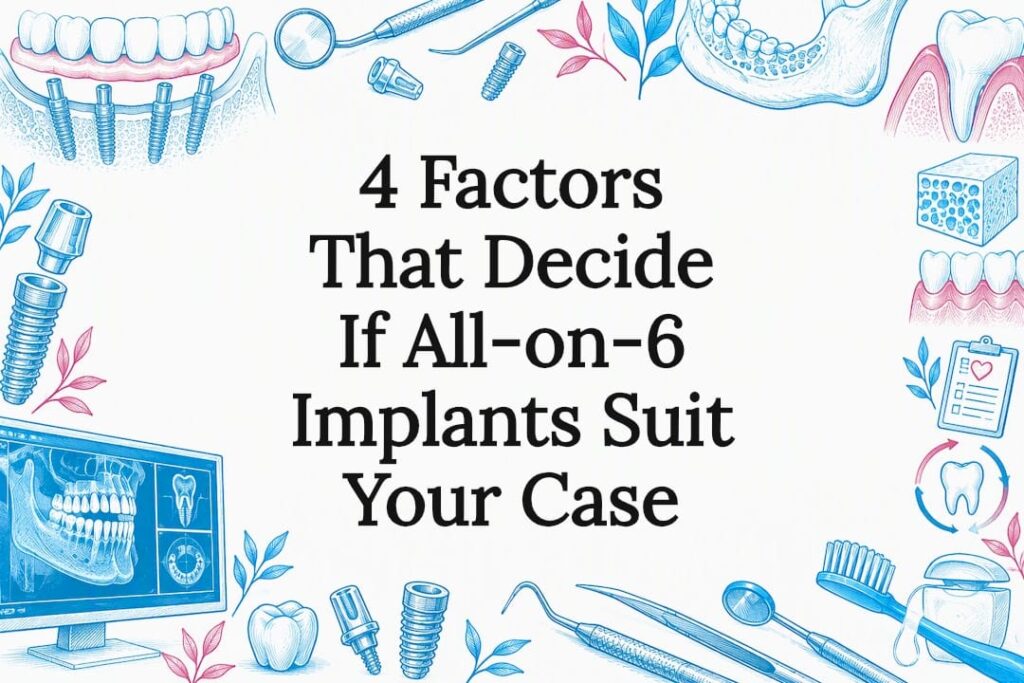
The choice between four and six implants comes down to a handful of measurable factors rather than a fixed rule.
- Bone volume and density. Thinner or softer bone, more common in the upper jaw than the lower, often needs the extra anchor points that six implants provide.
- Bite forces and bruxism. Patients who clench or grind put more strain on the prosthesis, and extra implants distribute that load.
- Cantilever length and esthetics. A longer bridge extension behind the last implant increases stress, so more support points can shorten the cantilever and improve the emergence profile.
- Provider planning and grafting needs. Dentists using 3D cone-beam imaging can map bone density precisely, and if volume is too low even for six implants, grafting becomes part of the plan.
Pro Tip: Ask your provider to walk through your own CBCT scan with you. Seeing your actual bone density and jaw shape makes the four-versus-six decision far less abstract.
What to Expect During the All-on-6 Procedure
The path from consultation to a finished smile follows a fairly consistent sequence, though timing varies by case.
- Preoperative planning. Digital scans, models, and a medical history review, including periodontal treatment if active gum disease is present, set the surgical plan before anything happens in the chair.
- Extractions and implant placement. Failing teeth come out, and six implants are placed into the jawbone in the same visit or in stages, depending on bone quality.
- Grafting when needed. Sinus lifts or ridge augmentation add bone volume first if the scans show insufficient support for six implants.
- Immediate provisional or staged healing. A temporary bridge may attach the same day for appropriate candidates, or the gums heal uncovered for several months before any prosthetic step.
- Final prosthesis and verification. Once integration is confirmed, the definitive bridge is fitted and checked for bite alignment and fit.
Healing Timeline and Recovery After All-on-6
Osseointegration, the process where bone fuses to the implant surface, commonly takes 3 to 6 months, though smoking, diabetes, and grafting can extend that window. The first 48 to 72 hours after surgery typically bring swelling, bruising, and soreness that respond to standard pain management, and the FDA notes that infection risk is highest in this early window. Provisional bridges are often adjusted or progressively loaded as healing advances, with the final prosthesis delivered only after imaging confirms the implants are stable.
- Swelling and bruising usually peak in the first two to three days.
- Soft food is standard for the early healing period before progressing to normal chewing.
- Follow-up X-rays check bone integration before the final bridge is placed.
A nested case-control study found that patients with periodontitis had implant-failure odds 12.82 times higher than those without it, which is why gum health before surgery matters as much as the surgery itself.
All-on-4 vs All-on-6: Who Benefits From Six Implants
A retrospective cohort study of 217 patients and 1,222 implants followed for 3 to 13 years found no significant overall difference in survival between All-on-4 and All-on-6. The advantage of six implants showed up in specific subgroups: elderly patients, smokers, bruxers, and those with lower bone density tended to do better with the extra support. That predictability comes with tradeoffs.
- All-on-6 generally involves more surgical time and, often, a higher cost than All-on-4.
- Six implants distribute chewing forces more evenly, which can matter more for heavy bite patients than for average ones.
- The right question is not which system is better in general, but which one matches your bone volume, bite habits, and jaw anatomy.
Risks, Complications, and Long-Term Maintenance
Full-arch implants carry the same fundamental risks as any implant surgery, plus the maintenance demands of a larger prosthesis. Peri-implant mucositis, a reversible gum inflammation around the implant, affects roughly 43 to 47% of implant patients, while peri-implantitis, the more serious bone-involving version, affects about 20 to 22% and tends to progress faster than ordinary periodontitis. Mechanical problems, including loose screws and fractured prosthetic material, are the other common complication category, often tied to bite overload.
- Watch for bleeding gums, swelling, or a loose-feeling bridge between visits.
- Screw loosening usually needs a same-week dental visit to prevent further strain.
- Daily cleaning around the prosthesis reduces the bacterial buildup that drives peri-implant disease.
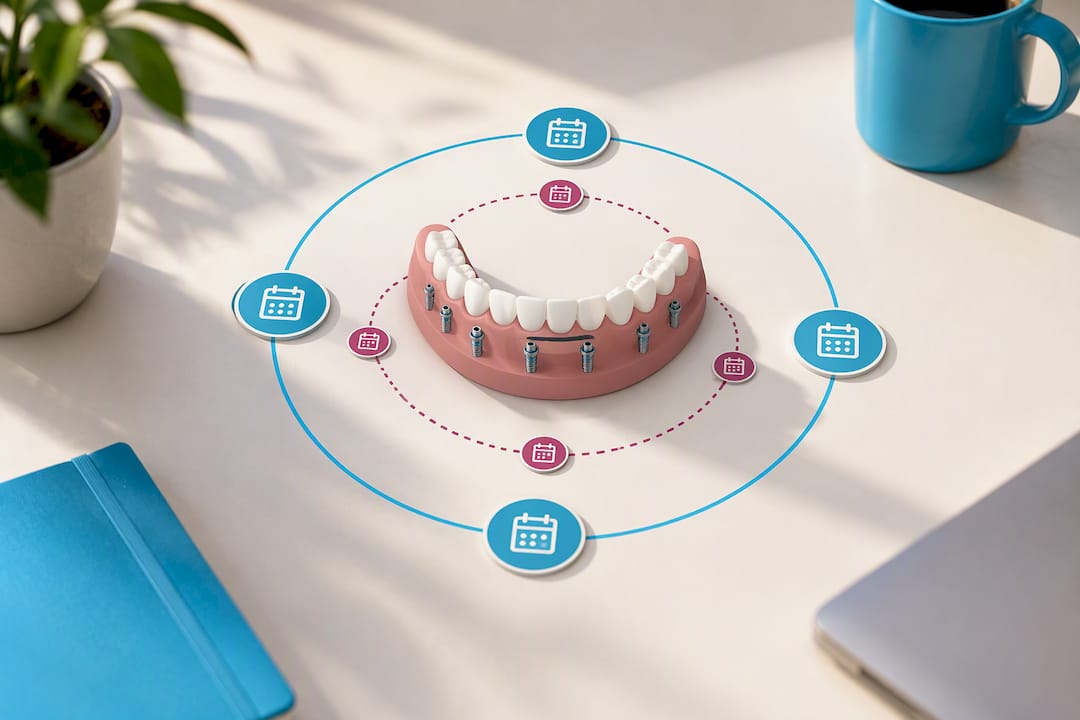
The American College of Prosthodontists recommends professional recall every 2 to 6 months based on individual risk, along with radiographic monitoring every 12 to 24 months to catch bone changes early.
Pro Tip: If you smoke or have a history of gum disease, book maintenance visits on the shorter end of that range, closer to every two to four months, rather than waiting for symptoms to show up.
Who Is a Good Candidate for All-on-6
Good candidates generally have adequate healed bone, controlled overall health, and realistic expectations about the maintenance commitment ahead. Heavy smokers, patients with uncontrolled type 2 diabetes, and those with active untreated periodontitis face measurably higher failure risk and usually need medical or periodontal optimization first.
- Quitting smoking, or at least pausing around surgery, meaningfully lowers complication risk.
- Getting blood sugar under control before surgery supports healing and integration.
- Treating active gum disease, sometimes through a program like implants after gum disease, should happen before implant placement, not after.
Before committing, ask a provider about their experience with full-arch cases, how they handle complications if they arise, and what prosthesis materials they recommend for your bite pattern.
Where Complete Dental Care Fits Into This Conversation
A dental practice may use 3D imaging to plan full-arch cases and offer immediate-load Teeth in a Day options for patients who qualify after evaluation. The practice also treats patients presenting with gum disease as part of implant preparation and maintains a video library showing procedures and what patients can expect, aimed at making the decision less opaque before treatment begins.
— Complete Dental Care
Getting Full-Arch Implants Done at Complete Dental Care
If you are weighing All-on-4 against All-on-6, a consultation with digital scans gives you a clearer answer than any general article can. A dental practice evaluates bone volume, bite force, and jaw anatomy, then discusses whether a same-day provisional or a staged healing plan fits each case.
- Discuss financing or the practice’s membership plan at your first visit.
- Ask about surgical and implant dentistry options, including bone grafting if your scans show reduced volume.
- Review Teeth in a Day to see if immediate-load treatment applies to your situation.
Request a consultation to get your own scan-based recommendation rather than a generic estimate.
Sources
- Dental implants: What you should know | FDA
- Periodontitis, type 2 diabetes, and other risk factors for implant failure: A nested case-control study – PubMed
- Consensus/review on peri-implant disease risk factors and management – PubMed
- Maintenance of Full-Arch Implant Restorations (American College of Prosthodontists guidance)
This article is general information, not a substitute for advice from a qualified doctor. Consult a qualified healthcare professional about your own circumstances before acting on anything here.
FAQ
How much do All-on-6 implants cost?
Complete Dental Care does not publish a fixed price for All-on-6 because costs depend on bone grafting needs, prosthesis materials, and whether immediate loading applies to your case. A full-arch implants cost breakdown can help explain the main cost drivers, and a provider can quote your specific plan after scans.
Which is better, All-on-4 or All-on-6 dental implants?
Neither system is universally better. A cohort study found similar overall survival between the two, but All-on-6 tended to perform more predictably for smokers, bruxers, and patients with lower bone density.
What is the average lifespan of All-on-6 dental implants?
Lifespan depends heavily on maintenance adherence and individual risk factors rather than a single fixed number. Following a professional recall schedule of every 2 to 6 months, as recommended by prosthodontic guidance, and treating early signs of peri-implant disease promptly both support longer-term success.
What are the disadvantages of All-on-6 dental implants?
All-on-6 typically involves more surgical time, a higher likelihood of needing bone grafting, and generally higher cost compared with All-on-4. It also carries the same underlying risks as any implant surgery, including infection, mucositis, and the potential for implant failure noted by the FDA.
questions about this? we're happy to help.
Every patient's situation is a little different. If you want to talk through what this means for you, our Greenville team is one call away.
schedule a free consultation