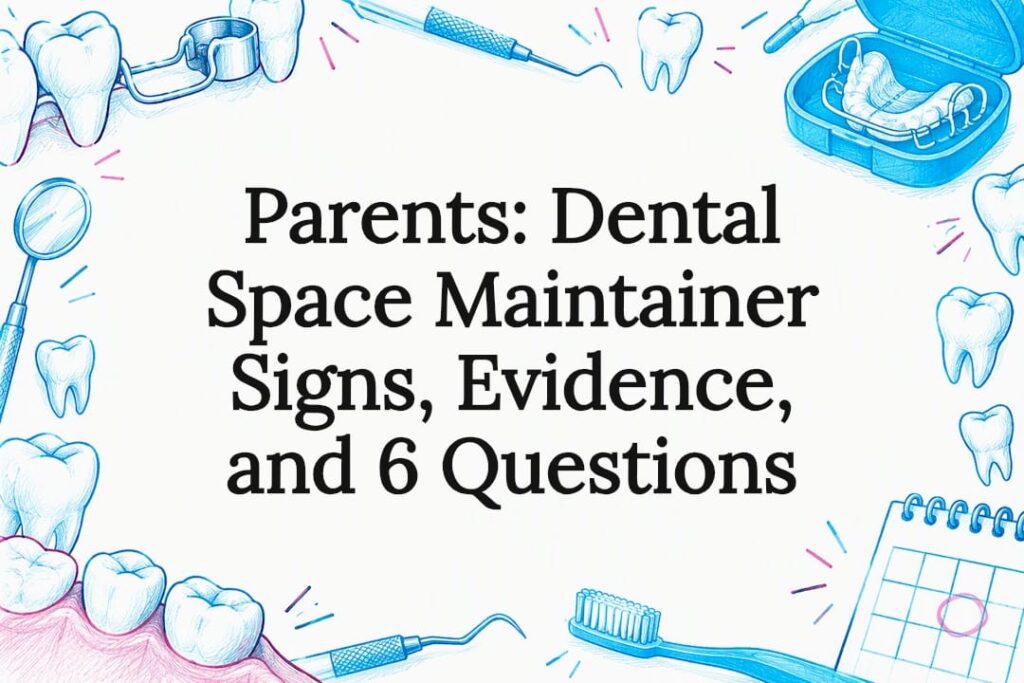
A dental space maintainer is an appliance used to hold open the gap after an early baby tooth loss so permanent teeth can erupt properly. Your child’s dentist will recommend one when the risk of space loss is likely to cause future alignment problems, following guidance from the AAPD on premature tooth loss in kids.
TL;DR:
- Fixed appliances like band-and-loop or crown-and-loop are preferred for single gaps caused by early molar loss, especially if the child is less likely to lose or chew the appliance.
- Space maintainers are mainly necessary for early loss of molars and canines, but rarely for front incisors, unless there is a high risk of space loss or arch crowding.
- Placement involves a quick exam, X-rays, impressions or scans, and cementation, with follow-up visits every six months to monitor eruption and appliance integrity.
- Routine care requires careful brushing, avoiding sticky and hard foods, and prompt dentist contact if the appliance becomes loose or causes discomfort.
- The need for a space maintainer depends on the child’s dental age, the type of tooth lost, and the likelihood of neighboring teeth drifting into the gap.
questions about this? we're happy to help.
Every patient's situation is a little different. If you want to talk through what this means for you, our Greenville team is one call away.
schedule a free consultationTable of Contents
- Types of space maintainers parents will see
- When does a child actually need one?
- What to expect during placement and follow-up
- Caring for the appliance and spotting problems early
- What the research and guidelines actually say
- Questions to ask your dentist before moving forward
- Our approach to pediatric preventive care
- Getting your child evaluated at Complete Dental Care
- Sources
- FAQ
Types of space maintainers parents will see
Space maintainers fall into two broad categories: fixed appliances cemented onto a tooth, and removable ones a child takes out for cleaning. The choice depends on which tooth was lost, how many teeth are missing, and whether your child can reliably keep track of a removable piece.
Fixed unilateral options treat a gap on one side of the mouth. A band-and-loop uses a metal band on a neighboring tooth connected to a loop that holds the space. A crown-and-loop works the same way but uses a crown instead of a band, often when the anchor tooth has a large filling or was treated with a root canal. A distal shoe extends slightly below the gumline to guide an unerupted first permanent molar into position, a design reserved for cases where that molar has not yet come in.
Bilateral appliances span both sides of the arch when several teeth are missing. A lower lingual holding arch (LLHA), a Nance appliance, and a transpalatal bar all connect to molars on each side to prevent the whole arch from collapsing inward.
Removable, Hawley-style partials look like a small retainer with an artificial tooth filling the gap. They suit older, cooperative children who will not lose or chew on the appliance. Resin-bonded or fiber-reinforced composite maintainers bond directly to teeth without bands, offering a quicker, less visible option, though a 2025 systematic review found their durability drops off after six to twelve months.
- Band-and-loop and crown-and-loop: hold a single-sided gap after losing one primary molar.
- Distal shoe: guides an unerupted first permanent molar into its correct position.
- LLHA, Nance, and transpalatal bar: protect arch space when multiple teeth are missing on both sides.
- Hawley-style removable and resin-bonded options: fit cooperative, older children or short-term needs.
When does a child actually need one?
Not every lost baby tooth calls for a maintainer. Primary molars and canines lost early are the usual candidates, since neighboring teeth tend to drift into that space before the permanent tooth is ready to erupt. A lost front incisor rarely causes the same shifting problem and often does not need an appliance at all.
- Check the tooth type: molars and canines carry higher space-loss risk than incisors.
- Ask about dental age: dentists use X-rays to see how close the permanent successor is to erupting.
- Consider arch crowding: a tight arch increases the chance neighboring teeth will tip into the gap.
- Factor in habits and cooperation: thumb-sucking or tongue-thrusting can complicate appliance success, and a child’s ability to follow care instructions matters for removable designs.
- Watch the timeline: loss more than six months before the expected eruption of the permanent tooth generally raises the case for a maintainer.
If your child lost a molar unusually early, or X-rays show the permanent tooth is still a while away, your dentist will likely bring up a space maintainer at the next visit.
What to expect during placement and follow-up
Placing a space maintainer is usually a single, straightforward appointment. The dentist examines the mouth and takes X-rays to confirm the successor tooth’s position, then takes an impression or digital scan of the arch. A lab fabricates the appliance, or in some cases the dentist builds a simple version chairside, and cements it at a follow-up visit.
Local anesthesia is standard for fitting a band or crown; sedation is uncommon for a routine case like this. Most appliances stay in place until the permanent tooth is ready to erupt, with checkups roughly every six months to monitor fit and hygiene.
- Exam and X-rays confirm which appliance fits the situation.
- Impressions or digital scans are sent for fabrication.
- Cementation and a fit check happen at a short follow-up visit.
- Routine recall exams track the appliance and eruption progress; see our guide on how often kids should have checkups.
Pro Tip: Call your dentist promptly if the appliance feels loose rather than waiting for the next scheduled visit, since a loose band can trap food and speed up decay on the anchor tooth.
Caring for the appliance and spotting problems early
Daily care is simple but matters. Brush around the bands or wires carefully, avoid sticky candy, gum, and hard foods that can bend or dislodge the appliance, and floss as your dentist demonstrates around the anchor teeth.
- Avoid sticky, chewy, or hard foods that can loosen bands or bend loops.
- Brush thoroughly around bands and crowns to prevent plaque buildup.
- Floss as instructed, since food traps easily around fixed appliances.
- Call the dentist for sharp pain, a dislodged piece, swelling, or visible decay near the appliance.
A review of guideline and clinical literature identifies dislodgement, wire breakage, plaque accumulation, and soft-tissue irritation as the most common complications tied to space maintainers, underscoring why routine monitoring matters as much as the appliance itself. When a problem does turn up, dentists typically recement a loosened band, repair a bent loop, or replace the appliance outright if damage is extensive.
What the research and guidelines actually say
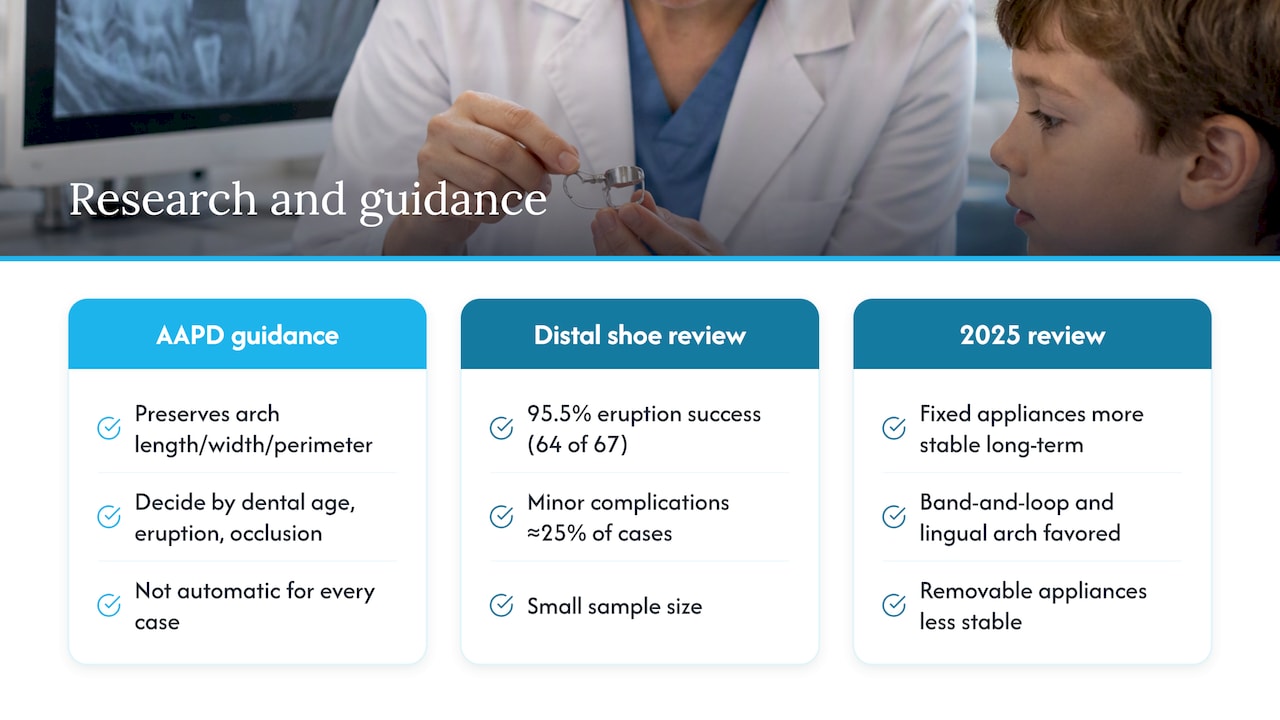
The AAPD states that a space maintainer preserves arch length, width, and perimeter after premature tooth loss, and should be considered based on the child’s dental age, eruption stage, and occlusion rather than applied automatically to every case.
Evidence on specific appliances is encouraging but limited in scope. A systematic review of distal shoe appliances reported a 95.5% eruption success rate for the first permanent molar (64 of 67 cases), with minor complications in about a quarter of cases, though the sample size was small. Separately, a 2025 review found fixed appliances like band-and-loop and lingual arch designs tend to offer better long-term stability than removable ones.
Space maintainers preserve arch length, width, and perimeter after premature loss of a primary tooth, and their use should depend on dental age, eruption stage, and occlusion.
AAPD clinical guidance
Questions to ask your dentist before moving forward
A short list of questions at the appointment helps you leave with a clear plan.
- Is a space maintainer necessary for this specific tooth, or can we monitor without one?
- Which type do you recommend, and why does it fit my child’s case?
- How long will the appliance likely stay in before the permanent tooth erupts?
- What does the follow-up schedule look like?
- What happens if it breaks or comes loose, and is repair included in the cost?
- What will this cost, and does insurance or a payment plan apply?
Ask to see the X-rays and have the dentist walk through why this tooth, at this stage, calls for this particular appliance. A provider unwilling to explain the reasoning or show you the images is worth a second opinion.
Our approach to pediatric preventive care
At Complete Dental Care, we treat pediatric preventive visits with the same individualized planning we apply across the practice, using digital imaging to assess a child’s dental age and eruption timeline before recommending an appliance. We build a plan around your child’s specific situation rather than a one-size answer, and we schedule follow-up checkups to track progress until the permanent tooth comes in. If you want a clinical assessment, a dental team can provide an evaluation.
— Complete Dental Care
Getting your child evaluated at Complete Dental Care
If your child recently lost a tooth early, an evaluation gives you clarity instead of guesswork about what comes next. Our general dentistry team combines exams, X-rays, and digital imaging to check whether a space maintainer fits your child’s case, and we walk you through the reasoning before recommending anything. Bring your child’s dental history and any prior X-rays if you have them. A membership plan is available for families who want predictable costs on preventive visits. Visit our first-visit guide to see what to expect, or reach out to book an appointment.
Sources
- Management of the developing dentition and occlusion in pediatric dentistry (AAPD guideline)
- Effectiveness of Distal Shoe Space Maintainers for First Permanent Molar Eruption: A Systematic Review
- Dental Space Maintainers for the Management of Premature Loss of Deciduous Molars: A Review of the Clinical Effectiveness, Cost-effectiveness and Guidelines
- Dental Space Maintainers for the Management of Premature Loss of Deciduous Molars: clinical effectiveness and guidelines (NCBI Bookshelf)
This article is general information, not a substitute for advice from a qualified doctor. Consult a qualified healthcare professional about your own circumstances before acting on anything here.
FAQ
What is a space maintainer in dentistry?
A space maintainer is a small dental appliance, fixed or removable, that holds open the gap left by an early lost baby tooth. It keeps neighboring teeth from drifting into the space so the permanent tooth can erupt in the right position.
What is the 2-2-2 rule for teeth?
There is no established clinical rule by this name in pediatric dentistry guidelines, and definitions circulating online vary widely. Ask your dentist directly about eruption timing for your child’s specific teeth rather than relying on a general rule.
How long does a dental spacer stay in?
The duration depends on how long it takes the permanent tooth underneath to erupt, which your dentist tracks with periodic X-rays and checkups roughly every six months. Some appliances stay in for months, others for a couple of years, depending on the child’s dental age and which tooth is involved.
Are space maintainers really necessary?
They are not automatic for every lost tooth. The AAPD recommends considering one based on which tooth was lost, the child’s dental age, and eruption stage, since molars and canines carry more risk of space loss than incisors.
questions about this? we're happy to help.
Every patient's situation is a little different. If you want to talk through what this means for you, our Greenville team is one call away.
schedule a free consultation