Gum tissue that has already pulled back does not grow back on its own, so treatment focuses on stopping the recession, calming sensitivity, and covering exposed roots when that’s realistic. Care typically follows a sequence: diagnosis, then non-surgical therapy like scaling and root planing and better home habits, then surgical root coverage (often a connective tissue graft) if the recession is advanced, and finally ongoing periodontal maintenance. Most people land somewhere in that pathway rather than needing every step.
TL;DR:
- Non-surgical care, like scaling and root planing, can halt active gum disease and prevent further recession in mild to moderate cases, but cannot restore lost gum tissue.
- Surgical options such as connective tissue grafts offer predictable root coverage, especially for advanced recession, with success influenced by tissue thickness, smoking status, and defect size.
- Desensitizing treatments provide quick relief for exposed roots, while regenerative procedures are necessary when bone loss accompanies recession, though healing times are longer.
- Effective daily habits, including gentle brushing, interdental cleaning, quitting smoking, and regular periodontal maintenance, are crucial to maintaining treatment results and preventing recurrence.
- Cost varies depending on whether treatment is non-surgical or surgical, with insurance coverage more likely for disease-related procedures and little to no coverage for purely cosmetic cases.
questions about this? we're happy to help.
Every patient's situation is a little different. If you want to talk through what this means for you, our Greenville team is one call away.
schedule a free consultationTable of Contents
- Non-Surgical vs. Surgical vs. Symptom Control: A Quick Comparison
- Scaling, Root Planing, and Home-Care Changes
- Gum Grafts, Flap Surgery, and Regenerative Options
- Relief for Sensitivity and Protecting Exposed Roots
- What Happens During a Recession Exam, and When to See a Periodontist
- Daily Habits and Professional Care That Keep Recession From Coming Back
- How Complete Dental Care Evaluates and Treats Receding Gums
- What Actually Causes Gum Recession
- Cost Considerations and Insurance Coverage
- Healing Timelines for Each Treatment
- Risks and Complications Worth Knowing About
- Lifestyle and Diet Choices That Support Healing
- A Realistic Clinician’s View on Outcomes
- Getting Evaluated and Treated at Complete Dental Care
- Sources
- FAQ
Non-Surgical vs. Surgical vs. Symptom Control: A Quick Comparison
Not every case of gum recession needs a scalpel. The right starting point depends on what’s driving the recession and how far it’s progressed.
- Non-surgical care targets active gum disease or bad brushing habits. It’s the first move for mild to moderate recession, especially when bleeding, plaque buildup, or aggressive brushing is the obvious cause.
- Surgical root coverage (subepithelial connective tissue grafts and related techniques) is for recession that’s progressed enough to threaten the tooth root, cause visible asymmetry, or create root sensitivity that home care can’t manage.
- Symptom control and restorative options (desensitizing agents, bonding, crowns) step in when the priority is comfort or appearance rather than regrowing tissue.
- Regenerative procedures apply specifically when recession comes with bone loss underneath, not just soft-tissue shrinkage.
The realistic goal across all four is the same: stop the recession from getting worse and reduce sensitivity. Full root coverage is achievable in many cases, but how much coverage you get depends on the technique used, the size of the defect, and your own tissue biology.
Scaling, Root Planing, and Home-Care Changes
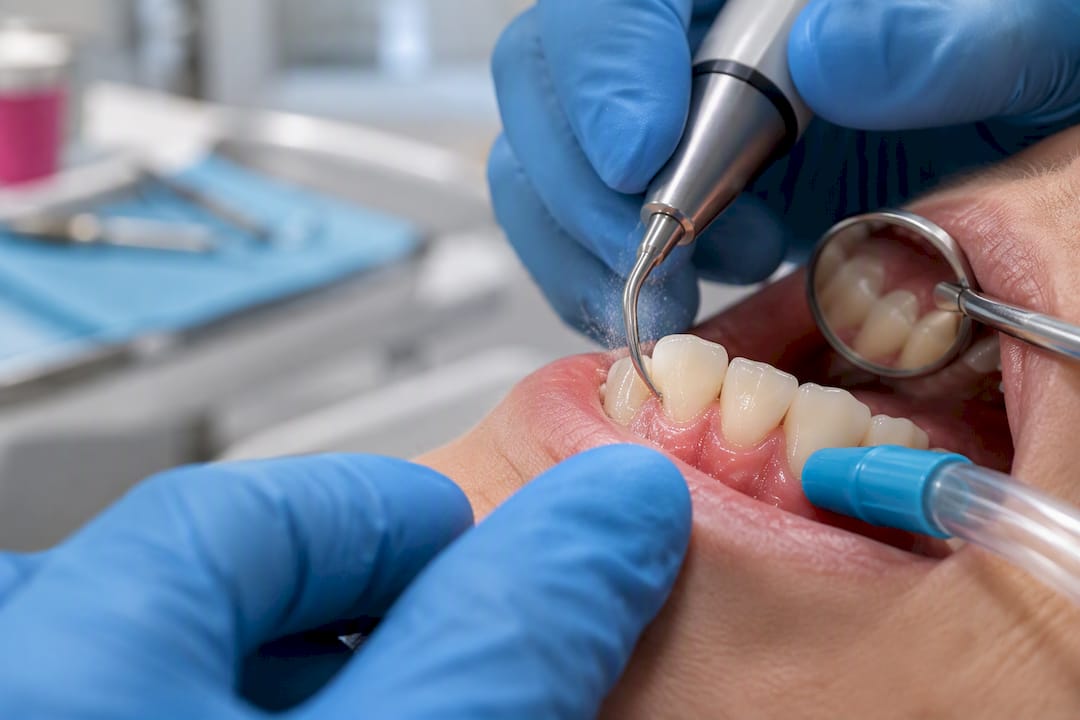
When gum disease is driving the recession, scaling and root planing is the standard first step. A hygienist or dentist removes plaque and calculus from below the gumline, then smooths the root surface so bacteria have a harder time reattaching. This usually happens over one or two visits, sometimes split into quadrants if the case is more advanced. Gums typically start responding within about four weeks, with reduced inflammation and tighter tissue around the tooth.
For moderate to severe cases, dentists sometimes add medication to the mix. This can include localized antimicrobial gels placed directly in the pocket or, per ADA guidance, a low, subantimicrobial dose of doxycycline taken over several months to help control the enzymes that break down gum tissue. Systemic antibiotics are reserved for more aggressive or resistant infections, not routine recession.
If aggressive brushing is the culprit rather than disease, the fix is often simpler:
- Switch to a soft-bristled brush and hold it at a 45-degree angle to the gumline.
- Use light pressure. Let the bristles do the work instead of scrubbing.
- Clean between teeth daily with floss or an interdental brush.
- Quit smoking, since it’s one of the biggest modifiable factors working against gum healing.
Pro Tip: If your gums bleed when you brush gently with a soft brush, that’s usually inflammation from plaque, not proof you’re brushing too hard. Get it checked before you assume technique is the problem.
Non-surgical therapy can absolutely stop disease-driven recession in its tracks. What it generally can’t do is bring back gum height you’ve already lost. That part usually needs surgery.
Gum Grafts, Flap Surgery, and Regenerative Options
The subepithelial connective tissue graft, or SCTG, is the procedure periodontists reach for most often when root coverage really matters. A surgeon takes a small piece of connective tissue, usually from the roof of the mouth, and places it under the gum tissue at the recession site to rebuild both coverage and thickness. Systematic reviews consistently rank it as the most predictable option for both root coverage and gaining back keratinized tissue, the tougher tissue that resists further recession.
It’s not the only option, though:
- Acellular dermal matrix grafts use donor tissue instead of tissue from your own palate, cutting down on a second surgical site but sometimes trading a bit of predictability for that convenience.
- Coronally advanced flap alone, without an added graft, works for smaller defects but tends to produce less reliable coverage than SCTG combined with a flap.
- Enamel matrix derivative and collagen matrices are sometimes layered into these procedures to encourage tissue regeneration.
- Guided tissue regeneration and bone grafting come into play specifically when imaging shows bone loss beneath the recession, not just soft-tissue shrinkage.
- Pinhole surgical technique offers a less invasive route with no scalpel or sutures, though the evidence base is thinner and outcomes vary more by case complexity than with SCTG.
Recession is common enough that surgical demand isn’t going away. NIDCR data shows periodontitis, a major driver of recession, affects about 42.2% of American adults 30 and older, with 7.8% having severe disease. Smoking status and gum tissue thickness both influence how well any of these grafts heal, which is why quitting smoking before surgery isn’t just a suggestion, it’s often a condition for a good outcome.
Relief for Sensitivity and Protecting Exposed Roots
When roots are exposed, sensitivity to cold, sweets, or even air is often the most immediate complaint, and there’s a real toolkit for managing it without surgery.
- Desensitizing toothpaste works by blocking the microscopic tubules in exposed dentin, dulling the nerve response over consistent use.
- In-office fluoride varnish or gel strengthens the root surface and can bring faster relief than toothpaste alone.
- Silver diamine fluoride (SDF), applied by a dentist, is FDA-cleared for sensitivity and doubles as a caries-arresting agent on exposed root surfaces, though it comes with a real trade-off: it permanently darkens the treated area, so it’s usually reserved for less visible teeth or specific clinical situations.
- Composite bonding over an exposed root can protect the surface and reduce sensitivity when a graft isn’t planned or needed yet.
- Crown lengthening or restorative crowns come into play when structural damage, not just sensitivity, is the concern.
None of these regrow tissue. They manage symptoms and protect what’s already exposed, which matters, but it’s a different goal than root coverage surgery.
What Happens During a Recession Exam, and When to See a Periodontist
A dentist evaluating recession measures a few specific things, not just a visual glance at your gumline.
- Recession depth in millimeters, measured from the original gumline to where it sits now.
- Clinical attachment level (CAL), which tracks how much the tissue actually attaching to the tooth has been lost.
- Pocket probing depth, checking for spaces where bacteria can hide below the gum.
- Tooth mobility, an indicator of how much support the tooth has lost.
- Radiographs, to check for bone loss that a visual exam can’t catch.
- Tissue biotype, since thin gum tissue recedes faster and responds differently to grafting than thick tissue.
General dentists manage most mild cases directly. Referral to a periodontist usually happens when recession keeps progressing despite treatment, pockets stay deep after scaling and root planing, root cavities develop, sensitivity won’t resolve, or you’re specifically interested in cosmetic root coverage.
Daily Habits and Professional Care That Keep Recession From Coming Back
Whatever treatment you get, maintenance decides whether it lasts. A few habits do most of the work:
- Brush with a soft-bristled brush and light pressure. If dexterity or consistency is an issue, an electric toothbrush with a pressure sensor helps.
- Clean between teeth daily, since plaque between teeth is what most home routines miss.
- If you clench or grind, ask about a nightguard. Repeated force on the gumline accelerates recession over time.
- Keep periodontal maintenance visits on schedule, commonly every three to six months for anyone with a history of gum disease, which is more frequent than the standard twice-yearly cleaning.
Pro Tip: Ask your hygienist to watch your brushing technique in person at least once. Most people who are “brushing too hard” don’t realize it until someone points out the exact spot where they’re pressing too aggressively.
Smoking cessation, better blood sugar control if you have diabetes, and addressing dry mouth from medications all measurably improve how well gum tissue holds up after treatment, surgical or not.
How Complete Dental Care Evaluates and Treats Receding Gums
Every recession treatment plan typically starts with detailed imaging and digital scanning to assess bone levels and tissue thickness before deciding whether non-surgical care, a soft-tissue graft, or a combination approach is appropriate. That imaging also matters for anyone whose recession has already led to root damage or missing teeth, since it factors into implant planning down the line.
The approach centers on clear explanations of treatment expectations, comfort-focused visits, individualized follow-up schedules, and staged treatment plans that revisit non-surgical results before recommending surgery.
What Actually Causes Gum Recession
Periodontal disease is the most common driver, and it works quietly. Bacterial plaque below the gumline triggers inflammation that breaks down the tissue and bone holding your teeth in place, and gingivitis at that early stage is reversible with cleaning and better home care. Left untreated, it progresses to periodontitis, where the damage becomes harder to reverse without professional intervention.
Brushing too hard is the other major cause, and it’s almost the opposite problem: not too little cleaning, but too much force in the wrong direction. A hard-bristled brush combined with a scrubbing motion wears away thin gum tissue over years, often on the same side as your dominant hand.
Tooth position plays a role too. Teeth that sit outside the normal dental arch, whether from crowding or crossbite, often have thinner bone and gum tissue covering them, making recession more likely at that specific spot even with good hygiene.
Physical trauma, like a piercing rubbing against the gumline or a hard toothbrush handle jabbed repeatedly during use, causes localized recession that shows up right where the trauma occurs. Smoking dries and irritates gum tissue while also masking the bleeding that would otherwise signal a problem early.
Genetics decides a lot of this too. Some people are simply born with thinner gum tissue and a thinner layer of bone over their tooth roots, which means recession can develop with far less provocation than it would in someone with naturally thicker tissue.
Cost Considerations and Insurance Coverage
Non-surgical treatment like scaling and root planing is typically covered at least partially by dental insurance, since it’s classified as a therapeutic treatment for existing disease rather than a cosmetic procedure. Surgical grafting coverage varies more by plan. Some insurers cover a portion when the recession is tied to documented periodontal disease, while purely cosmetic root coverage on a healthy tooth may get little to no coverage.
Desensitizing treatments and in-office fluoride applications are usually low-cost add-ons to a regular cleaning visit, often bundled into preventive care coverage. SDF application costs vary by provider and region.
If a tooth has been lost to advanced recession and bone loss, restorative options like implants enter a different cost category entirely, and financing becomes a bigger factor in the decision. Complete Dental Care offers membership plans for patients without traditional insurance, along with financing options for larger procedures. The most reliable way to know your actual out-of-pocket cost is a consultation where the specific procedure, your insurance benefits, and any financing options get laid out together, since recession cases vary enough that general price ranges rarely apply cleanly.
Healing Timelines for Each Treatment
Non-surgical scaling and root planing shows initial results fast. Inflammation typically drops within a week, and full tissue tightening around the tooth is usually visible by about four weeks. There’s little to no downtime.
Surgical grafting is a longer process. Initial healing after an SCTG procedure takes about one to two weeks before stitches come out or dissolve, but the graft continues integrating and maturing for two to three months. Final aesthetic and functional results, including how much root coverage held, aren’t fully assessed until around three months post-surgery, sometimes longer for larger grafts.
Regenerative procedures involving bone grafting material take the longest, often four to six months before the bone has integrated enough to evaluate success, since bone remodels much more slowly than soft tissue.
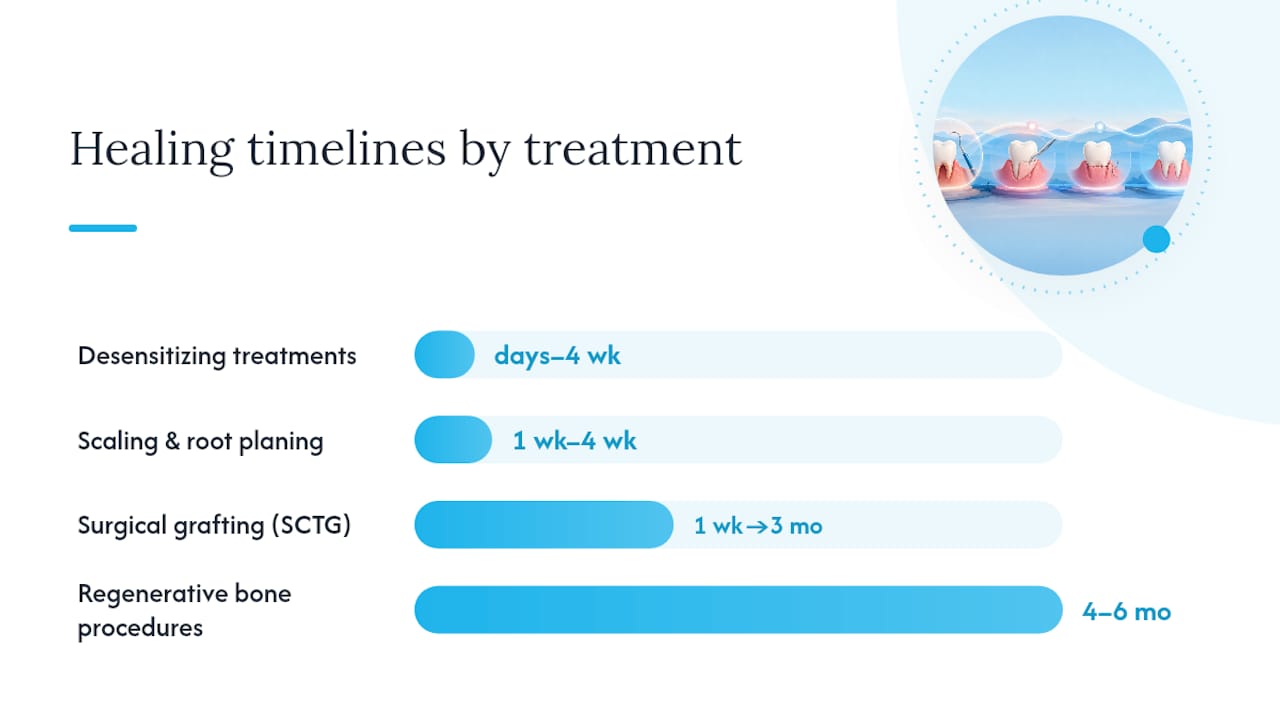
Desensitizing treatments work on the fastest timeline of all. Toothpaste-based desensitizers usually need two to four weeks of consistent use to show a real difference, while in-office fluoride or SDF application can reduce sensitivity within days.
Risks and Complications Worth Knowing About
Non-surgical treatment carries minimal risk, mostly temporary sensitivity and mild gum tenderness for a few days after scaling. Surgical procedures carry more to weigh. Graft failure or partial graft loss happens in a minority of cases, more often in smokers or in areas with very thin tissue to begin with. Post-surgical infection is uncommon but possible, which is part of why proper aftercare instructions matter as much as the surgery itself.
Donor site discomfort, when tissue is taken from the palate for an SCTG, tends to resolve within one to two weeks but can be the most uncomfortable part of recovery for some patients. Regenerative procedures involving bone graft material carry a small risk of graft rejection or incomplete integration.
SDF’s main downside isn’t a medical risk so much as a cosmetic one: the permanent dark staining it causes on treated areas, which is why dentists reserve it for specific situations rather than using it broadly. Any procedure performed on a patient who continues smoking heals less predictably and carries a higher failure risk across the board, surgical or not.
Lifestyle and Diet Choices That Support Healing
What you eat and how you live day to day affects how well any recession treatment holds up. A diet with adequate vitamin C supports collagen production, which matters directly for gum tissue repair after grafting or non-surgical therapy. Crunchy, acidic, or very hot foods can irritate a healing graft site in the weeks right after surgery, so most dentists recommend a soft, room-temperature diet for the first one to two weeks post-procedure.
Hydration matters more than people expect, since dry mouth reduces the saliva that naturally helps control bacteria. Limiting sugary and highly processed snacks between meals cuts down on the plaque buildup that drives gum disease in the first place.
Smoking cessation remains the single biggest lifestyle change tied to better healing and lower recurrence risk, applying to both surgical and non-surgical recession treatment. Managing stress-related teeth grinding, whether through a nightguard or behavioral changes, protects the gumline from the mechanical wear that clenching adds on top of any existing recession.
A Realistic Clinician’s View on Outcomes
The honest goal of recession treatment is stabilization, not restoration to some pre-recession ideal. Surgical root coverage genuinely improves sensitivity and appearance in many cases, but not every site responds the same way, and setting that expectation upfront avoids disappointment later. The real work happens after the procedure, in the maintenance visits and daily habits that decide whether the improvement holds. Shared decision-making between patient and dentist, with clear talk about what’s realistic for your specific tissue and disease history, tends to produce the outcomes people are actually happy with.
— Complete Dental Care
Getting Evaluated and Treated at Complete Dental Care
If your gums have been receding and you’re not sure whether you need a cleaning or a graft, that’s exactly what a consultation is for. Complete Dental Care starts with Exams & X-Rays and digital imaging to see what’s actually happening below the gumline before recommending anything, rather than assuming every case needs surgery.
From there, the path depends on what the imaging shows. Many patients start with Cleanings & Periodontal Therapy to get active disease under control first. If recession has progressed far enough to need grafting or other surgical and implant dentistry, that gets planned individually using 3D imaging rather than a generic protocol. And if recession has already cost you a tooth, Teeth in a Day offers a same-day path to full-arch restoration instead of a long staged timeline.
The clinic also offers a membership plan for patients handling costs without traditional insurance. The next step is simple: schedule an exam so you know exactly where your case stands before deciding anything else.
Sources
- Periodontal Disease in Adults (Age 30 or Older) | NIDCR
- Surgical procedures | American Academy of Periodontology (for patients)
- Systematic reviews supporting SCTG (PubMed)
This article is general information, not a substitute for advice from a qualified doctor. Consult a qualified healthcare professional about your own circumstances before acting on anything here.
FAQ
What Do Receding Gums Look Like?
Receding gums show more of the tooth root than usual, often with a visible line where the gum has pulled back and the tooth looks slightly longer. You may also notice a notch near the gumline, uneven gum height between teeth, or increased sensitivity at the exposed area.
Can Receding Gums Grow Back on Their Own?
No, lost gum tissue does not regenerate on its own once it recedes. Treatment can stop the recession from progressing and, with procedures like a connective tissue graft, cover exposed roots, but it cannot passively regrow through better brushing alone.
How Should I Brush My Teeth If I Have Receding Gums?
Use a soft-bristled brush, hold it at roughly a 45-degree angle to the gumline, and use light, gentle pressure rather than scrubbing. Clean between teeth daily and avoid hard-bristled brushes, which are one of the leading causes of recession in the first place.
Are There Home Remedies for Receding Gums?
Home care can slow or stop recession caused by aggressive brushing or early gum disease, mainly through gentler brushing technique, consistent flossing, and desensitizing toothpaste for exposed roots. These steps won’t reverse existing recession, and if bleeding, pocket depth, or sensitivity persists, an in-office evaluation and possible scaling and root planing is the next appropriate step.
How Much Does Receding Gums Treatment Cost?
Cost depends heavily on whether the case needs non-surgical therapy, which is often partially covered by insurance, or surgical grafting, where coverage varies more by plan and cause. Complete Dental Care does not publish flat pricing for these procedures online, but current options, including membership plans for patients without insurance, are available through a consultation.
questions about this? we're happy to help.
Every patient's situation is a little different. If you want to talk through what this means for you, our Greenville team is one call away.
schedule a free consultation